Starting a crystal business often feels like a dream, but you quickly encounter the harsh reality of sourcing: high Minimum Order Quantities (MOQs)1. This single requirement can feel like a barrier, forcing you to either invest your entire budget in one product type or settle for overpriced items from middlemen. The solution lies in understanding MOQ in crystal wholesale and finding a true factory partner who offers the flexibility of mixed lot orders.
A mixed lot allows you to purchase a variety of different crystal products in small quantities within a single order, effectively bypassing the high MOQ requirements traditionally set for individual product types. This strategy empowers new and growing businesses to build a diverse inventory with a smaller initial investment, reducing financial risk and improving cash flow.
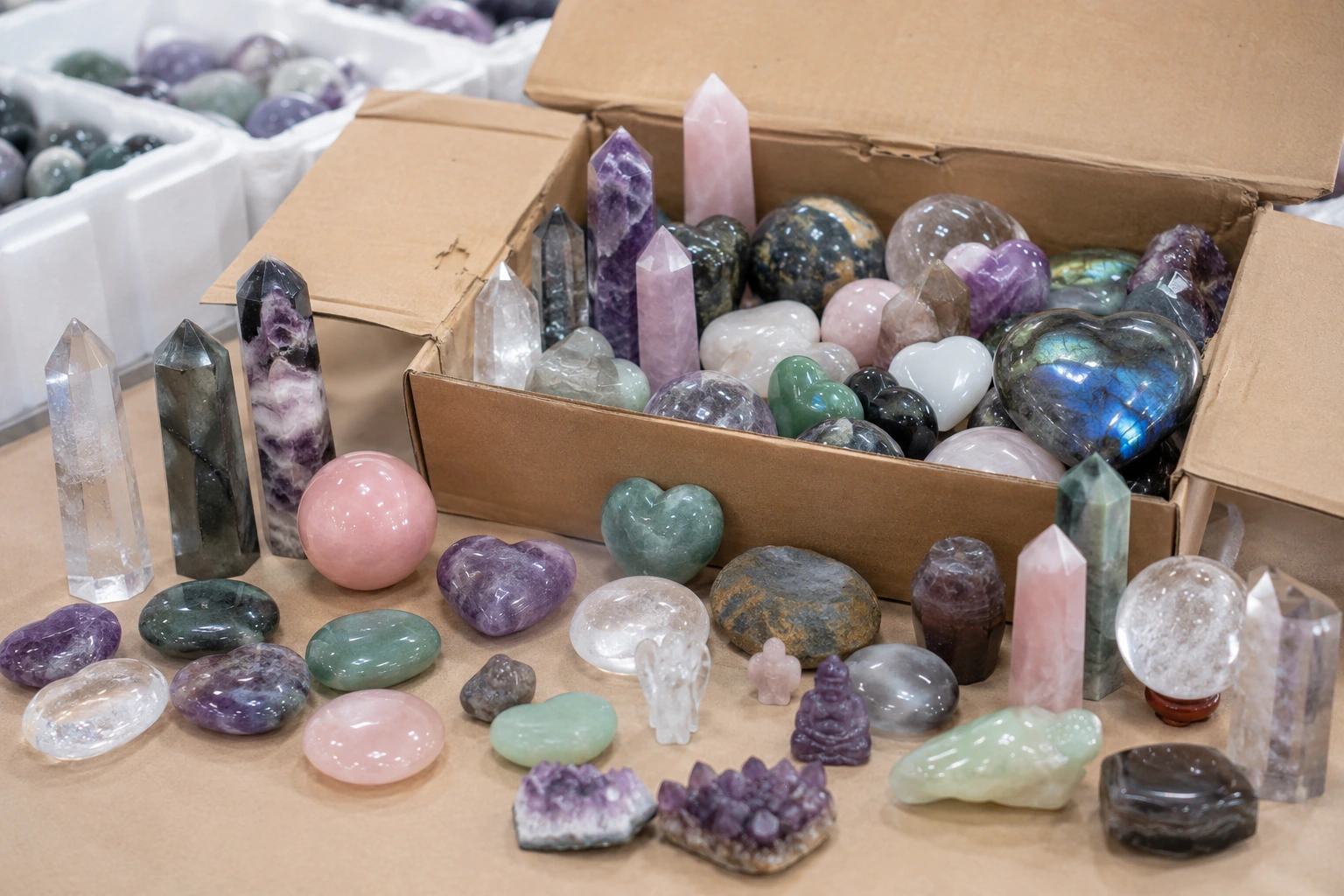
This approach bridges the gap between the needs of a modern retailer and the operational realities of a production factory. But to leverage it effectively, you first need to understand why those high MOQs exist in the first place and how to spot a genuine mixed lot opportunity.
Why Do Traditional Crystal Factories Have Such High MOQs?
You've found a promising source factory, but your heart sinks when you see their 1,000-piece MOQ for a single SKU. Why won't they just sell you the 10 rose quartz towers you need? The answer lies in the fundamental cost structure of manufacturing, a reality many buyers don't see.
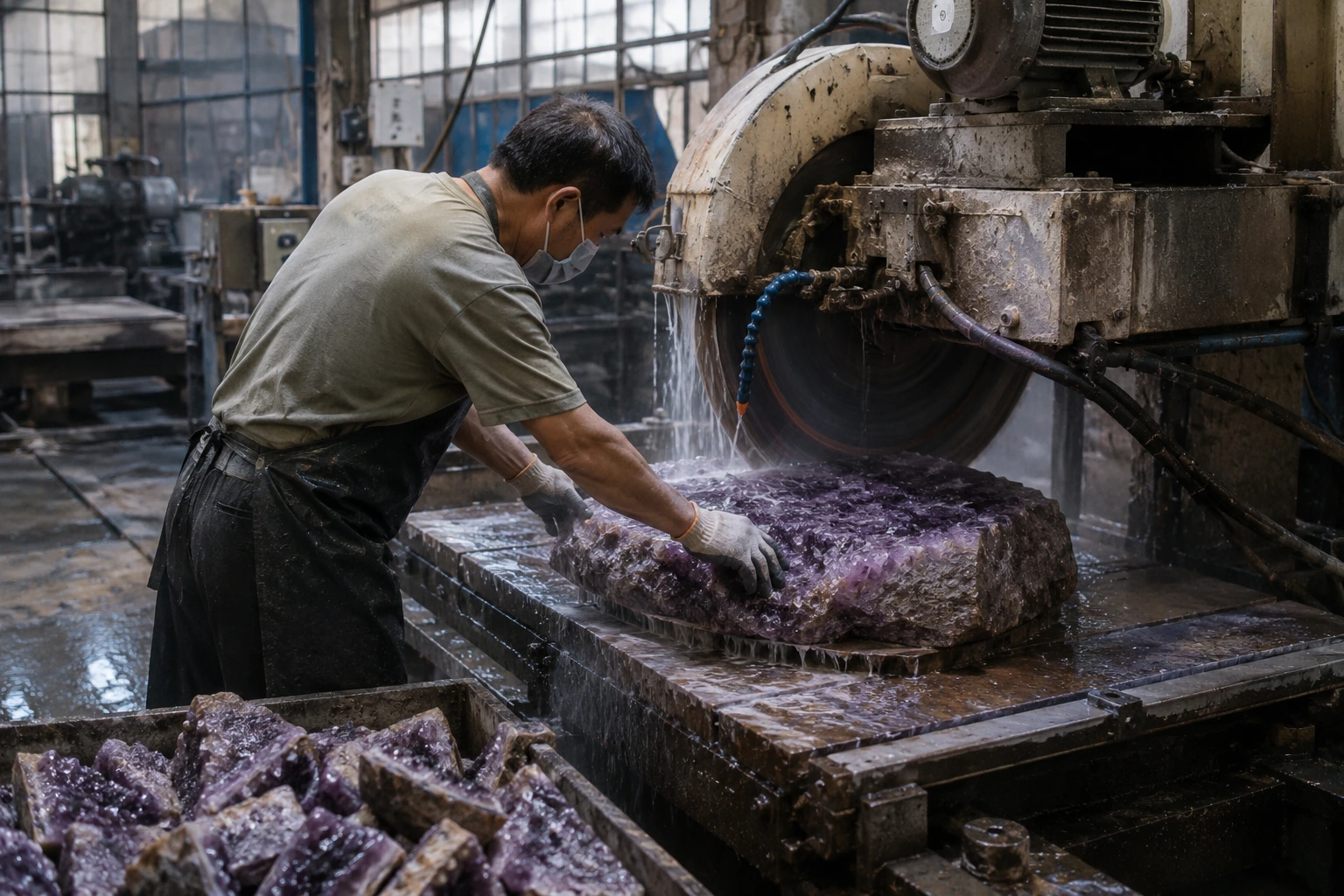
A factory's high MOQ isn't a strategy to exclude small buyers; it's a matter of economic survival. The costs associated with purchasing raw materials by the ton and the significant labor involved in setting up machinery for a specific production run make small orders unprofitable.
Dive Deeper: The Hidden Costs Behind the Minimum Order
As someone who manages a source factory, I've seen the disconnect between a buyer's request for "just 10 pieces" and our production floor's reality. Understanding this logic will make you a much smarter sourcing professional.
The "Tonnage" Barrier of Raw Stone Procurement
The journey of a crystal product doesn't begin with a small, manageable stone. It begins with a massive, multi-ton purchase.
- Global Sourcing2: We procure our rough stones directly from mines in places like Brazil, Madagascar, and Uruguay. These materials aren't sold by the kilogram; they are sold by the ton and shipped in ocean containers.
- Bulk Economics3: To get competitive pricing on high-grade amethyst or labradorite, we must commit to purchasing several tons at once. A single container can hold over 20 tons of raw material. This massive upfront investment must be justified by large-scale production.
The Sunk Cost of Machine Calibration
Once the raw material is in the factory, the next cost barrier appears: production setup.
- The Setup Process4: Imagine we need to cut 50mm amethyst spheres. A skilled technician must spend 30 minutes or more setting up the cutting and grinding machines. This involves selecting the right diamond-tipped blades, calibrating the cutting angles, setting the polishing parameters, and ensuring the central axis is perfect.
- Labor and Utility Costs: During this setup time, the machine is running, consuming electricity, and a skilled worker is being paid. If we only produce five spheres, the setup time could be longer than the actual production time. The labor and energy cost per piece becomes astronomically high, guaranteeing a loss on the order.
Therefore, the traditional factory rule emerged: a single SKU must be produced in a large batch—often 500 or 1,000 pieces—to distribute the setup costs and make the run profitable. This is precisely why many small B2B buyers, from Etsy sellers to local gift shop owners, have historically been forced to buy from trading companies at a significant markup.
How Do Mixed Lots Solve the High MOQ Problem?
You know that a diverse product range is key to attracting customers, but your budget is finite. The thought of spending $5,000 to stock just one type of crystal point is paralyzing. How can you offer the variety your customers crave without locking up all your capital?
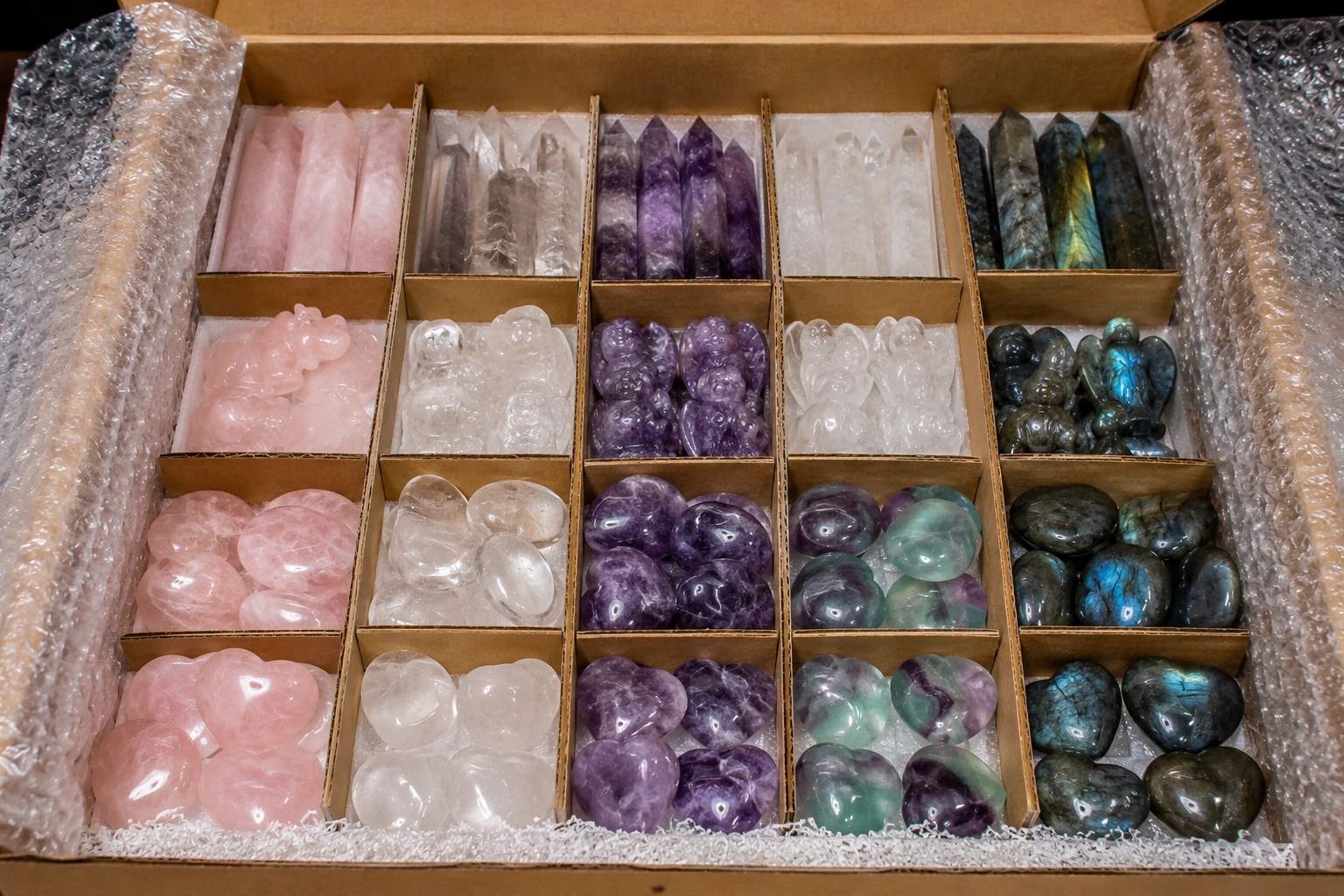
Mixed lots solve this by shifting the inventory risk from you, the retailer, to us, the factory. We pre-produce large quantities of our best-selling items, allowing you to select small numbers of many different products to build one consolidated, low-threshold order.
Dive Deeper: The "Shared Warehouse" Model
We recognized the pain points of our wholesale customers. For a retail business, SKU variety is often more important for growth than deep stock of a single item. So, we redesigned our process to serve this need.
Shifting the Inventory Risk to the Factory
Instead of making you bear the risk, we take it on.
- Data-Driven Production: Based on market trends and sales data, we know which products are consistent top performers. We proactively run large, efficient production batches of items like amethyst towers, clear quartz spheres, labradorite carvings, and fluorite freeforms.
- Our In-House Warehouse: These finished goods are then stored in our large, climate-controlled warehouse5. We've already absorbed the high-volume production costs. This means we don't need you to order 500 labradorite moons at once because we've already made 5,000. This strategy allows us to keep our production lines efficient while offering you incredible flexibility.
The "Building Block" Approach to Sourcing
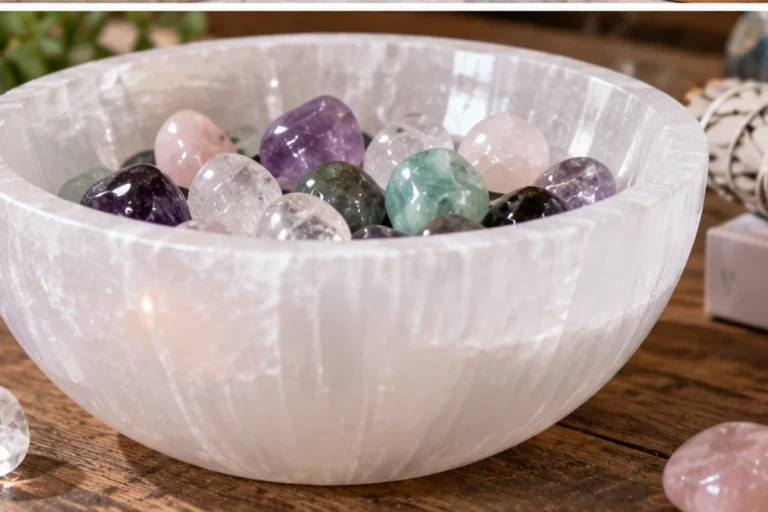
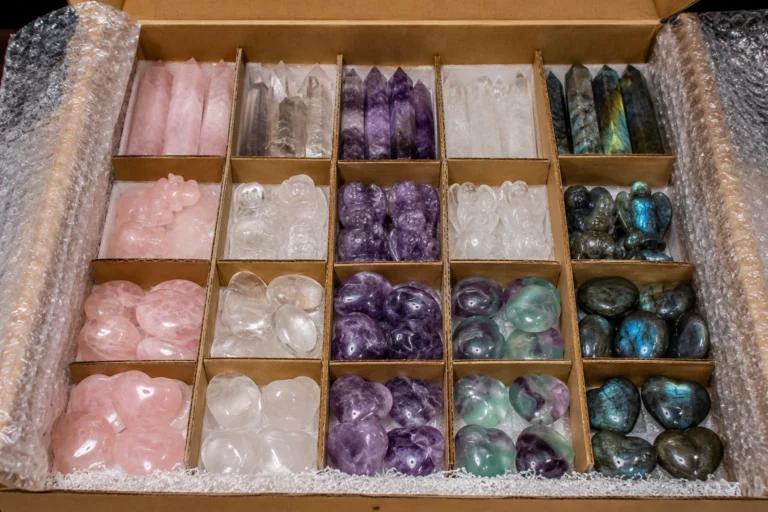
This model effectively turns our factory warehouse into your "overseas shared cloud warehouse." You can build your order like you're playing with building blocks. For example, a typical mixed lot order might look like:
- 10 Clear Quartz Points (5-8cm)
- 10 Rose Quartz Palm Stones
- 5 Labradorite Moon Carvings
- 5 Amethyst Clusters
- 3 Large, High-Quality Statement Carvings
This approach provides tangible benefits for your retail business, including improved cash flow, the ability to test new products with minimal risk, and the power to offer a wide and exciting product collection that keeps customers coming back.
Are All "Mixed Lot" Suppliers the Same?
You're browsing online platforms and see dozens of suppliers advertising "1-piece MOQ" and "mixed wholesale." It seems like the perfect solution, but it often isn't. The source of that mixed lot matters more than anything, and many buyers fall into a common trap.
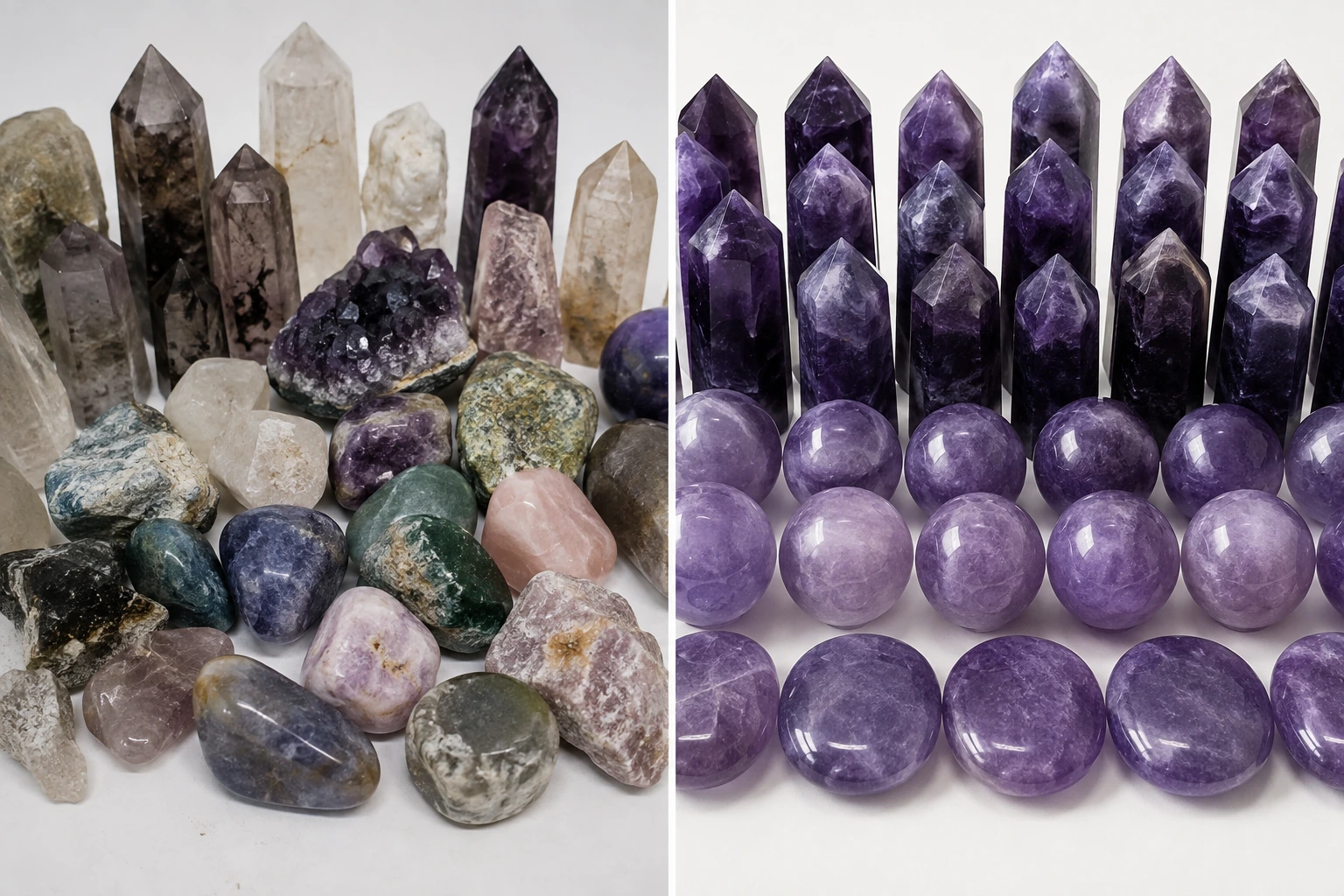
No, they are not the same. A "mixed lot" from a trading company is typically a collection of items sourced from various stalls in a public market, leading to zero quality control. A true factory's mixed lot consists of items produced on the same line to a consistent standard.
Dive Deeper: A Buyer's Guide to Spotting the Difference
Distinguishing between these two models is critical for protecting your investment and your brand's reputation.
The Trading Company "Mixed Lot" Trap
Many sellers on platforms like Alibaba are trading companies, not factories. When they offer "1-piece wholesale," here’s what is often happening behind the scenes:
- They receive your order for 10 different items.
- They send an agent to a large wholesale market, like the famous Donghai crystal market.
- The agent walks from stall to stall, haggling for each item on your list.
The consequences for you, the buyer, are disastrous:
- No Quality Control: The rose quartz you receive today will look completely different from the one you order next month. Some might be pale and chalky, others a deep pink.
- Inconsistent Sizing: A "5cm tower" might range from 4cm to 6cm because each piece came from a different vendor with different standards.
- Risk of Fakes: The agent's priority is finding the cheapest item to maximize their margin. This opens the door to receiving dyed, heated, or acid-washed fakes mixed in with genuine stones.
- No Batch Consistency: You can never build a reliable, repeatable product line.
The Factory-Direct "True Mixed Lot" Advantage
When you work with a source factory like Crystal Carvings Wholesale, the process is entirely different.
- Single Source of Production: Even if your order contains 30 different SKUs, every single piece came from our production facility. They were cut from the same batches of raw material, shaped by the same machines, and polished by the same team.
- Unified Quality Standard6: Our in-house Quality Control (QC) team inspects every item before it's placed into warehouse inventory. When your mixed lot is being packed, our team checks it again, ensuring the pieces meet our "brand-level" standard for color, clarity, and finish.
- Professional Packing: We know that a labradorite carving needs different protection than a delicate selenite wand. Our team packs your mixed lot by material and shape to prevent chipping and breakage during international transit.
Choosing a factory-direct mixed lot means you are building your brand on a foundation of consistency and quality that a trading company simply cannot provide.
How Should You Plan Your First Mixed Lot Order?
Faced with a catalog of hundreds of beautiful crystals, it's easy to get overwhelmed. New buyers often make the mistake of either buying a little bit of everything randomly or only buying what they personally like. How can you build your first order strategically to maximize sales and profit?
To plan an effective first order, use the "Golden Mix Formula7" to balance your inventory. Allocate your budget across three key categories: essential cash-flow products, eye-catching trend items, and high-value anchor pieces to ensure a well-rounded and profitable collection.
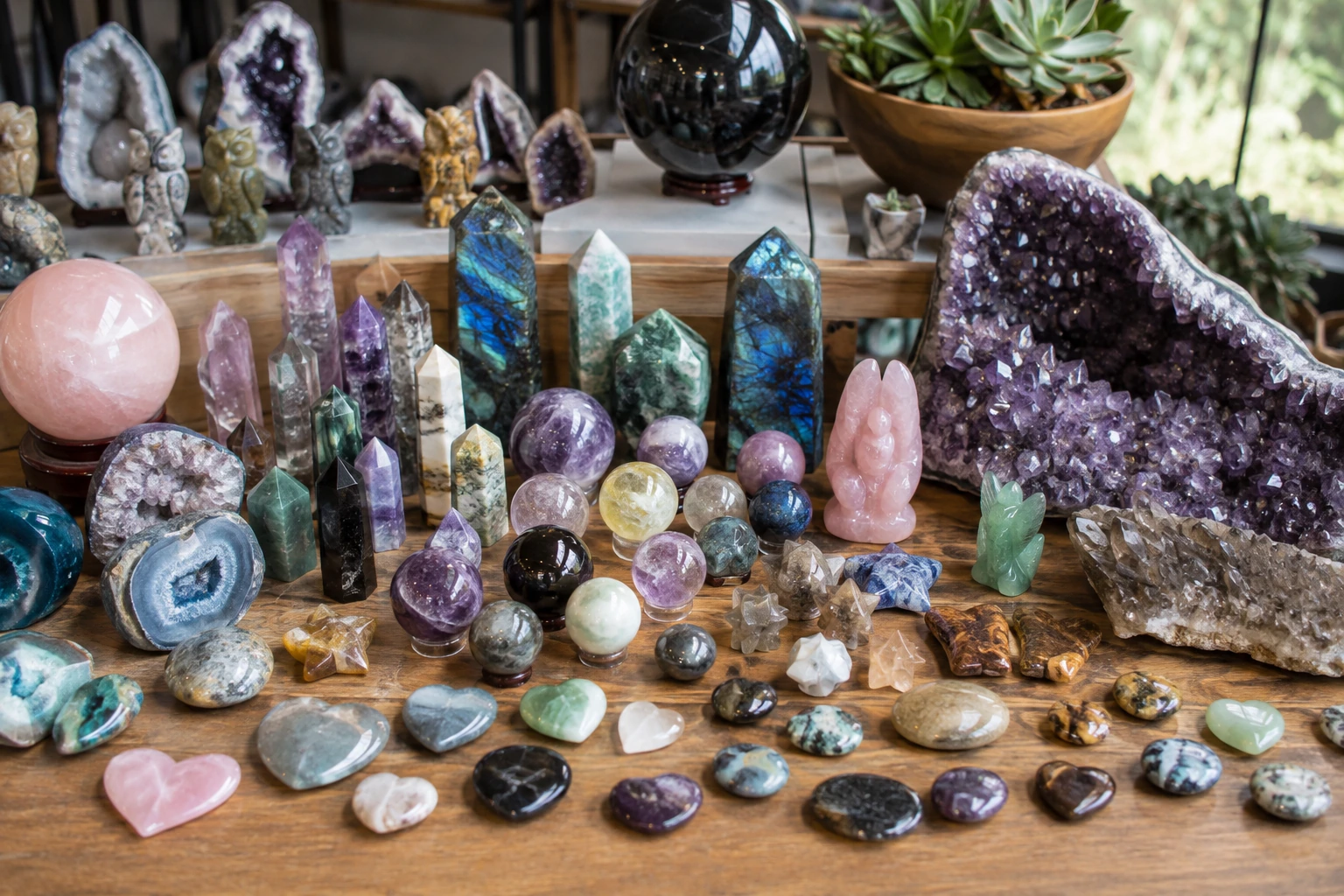
Dive Deeper: My "Golden Mix Formula" for a Killer First Order
I always recommend this framework to new wholesale clients to help them avoid common pitfalls and build a successful inventory from day one. Structure your budget using this 50/30/20 rule.
50% — Bread & Butter (Cash Flow Essentials)
This is the foundation of your inventory. These are the tried-and-true products that have consistent demand and turn over quickly, ensuring a steady cash flow for your shop.
- What to Buy: Standard shapes like towers, spheres, and palm stones in the 5-8cm range.
- Key Materials: Amethyst, Rose Quartz, Clear Quartz, and Selenite. These are universally recognized and are often the first purchase for a new crystal enthusiast.
- Purpose: These items pay the bills. Their reliable sales provide the capital you need to restock and experiment with other products.
30% — Trend & Niche Carvings (Margin & Marketing)
This category is designed to capture attention and drive higher profit margins. These are the unique, "Instagrammable" pieces that make your shop stand out.
- What to Buy: Special carvings (e.g., animals, moons, mushrooms, goddesses), unique freeforms, and items featuring flashy materials.
- Key Materials: Labradorite, Fluorite, Ocean Jasper, and various Agates. Their vibrant colors and patterns are perfect for social media marketing on platforms like Instagram and TikTok.
- Purpose: These products generate excitement and attract new customers. They typically carry a higher markup than basic shapes, boosting your overall profitability.
20% — Statement Pieces8 (Brand Elevation)
This small but crucial part of your order is about building your brand's authority and perceived value. Don't be afraid to invest in one or two "wow" pieces.
- What to Buy: A large, high-quality carving, a significant amethyst geode, a high-grade sphere, or a unique mineral specimen.
- Purpose: These items act as an anchor price. When a customer sees a stunning $500 piece, the $50 items next to it suddenly seem much more affordable. Even if they don't sell quickly, they elevate the entire feel of your shop, justify higher prices on other items, and make for incredible display and marketing content.
By following this formula, your first mixed lot won't just be a random collection of stones; it will be a strategic assortment designed for cash flow, marketing, and brand building.
Frequently Asked Questions
What is a typical MOQ for wholesale crystals?
For traditional factories, a typical MOQ can be 50 to 100 kilograms per material or 500 to 1,000 pieces per specific size and shape. With a flexible supplier offering mixed lots, you can often start with a total order value as low as a few hundred dollars, with no per-item minimum.
Is it always cheaper to buy directly from a factory?
Directly from a factory, the per-piece price is almost always lower, but only if you can meet their high MOQ for a single item. For small businesses, the total cost of a 1,000-piece order is prohibitive. Mixed lots from a factory offer the best of both worlds: factory-level quality with a low total investment.
How can I verify the quality of a mixed lot before it ships?
Work with a transparent supplier. Before payment, you should be able to request a catalog with clear photos and specifications. A reliable partner will also offer to send pre-shipment photos9 or a short video of your exact packed order, allowing you to verify the quality and assortment.
Can I include custom-designed products in a mixed lot order?
Generally, no. Mixed lots consist of pre-produced, in-stock items. Custom designs (OEM/ODM) are a separate production process and will have their own MOQ requirements because the factory has to create new molds and machine setups specifically for your design.
Conclusion
The world of crystal sourcing can seem intimidating, but it doesn't have to be. Understanding the logic behind MOQ in crystal wholesale empowers you to make smarter purchasing decisions. While traditional factory MOQs are based on real production costs, modern, customer-focused suppliers have created a solution. By embracing a true factory-direct mixed lot model, you can bypass the risks of middlemen and the capital constraints of high MOQs.
Using a strategic framework like the 50/30/20 formula will help you build a diverse, profitable, and visually stunning inventory from your very first order. Navigating MOQ in crystal wholesale becomes simple when you find a partner who acts as your overseas warehouse, prioritizing your need for variety and cash flow.
Ready to build your first high-variety, low-risk crystal collection? Contact us at Crystal Carvings Wholesale via WhatsApp (+86 150 7540 9178) or email (sales@crystalcarvingswholesale.com) for our latest mixed lot catalog. Let's build your dream inventory together.
"Personalized Crystal Keepsake Ideas for a Baby's First Christmas ...", https://crystalcarvingswholesale.com/personalized-crystal-keepsake-ideas-for-a-babys-first-christmas/. High MOQs in wholesale industries often limit small businesses' ability to diversify inventory and manage cash flow effectively, as noted in studies on supply chain constraints for small retailers. Evidence role: general_support; source type: research. Supports: High MOQs create financial and operational challenges for small businesses in the crystal industry.. Scope note: The source may discuss MOQs in general wholesale contexts rather than specifically in the crystal industry. ↩
"How to Choose a Reliable Crystal Carvings Wholesale Supplier in ...", https://crystalcarvingswholesale.com/how-to-choose-a-reliable-crystal-carvings-wholesale-supplier-in-china/. Brazil, Madagascar, and Uruguay are known for their significant contributions to the global supply of rough gemstones and crystals, often sold in bulk quantities. Evidence role: general_support; source type: encyclopedia. Supports: Factories source rough stones in bulk from countries like Brazil, Madagascar, and Uruguay.. Scope note: The source may provide general information about gemstone exports rather than specific factory practices. ↩
"What Information Is Needed for an Accurate Wholesale Crystal Quote?", https://crystalcarvingswholesale.com/what-information-is-needed-for-an-accurate-wholesale-crystal-quote/. Studies on bulk procurement in the gemstone industry highlight that purchasing raw materials in large quantities significantly lowers per-unit costs due to economies of scale. Evidence role: mechanism; source type: research. Supports: Bulk purchasing of raw materials like amethyst and labradorite reduces per-unit costs for factories.. Scope note: The source may focus on general gemstone procurement rather than specific examples of amethyst or labradorite. ↩
"How Are Crystal Carvings Made? A Complete Production Process ...", https://crystalcarvingswholesale.com/how-are-crystal-carvings-made-a-complete-production-process-guide/. Educational resources on gemstone manufacturing detail the time-intensive process of calibrating machinery and selecting tools for precision cutting and polishing. Evidence role: mechanism; source type: education. Supports: Crystal production setup involves calibrating machinery and selecting appropriate tools, which can take significant time.. Scope note: The source may describe general gemstone manufacturing rather than specific time estimates for crystal production. ↩
"Effect of Storage Temperature on Crystal Formation Rate ...", https://pubmed.ncbi.nlm.nih.gov/23548293/. Research on storage conditions for minerals and crystals highlights the importance of climate control in preserving product quality. Evidence role: mechanism; source type: research. Supports: Climate-controlled warehouses help maintain the quality of crystal products.. Scope note: The source may discuss climate-controlled storage for minerals broadly rather than specifically for wholesale crystals. ↩
"Wholesale Readiness Training", https://misa.umn.edu/farm-food-resources/wholesale-readiness-training. Educational materials on manufacturing quality control emphasize the role of unified production standards in ensuring consistent product quality. Evidence role: expert_consensus; source type: education. Supports: Factory-direct production ensures consistent quality by maintaining unified standards across all items.. Scope note: The source may discuss quality control in manufacturing broadly rather than specifically in the crystal industry. ↩
"The 50-30-20 Budget Rule Explained - Henrico HR", https://employees.henrico.gov/county-connection/the-50-30-20-budget-rule-explained/. Educational resources on retail inventory management suggest that balanced budget allocation strategies, like the 50/30/20 rule, can optimize sales and profitability. Evidence role: general_support; source type: education. Supports: The 50/30/20 rule is an effective strategy for inventory planning in retail businesses.. Scope note: The source may discuss inventory strategies in general retail contexts rather than specifically for crystals. ↩
"The Influence of Price on Purchase Intentions: Comparative Study ...", https://pmc.ncbi.nlm.nih.gov/articles/PMC7911682/. Experts in retail strategy suggest that high-value statement pieces can elevate brand perception and justify premium pricing for other products. Evidence role: expert_consensus; source type: research. Supports: Statement pieces enhance brand authority and influence customer perception of pricing.. Scope note: The source may discuss statement pieces in general retail contexts rather than specifically in the crystal industry. ↩
"Quality, Authenticity & Identification - Crystal Carvings", https://crystalcarvingswholesale.com/category/crystal-quality-authenticity/. Institutional guidelines on wholesale trade recommend pre-shipment photos or videos as a best practice for ensuring product quality and buyer satisfaction. Evidence role: general_support; source type: institution. Supports: Pre-shipment photos or videos are a common practice for quality assurance in wholesale transactions.. Scope note: The source may discuss pre-shipment practices in general wholesale contexts rather than specifically for crystals. ↩
Keep Reading