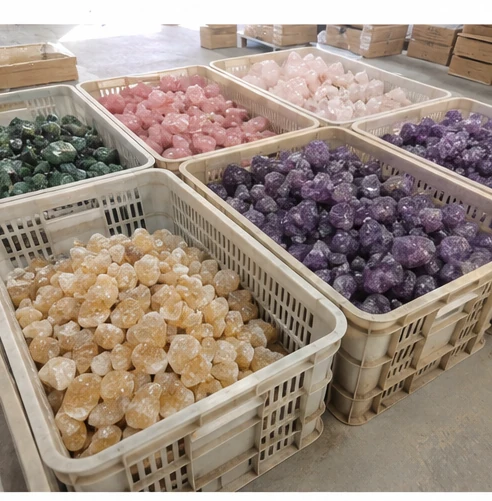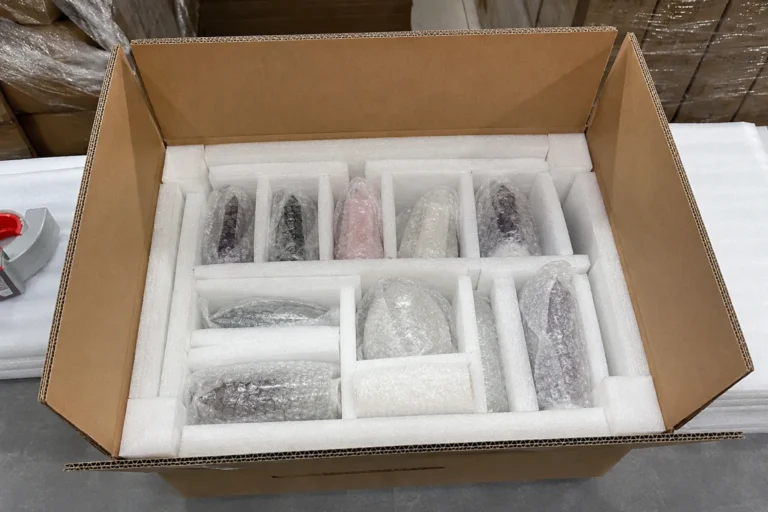

Struggling to get clear, consistent pricing from crystal suppliers? You send inquiries for products you’re excited about, but the replies are often vague, full of questions, or contain prices that seem to change, making it impossible to plan your inventory and budget. The solution is to understand that a reliable wholesale crystal quote depends on providing three key pieces of information that empower you as a buyer.
To get an accurate wholesale crystal quote, you must provide your supplier with three critical details: the specific crystal material and desired grade (e.g., A-grade Rose Quartz)1, precise product dimensions or weight (e.g., 45-50mm wide)2, and the total order quantity (e.g., 100 units)3. These factors directly determine production costs, material sourcing, and final pricing.
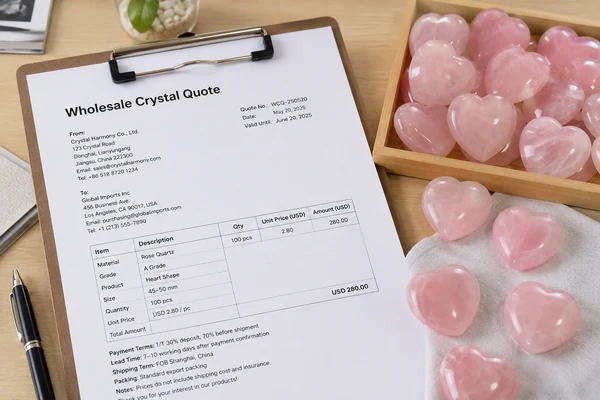
Now that you know the three core elements, let's explore why each one is so crucial for your business. Understanding the supplier's logic will transform you from a hopeful inquirer into a confident buyer who gets exactly what they need, every single time.
Why Isn't There a Fixed Price for a Crystal Product?
Have you ever asked a supplier, "How much for a rose quartz heart?" only to receive a list of follow-up questions instead of a price? It's a frustrating experience when you just want a simple number for your spreadsheet. But in the world of wholesale sourcing, that "simple" product has hidden complexities that directly affect its cost, quality, and market value.
There's no fixed price because wholesale products are not pre-packaged retail items with a barcode. The final cost is determined by variables like material quality, craftsmanship, and size—all of which are specified by you, the buyer. A supplier can't quote a price until they know exactly what you want them to create for you.
Dive Deeper: Deconstructing a "Simple" Rose Quartz Heart
When a new buyer asks me for the price of a rose quartz heart, I immediately see several different products in my mind, each with a different price point. Let's break down the two most important variables that change the cost.
H3: Material Grade Dictates Your Market Position
The first question is always about the material itself. Not all rose quartz is created equal.4 The quality of the raw stone, or its grade, is the single biggest factor in its cost and how you'll position it in your shop.
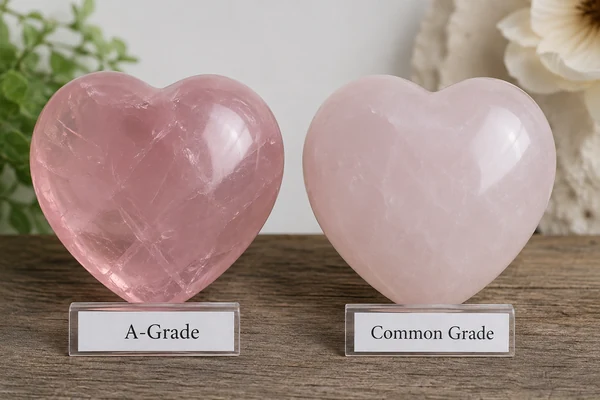
- A-Grade (or higher): This material has a deep, saturated pink color, good translucency, and very few internal fractures or milky inclusions. It's visually stunning and commands a higher price. This is ideal for gift shops, jewelry lines, or high-end decor brands where aesthetics are paramount.
- Common or B-Grade: This material is much more abundant and affordable. It tends to be a paler, milkier pink and may have more visible internal cracks or cloudy patches. While less visually "perfect," it's perfect for customers who prioritize the stone's energy or for products in a lower, more accessible price range.
Asking for a "rose quartz heart" without specifying the grade is like asking a jeweler for the price of a "diamond ring" without mentioning the carat, cut, or clarity. To give you an accurate wholesale crystal quote, we need to know if you're serving a boutique market or a mass market.
H3: Size, Weight, and Craftsmanship Define Unit Cost
Next, "heart" is a shape, not a specification. The size and, more importantly, the crafting style dramatically alter the labor and material costs.5 Let's compare two 50mm hearts.
| Feature | Option A: "Puffy" Heart | Option B: "Flat" Heart |
|---|---|---|
| Size | 50mm Wide | 50mm Wide |
| Thickness | ~25mm | ~10mm |
| Craftsmanship | Hand-polished, deep curve | Machine-cut, slight bevel |
| Raw Material Used | More material per piece | Less material per piece |
| Labor Cost | Higher (skilled work) | Lower (faster process) |
| Resulting Price | Higher | Lower |
A "puffy" heart is thicker, rounder, and feels substantial in the hand. It requires a larger chunk of raw material and more skilled labor to carve and polish its deep curves without breaking the stone. A "flat" heart uses less raw material and is quicker to produce, making it a more budget-friendly option. Both are valid products, but they serve different needs and price points. Without this detail, any quote is just a guess.
How Do Specifications Impact Your Wholesale Crystal Quote?
Do you worry that providing too much detail gives the supplier leverage to charge you more? It’s a common fear for new importers, but the reality is the exact opposite. Vague requests lead to supplier guesswork and, too often, a delivery of products that don't match your expectations. Clear specifications put you in control of the outcome.6
Detailed specifications for material, size, and finish are your most powerful sourcing tool. They eliminate ambiguity, ensuring the supplier quotes for the exact product you envision. This allows you to accurately forecast your costs and, critically, compare offers from different vendors on an apples-to-apples basis.
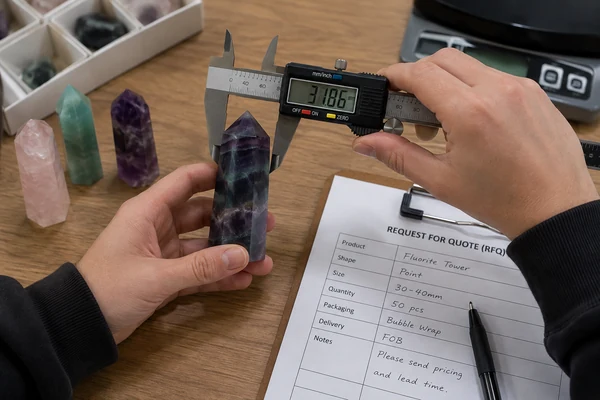
Dive Deeper: From Vague Idea to Tangible Product
The goal of your inquiry is to translate the product in your head into a concrete set of instructions a workshop can follow. This removes risk for both you and the supplier. A detailed request is the foundation of a successful wholesale crystal quote and a smooth production process.
H3: Creating Actionable Product Specifications
Let's contrast a weak inquiry with a strong one.
- Weak Inquiry: "Hi, I need amethyst towers. What is your price?"
- Strong Inquiry: "Hi, I am looking for a quote for 100 amethyst towers with the following specifications:
- Material: A-grade Amethyst, deep purple, good clarity.
- Dimensions: 80-100mm in height and 20-25mm at the base.
- Shape: Standard 6-sided point with a flat base.
- Finish: Fully polished."
The weak inquiry forces the supplier to guess or start a long back-and-forth conversation. The strong inquiry gives us everything we need to calculate a precise cost. It defines the material quality, the size range, the shape, and the finish. There is no room for misunderstanding. This professionalism not only gets you a faster, more accurate quote but also signals to the supplier that you are a serious, organized buyer.
H3: Using Weight vs. Dimensions in Your Request
When should you specify size in millimeters versus grams? It depends on the product's shape.
- Use Dimensions (mm or inches) for: Items with consistent, repeatable shapes. This includes towers, points, spheres, hearts, palm stones, and any custom geometric carvings. Providing a range (e.g., "45-50mm spheres") is often more practical and cost-effective than a single, exact measurement, as it accounts for minor variations in hand-finishing.
- Use Weight (g or kg) for: Items with irregular, organic shapes. This is best for freeform carvings, raw stone clusters, and mineral specimens. For these, specifying a weight range (e.g., "Rose quartz freeforms, 500-700g per piece") is the most effective way to define the product size and cost.
By providing the right kind of measurement, you help the supplier select the right pieces of raw material, ensuring the final products match your expectations for size and substance.
Why Does Order Quantity Affect More Than Just a Volume Discount?
You already know that ordering more inventory can get you a better price—that’s the basic principle of wholesale. But it’s a mistake to think of this as a simple discount negotiation. Your order quantity fundamentally impacts the entire production and logistics chain, which is why it's a non-negotiable part of any serious inquiry.
Order quantity is fundamental to a wholesale crystal quote because it determines everything from raw material sourcing and production efficiency to packaging and shipping logistics. A supplier needs to know the scale of your order to calculate an accurate, sustainable per-unit cost that reflects the true cost of production.

Dive Deeper: The Ripple Effect of Quantity
Let's look past the surface-level "volume discount" and see how your order size affects the core costs that make up your final price.
H3: Raw Material Sourcing Strategy
The quantity you need dictates how we source the stone.
- Small Order (e.g., 20-50 pieces): For a small or trial order, we can likely use existing raw material blocks already in our workshop. This is fast and flexible but relies on the material we have on hand.
- Large Order (e.g., 500+ pieces): For a bulk order, we will likely need to purchase a large, new block of raw stone specifically for your project. Buying raw material in bulk reduces the cost per kilogram, and we pass that savings directly on to you in your quote. Specifying your quantity allows us to plan our material purchasing efficiently.
H3: Production and Labor Efficiency
Manufacturing has economies of scale.7 Setting up cutting saws, grinding wheels, and polishing stations for a specific product takes a fixed amount of time and effort.
- The "Cookie Batch" Analogy: It’s like baking cookies at home. The effort to preheat the oven, mix the dough, and clean the bowls is the same whether you bake one dozen or ten dozen. The more cookies you bake in one go, the lower your "setup cost" is per cookie.
- In the Workshop: The same logic applies. The labor cost to configure machinery and prepare tools is amortized over the total number of units produced.8 Making 500 crystal towers in a single run is far more efficient per piece than making 50. This efficiency is a major component of your per-unit price.
H3: Packaging and Shipping Logistics
Shipping cost is a significant part of your total landed cost, and it is heavily influenced by weight and volume.
- Cost Per Kilogram: Shipping a 20kg box is significantly cheaper per kilogram than shipping a 2kg box.
- Optimizing Space: Larger orders allow us to use carton and pallet space more efficiently, which further reduces the shipping cost per item.9
When we know your order quantity, we can provide a more accurate estimate for shipping, giving you a clearer picture of your total investment and helping you price your products profitably.
Frequently Asked Questions
What if I don't know what material grade I need?
A good supplier will help guide you. Send them photos or links to products you admire, and tell them about your target customers and desired retail price point. Based on that, we can recommend a suitable grade and provide photos of our material to help you decide.
Is it better to specify size in millimeters or inches?
Either is acceptable, but millimeters (mm) are the global standard in manufacturing and offer more precision. If you prefer inches, that's perfectly fine—just be clear. For most hand-carved items, providing a size range (e.g., 3.5-4 inches) is more practical and cost-effective than a single, rigid measurement.
How can I get a quote for a custom crystal carving?
For custom designs, a clear visual guide is essential. Provide a drawing, sketch, or reference photo with precise dimensions from all angles (height, width, depth). Also specify the material, desired finish (e.g., polished, matte, or raw), and the quantity you need. The more detail you give, the more accurate your quote will be.
What is a "Request for Quote" (RFQ)?
An RFQ is a formal document you create to request pricing. In it, you list all your product specifications: material, grade, dimensions/weight, quantity, finish, and any special packaging requirements. Using a consistent RFQ format allows you to get truly comparable quotes from different suppliers, empowering you to make the best choice.
Conclusion
Moving from a retail mindset to a professional B2B purchasing approach is the most important step you can take toward building a successful crystal business. The key is to stop asking "How much does this cost?" and start stating "This is what I need." Providing clear specifications on material grade, size or weight, and order quantity is not a burden; it is the most effective way to get an accurate wholesale crystal quote. This simple shift in communication empowers you to control product quality, forecast your costs accurately, and build a reliable and profitable supply chain. It's the foundation for a lasting partnership with your supplier and the secret to building a beautiful crystal collection that delights your customers.
Ready to build your next collection? Use the simple checklist below to prepare your inquiry, or contact us directly on WhatsApp (+86 150 7540 9178) or email (sales@crystalcarvingswholesale.com) with your specifications. We're here to help you turn your ideas into marketable crystal products.
My Crystal RFQ Checklist:
- Product Name: (e.g., Amethyst Tower, Rose Quartz Heart)
- Material & Grade: (e.g., A-Grade Amethyst, Common Rose Quartz)
- Dimensions/Weight: (e.g., 80-100mm Height, 45-50mm Wide, 200-300g per piece)
- Finish/Style: (e.g., Polished, Puffy Shape, Flat Base)
- Quantity: (e.g., 100 units)
- Packaging: (e.g., Standard bulk pack, Individual boxes)
-
Reference Photos: (Attach any images that help explain what you want)
<!--[googlesitekit-end-of-content]-->
"Colored Gemstone Value Factors - GIA", https://www.gia.edu/gia-news-research/value-factors-design-cut-quality-colored-gemstone-value-factors. Research indicates that the grade of a crystal, such as its clarity and color, significantly influences its market value and production costs due to the rarity and quality of the raw material used. Evidence role: general_support; source type: research. Supports: The connection between crystal grade and its impact on production costs and pricing.. Scope note: The specific impact on pricing may vary depending on the supplier and market conditions. ↩
"Size-Effect-Based Dimension Compensations in Wet Etching for ...", https://pmc.ncbi.nlm.nih.gov/articles/PMC11205438/. Studies in manufacturing processes highlight that precise dimensions or weight specifications are critical for calculating material usage and production costs. Evidence role: mechanism; source type: research. Supports: The importance of specifying dimensions or weight for accurate pricing and production planning in crystal manufacturing.. Scope note: The degree of impact may vary depending on the type of crystal and manufacturing method. ↩
"The Impact of Sourcing on the Delivery of Raw Material", https://www.academia.edu/19594731/The_Impact_of_Sourcing_on_the_Delivery_of_Raw_Material. Manufacturing research shows that larger order quantities improve production efficiency and reduce per-unit costs due to economies of scale. Evidence role: general_support; source type: research. Supports: The influence of order quantity on production efficiency, material sourcing, and pricing.. Scope note: The specific cost reductions may depend on the industry and production setup. ↩
"How Are Crystal Carvings Made? A Complete Production Process ...", https://crystalcarvingswholesale.com/how-are-crystal-carvings-made-a-complete-production-process-guide/. Encyclopedic sources describe rose quartz grading based on color saturation, translucency, and inclusions, which directly affect its market value. Evidence role: definition; source type: encyclopedia. Supports: The variation in quality and pricing of rose quartz based on its grade.. Scope note: Grading standards may vary between suppliers and regions. ↩
"Role of design complexity in technology improvement - PMC", https://pmc.ncbi.nlm.nih.gov/articles/PMC3107265/. Research in artisanal manufacturing shows that intricate crafting styles require more labor and material, increasing production costs. Evidence role: mechanism; source type: research. Supports: The role of crafting style in determining labor and material costs for crystal products.. Scope note: The cost impact may vary depending on the specific crafting techniques used. ↩
"Managing Relationships with Suppliers and Vendors You Use", https://www.apu.apus.edu/area-of-study/business-and-management/resources/managing-relationships-with-suppliers-and-vendors-you-use/. Educational materials on supply chain management emphasize that detailed specifications are critical for aligning supplier and buyer expectations. Evidence role: general_support; source type: education. Supports: The importance of clear product specifications in reducing misunderstandings and ensuring desired outcomes.. Scope note: The effectiveness of clear specifications may depend on the supplier's expertise and communication skills. ↩
"Economies of scale", https://en.wikipedia.org/wiki/Economies_of_scale. Educational resources on economics explain that economies of scale reduce per-unit costs by spreading fixed costs over a larger number of units. Evidence role: mechanism; source type: education. Supports: The principle that larger production runs reduce per-unit costs due to economies of scale.. Scope note: The extent of cost reduction may vary depending on the production process and industry. ↩
"Distribution Costs", https://www.imf.org/en/publications/wp/issues/2022/01/14/distribution-costs-510845. Educational resources on manufacturing processes explain that setup costs are fixed and are spread over the total production volume, lowering per-unit costs in larger runs. Evidence role: mechanism; source type: education. Supports: The distribution of setup costs across larger production volumes reduces per-unit costs.. Scope note: The cost reduction depends on the complexity and duration of the setup process. ↩
"How to Choose a Reliable Crystal Carvings Wholesale Supplier in ...", https://crystalcarvingswholesale.com/how-to-choose-a-reliable-crystal-carvings-wholesale-supplier-in-china/. Logistics research shows that bulk orders allow for better utilization of shipping containers and pallets, reducing per-unit shipping costs. Evidence role: mechanism; source type: research. Supports: The efficiency gains in shipping costs achieved through larger order sizes and optimized packaging.. Scope note: The degree of cost savings depends on the specific shipping method and order configuration. ↩
Keep Reading