Struggling to make your crystal shop stand out in a crowded market? You're sourcing beautiful products, but you find yourself lost in a sea of competitors selling the exact same things, forcing you into a price war you can't win. The secret to building a memorable brand for a crystal shop isn't a fancier logo or a catchier name; it's a strategically curated product collection that tells a unique story and sidesteps the competition altogether.
To create a memorable brand for a crystal shop, you must shift your focus from simply collecting inventory to curating a cohesive product line. This involves building your collection around a specific theme, aesthetic, or craft specialty. The most powerful strategy is to collaborate with a supplier on exclusive, custom-designed products (OEM/ODM) that no other shop can offer, transforming you from a reseller into a true brand creator.
This approach might sound complex, but it's far more practical than abstract marketing theory. It all comes down to the sourcing decisions you make. Let's explore the common traps new shop owners fall into and how you can use product strategy to build a brand that attracts loyal customers and commands better prices.
Why Do Most New Crystal Shops Fail to Build a Brand?
Have you ever looked at your inventory and felt it was either a random assortment of trending items or a carbon copy of every other new shop? This is a common problem. You're sourcing what you think people want, but this reactive approach often prevents a coherent brand from ever taking shape. Understanding this trap is the first step toward building a business with a real identity.
Most new crystal shops fail to build a brand because their sourcing strategy is reactive.1 They either chase random trends, creating a chaotic "junk drawer" of unrelated products, or they only stock generic basics, making them indistinguishable from hundreds of competitors and forcing them into a brutal race to the bottom on price.
Dive Deeper: The Two Sourcing Traps
From my perspective as a supplier, I review hundreds of order sheets from businesses worldwide. The patterns are clear, and they often fall into two categories that hinder brand development.
H3: The "Junk Drawer" Effect
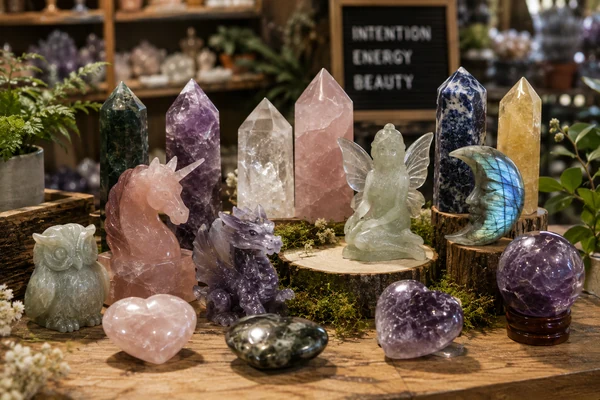
This happens when a shop owner chases every new trend. One month, it's all about flower agate. The next, it's Caribbean calcite. Then, a wave of yooperlite comes through. While these products are individually popular, an inventory built solely on chasing trends becomes a confusing and incoherent "junk drawer."
Customers can't figure out what your shop stands for. Are you about gentle energy? High-vibration stones? Earthy aesthetics? When your collection lacks a core identity, you fail to attract a specific, loyal customer base. Instead, you only attract fleeting, trend-driven buyers who will move on to the next hot item at the next shop. A memorable brand for a crystal shop requires consistency.
H3: The "Generic Basics" Problem
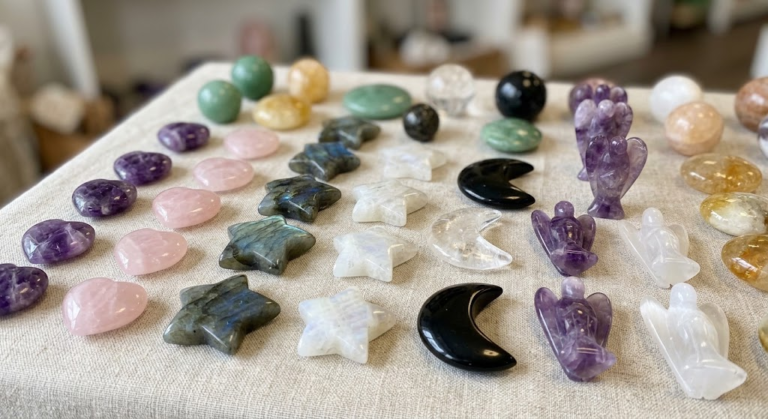
The opposite trap is stocking only the most common, basic items: standard amethyst clusters, small rose quartz hearts, and generic clear quartz points. While these are essential staples, building an entire business on them is a recipe for failure.
Why? Because thousands of other sellers—from massive online retailers to small Etsy shops—are selling the exact same things. When your product is identical to everyone else's, the only way to compete is on price. This creates a vicious cycle:
- You lower your price to get a sale.
- A competitor lowers their price to match you.
- You are forced to lower it again, squeezing your profit margins until the business is no longer sustainable.
You become a commodity seller, not a brand builder. Customers have no reason to be loyal to you; they will simply buy from whoever offers the lowest price that day.
How Does Curation Create a Memorable Brand for a Crystal Shop?
You might think that building a business means buying more and more inventory to offer a wide selection. But simply "collecting" products is not the same as building a brand. A random assortment of items, no matter how beautiful, doesn't tell a story or attract the kind of dedicated customers who will support your business long-term. Shifting your mindset from collecting to curating is how you build a powerful, defensible brand identity.
Curation creates a memorable brand for a crystal shop by building a cohesive product line around a specific "brand pillar"—such as a theme, a visual style, or a specialized craft. This focused approach tells a clear story, attracts a loyal niche audience, and immediately differentiates your shop from generic competitors.
Dive Deeper: Finding Your Brand Pillar
Instead of asking "What's popular?" you should be asking, "Does this product fit my brand's story?" A brand pillar is the central concept that guides all your sourcing decisions. It acts as a filter, ensuring every product you add to your shop contributes to a unified vision.
Here are a few examples of brand pillars we've seen clients use successfully:
-
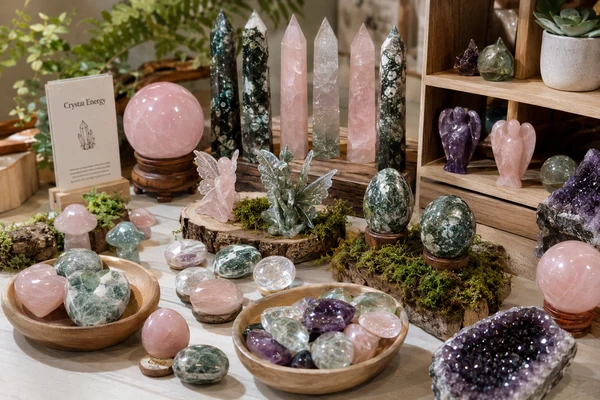
Thematic Curation: This is about building a collection around a narrative. For example, a "Forest Magic" theme could include moss agate, tree agate, green fluorite, fairy carvings, and raw, earthy specimens. A "Coastal Serenity" theme might feature larimar, aquamarine, blue calcite, and shell-shaped carvings. We once worked with a client to develop this exact coastal theme, and they successfully attracted customers specifically looking for that beach-inspired aesthetic, completely avoiding competition with generalist stores.
-
Aesthetic Curation: This pillar focuses on a consistent visual style. You could become known for a minimalist aesthetic, curating only crystals with clean geometric shapes (spheres, pyramids, cubes), a monochrome color palette (howlite, clear quartz, obsidian), and simple, elegant jewelry. Conversely, you could build a brand around a rustic, bohemian look with large, unpolished specimens, raw stone jewelry, and natural wood displays.
-
Craftsmanship Curation: This is about becoming a specialist. Instead of offering a little bit of everything, you become the go-to shop for one specific type of product. For example, you could specialize in highly detailed, intricate 3D animal carvings, sourcing the best and most unique designs from suppliers. Or you could focus entirely on perfectly polished spheres and palm stones, becoming known for your quality and variety in that niche.
When you curate around a pillar, your sourcing becomes proactive and strategic. Your shop develops a clear identity, making it instantly recognizable and memorable to the right customers.
Can Custom Products (OEM/ODM) Solidify Your Brand for a Crystal Shop?
Even with a beautifully curated collection, a determined competitor could try to copy your theme. To build a truly defensible business, you need a "moat"—something that protects your brand identity and makes you irreplaceable. While curation is a huge step forward, developing exclusive products is the ultimate way to create something no one else can sell.
Yes, absolutely. Collaborating with a supplier on custom-designed products (OEM/ODM) is the most powerful way to solidify your brand for a crystal shop. It provides you with truly unique items that cannot be easily copied or price-shopped by competitors, elevating you from a simple reseller to a genuine brand creator.

Dive Deeper: From Reseller to Brand Creator
Working with a supplier on custom products is more accessible than many small business owners think. This process is generally referred to as OEM or ODM.
H3: What Are OEM and ODM?
- OEM (Original Equipment Manufacturer): This is when we, as your supplier, produce a product based on your unique design. You provide the sketch, digital file, or detailed concept, and we bring it to life. For example, a client recently sent us a hand-drawn sketch of a triquetra intertwined with a crescent moon. We worked with them to refine the dimensions, chose fluorite as the material, and produced an exclusive altar piece that became their bestseller. No one else had it.
- ODM (Original Design Manufacturer): This is when you select one of our existing proprietary designs and we produce it exclusively for you, often with your private label. For instance, we might have a unique dragon carving mold that isn't in our public catalog. You could order that design to be made in labradorite, and it would be exclusively for your shop.
H3: Taking the First Steps
Engaging in OEM/ODM transforms your role. You are no longer just picking items from a catalog; you are co-creating your inventory and infusing your brand's DNA directly into your products.
Here’s how you can start:
- Start with a clear idea. It doesn't have to be a full collection. Think of one "hero" product that perfectly represents your brand. Is it a moon phase carving set? A unique goddess shape? An animal totem that resonates with your theme?
- Talk to your supplier. This is the most important step. A good wholesale partner will be open to discussion. Ask direct questions:
- "What are your capabilities for custom shapes and engravings?"
- "What are the Minimum Order Quantities (MOQs) for a custom design?"
- "Can you help refine a design idea if I provide a sketch?"
- "What is the process for sampling and production?"
By creating something exclusive, you give customers a compelling reason to buy from you and only you.
What is the Commercial Payoff of a Strong Brand for a Crystal Shop?
All this work on curation and developing custom products can seem like a lot of effort, especially when you're busy running a business. Is it really worth it when you could just focus on selling cheap tumbles and trending items? The answer is an emphatic yes. The commercial payoff is a more resilient, profitable, and ultimately more enjoyable business to run.
The primary commercial payoff of a strong brand for a crystal shop is the ability to move beyond price competition. A unique, curated collection attracts loyal customers who value your specific vision, which allows you to command premium prices, increase your profit margins, and build a sustainable business that isn't vulnerable to market fluctuations.
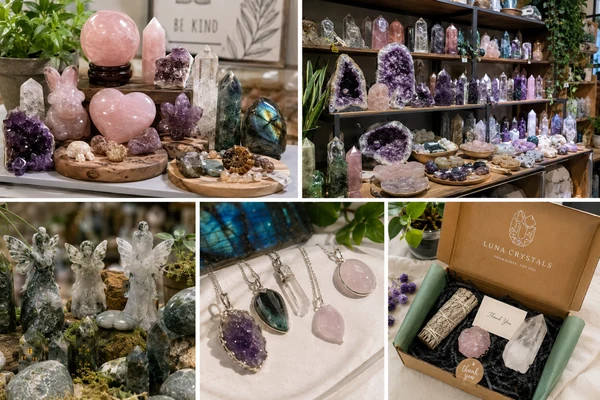
Dive Deeper: The Tangible Business Benefits
Building a brand through strategic sourcing isn't just a creative exercise; it's one of the smartest commercial decisions you can make.2
H3: Escaping the Race to the Bottom
When your products are unique, customers can no longer make a simple apples-to-apples price comparison. The conversation in their mind shifts from "Where can I get this cheaper?" to "Wow, I've never seen anything like this before." Your exclusive "Moon Goddess" carving in amethyst isn't comparable to a standard amethyst point, so you get to set the price based on its unique value, not based on the market price of amethyst per gram.
H3: Building True Customer Loyalty
People don't form an emotional connection with a commodity.3 They form it with a story, an aesthetic, and a brand they trust. A customer who loves your "Cosmic Wonder" theme will return to your shop specifically to see what new "out of this world" products you've curated. They become fans who follow your journey, recommend you to friends, and eagerly await your next collection—a level of loyalty you can never achieve when competing only on price.
H3: Increased Perceived Value and Higher Margins
A strong brand directly increases the perceived value of your products, which translates to healthier profit margins. A custom-designed product or a piece curated as part of a thoughtful collection simply feels more special.
Consider the difference:
| Feature | Generic Shop | Curated Brand Shop |
|---|---|---|
| Product | Standard Amethyst Point | Custom-designed "Moon Goddess" Amethyst Carving |
| Competition | High (dozens of sellers) | Low to None (exclusive product) |
| Customer Focus | Price | Uniqueness, Story, Craftsmanship |
| Profit Margin | Low | High |
| Customer Loyalty | Low (transactional) | High (brand-driven) |
This table shows how a strong brand for a crystal shop isn't just about looking good—it's about building a fundamentally stronger business model.
Frequently Asked Questions
How do I find a theme for my crystal shop?
Start by looking at your own passions and the stories you want to tell. What drew you to crystals in the first place? Consider an aesthetic you love (minimalist, rustic, vibrant), a spiritual path (yoga, reiki, celestial), or a specific type of crystal you're an expert in. Your brand should be an authentic reflection of you.
Is OEM/ODM expensive for a small shop?
It can be, but it doesn't have to be. The cost depends on the complexity of the design, the material chosen, and the order quantity. Many suppliers, including us, are willing to work with small businesses on low-MOQ trial orders for simple customizations like engraving or modifying an existing shape. The best way to find out is to start a conversation and ask for a quote.
Do I still need to sell basic crystals like quartz points?
Yes, foundational products are often important. However, you should frame them within your brand's context. If your theme is "Minimalist Energy," you can sell high-quality, perfectly clear quartz points as an essential piece for creating a clean energy grid. They become part of your story, not just a generic item on a shelf.
How much of my inventory should be unique vs. basic?
A good guideline to start with is the 80/20 rule.4 About 80% of your inventory can be curated, widely available products that perfectly fit your theme. The other 20% should be your "hero" products—the truly unique, custom, or rare items that define your brand and generate excitement. These are the pieces that make you memorable.
Conclusion
Creating a memorable brand for a crystal shop has very little to do with your logo and everything to do with your product strategy. By moving away from the reactive sourcing traps of chasing trends or selling only generic basics, you can build a powerful, defensible business. The path forward is clear: shift from collecting inventory to curating a cohesive story.5 Build your collection around a distinct brand pillar, whether it's a theme, an aesthetic, or a craft. Most importantly, leverage custom products through OEM/ODM to create a truly unfair advantage that no competitor can match. This strategy is your best defense against price wars and the surest way to build a profitable, sustainable, and beloved crystal brand.
If you're ready to move beyond generic sourcing and start building a truly memorable collection, we're here to help. Contact us today to discuss your ideas for custom carvings or to explore how we can support your unique brand vision.
WhatsApp: +86 150 7540 9178 Email: sales@crystalcarvingswholesale.com
<!--[googlesitekit-end-of-content]-->
"6 common branding mistakes and how to avoid them", https://web.uri.edu/risbdc/6-common-branding-mistakes-and-how-to-avoid-them/. A study on small business branding challenges highlights that reactive sourcing often leads to incoherent brand identity, reducing customer loyalty and competitive advantage. Evidence role: general_support; source type: research. Supports: The challenges faced by new businesses, particularly in niche markets like crystal shops, due to reactive sourcing strategies.. Scope note: The study may focus on broader retail sectors rather than crystal shops specifically. ↩
"Supply Chain Resilience by Strategic Sourcing: A Case Study", https://repository.rit.edu/cgi/viewcontent.cgi?article=12936&context=theses. Research from business institutions shows that strategic sourcing improves brand differentiation and customer loyalty, leading to higher profit margins. Evidence role: general_support; source type: institution. Supports: Strategic sourcing can enhance brand identity and profitability by aligning inventory with a cohesive business vision.. Scope note: The findings may focus on general retail rather than crystal shops specifically. ↩
"Decomposing Brand Loyalty: An Examination of ... - PMC - NIH", https://pmc.ncbi.nlm.nih.gov/articles/PMC11851547/. Consumer psychology research shows that emotional branding fosters deeper customer relationships, increasing loyalty and perceived value. Evidence role: mechanism; source type: research. Supports: Emotional connections are a key driver of customer loyalty, distinguishing branded products from commodities.. Scope note: The research may focus on general branding rather than crystal shops specifically. ↩
"What is the 80/20 Inventory Rule?", https://www.netsuite.com/portal/resource/articles/inventory-management/80-20-inventory-rule.shtml. Business management textbooks recommend the 80/20 rule for inventory planning, emphasizing its effectiveness in balancing variety and focus. Evidence role: general_support; source type: education. Supports: The 80/20 rule is a common inventory strategy, balancing staple products with unique offerings to optimize sales and branding.. Scope note: The recommendation may not be tailored specifically to crystal shops. ↩
"Storytelling in Marketing: The Importance of Brand Narrative", https://online.uwa.edu/news/brand-narrative-storytelling/. Marketing textbooks emphasize the importance of storytelling in creating memorable and engaging brand experiences. Evidence role: general_support; source type: education. Supports: Curating inventory around a cohesive story enhances brand identity and customer engagement.. Scope note: The emphasis on storytelling may not address inventory curation directly. ↩
Keep Reading