Struggling to make your crystal business stand out in a crowded market? You have a powerful brand vision, but every supplier seems to offer the same generic inventory, making it impossible to build a unique identity. This forces you to compete on price, eroding your margins and brand value. Building a genuine private label crystal brand requires moving beyond simply sticking your logo on a stock product to creating a truly exclusive collection.
A successful private label crystal brand is built on four pillars: creating exclusive product shapes through custom molding, ensuring visual consistency through rigorous material selection, developing protective and beautiful branded packaging, and leveraging flexible sourcing strategies to manage costs.1 This approach creates a defensible brand with higher perceived value, moving beyond the limitations of standard wholesale.
This process might sound complex, but it's more accessible than you think when you partner with the right manufacturer. Let's break down each of these essential pillars to give you a clear roadmap for launching a brand that truly resonates with customers and commands a premium price.
How Can Custom Carvings Differentiate Your Private Label Crystal Brand?
You're trying to build a premium brand, but the "private label" options you find involve picking from the same catalog as your competitors. How can you create a unique story and justify higher prices when your products are identical to everyone else's?
The solution is to shift from "private labeling" to true "custom carving." Instead of just adding your logo to a standard heart or tower, you can work with a manufacturer to design and produce a shape that is exclusively yours, creating a powerful brand moat.
Dive Deeper: From Stock Products to Exclusive Molds
Many new brand owners fall into a common trap. They find a supplier who offers "private label," but this often means the supplier simply puts your brand's name on packaging for their existing, mass-produced inventory. While this is a start, it offers zero product differentiation. Your rose quartz moon is the same as ten other brands' rose quartz moons. This is not a sustainable foundation for a premium brand.2
A factory-level approach is completely different. When we partner with clients to build a serious private label crystal brand, the conversation starts with your brand's unique concept.
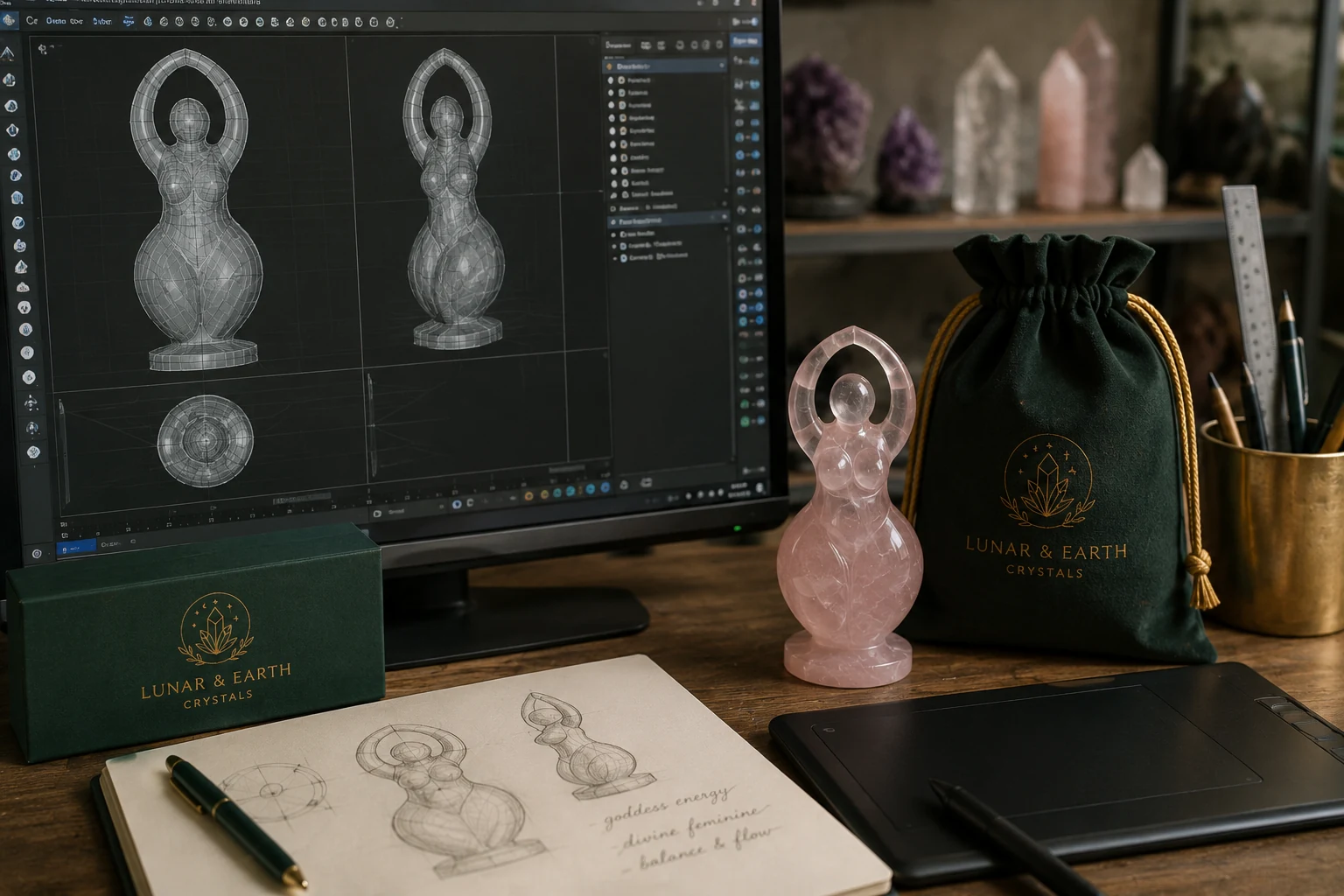
- Conceptualization: Let's say your brand focuses on "feminine healing and empowerment." Instead of a generic goddess shape, we can collaborate on a design that embodies your specific vision.
- Digital Design: Our team uses CAD software to create a precise 3D model. We can refine every curve and detail, perhaps incorporating a unique symbol or a specific posture that reflects your brand's ethos.
- Exclusive Molding: Once the design is approved, we create an exclusive mold. This is the key. "Exclusive" means we use this mold only for your orders. No other client will have access to this shape.
This process ensures that your signature product is found nowhere else online or in stores. It becomes an authentic representation of your brand, something customers can't find elsewhere. This uniqueness is what builds brand loyalty and allows you to escape the endless cycle of price competition.3
| Feature | Standard "Private Label" | True Custom Carving |
|---|---|---|
| Product Uniqueness | Low (Stock item) | High (Exclusive shape) |
| Brand Defensibility | None | Strong (Product is a moat) |
| Perceived Value | Low to Medium | High to Premium |
| Supplier Type | Trading Company or Wholesaler | Direct-to-Factory Manufacturer |
When a customer sees a product they have never seen before, they are naturally more curious and willing to pay for that originality. This is the foundation of a strong private label crystal brand.
How Do You Maintain Color Consistency for a Natural Crystal Brand?
You’ve launched your brand, and the first batch of amethyst towers is a beautiful, deep purple. Customers love them! But when you reorder, the new batch arrives pale and washed out. Suddenly, you're getting angry emails and bad reviews from customers whose products don't match your photos, shattering your brand's credibility.
This happens because many suppliers don't control for natural variations. A true manufacturing partner ensures visual consistency for your private label crystal brand by intervening at the raw material selection stage, sorting and grading stones before they are ever carved.
Dive Deeper: The Art of Managing Natural Variation
Crystals are natural minerals, and color variation is an inherent and beautiful quality.4 However, for a brand, consistency is paramount. A customer who buys a "deep pink" rose quartz palm stone from you expects the next one they buy to also be deep pink, not a milky, anemic white. Brand trust is built on meeting expectations.
The common point of failure is with suppliers who are merely middlemen. They buy whatever carvings are available on the market, so batch-to-batch consistency is left to chance. A dedicated manufacturing partner integrates quality control much earlier in the process.
Here’s how we handle it for our private label clients:
- Define the Brand's "Color Code": First, we work with you to define the specific visual identity of your brand. Do you want your fluorite to be predominantly green and purple? Does your brand's rose quartz need to be a rich, vibrant pink?
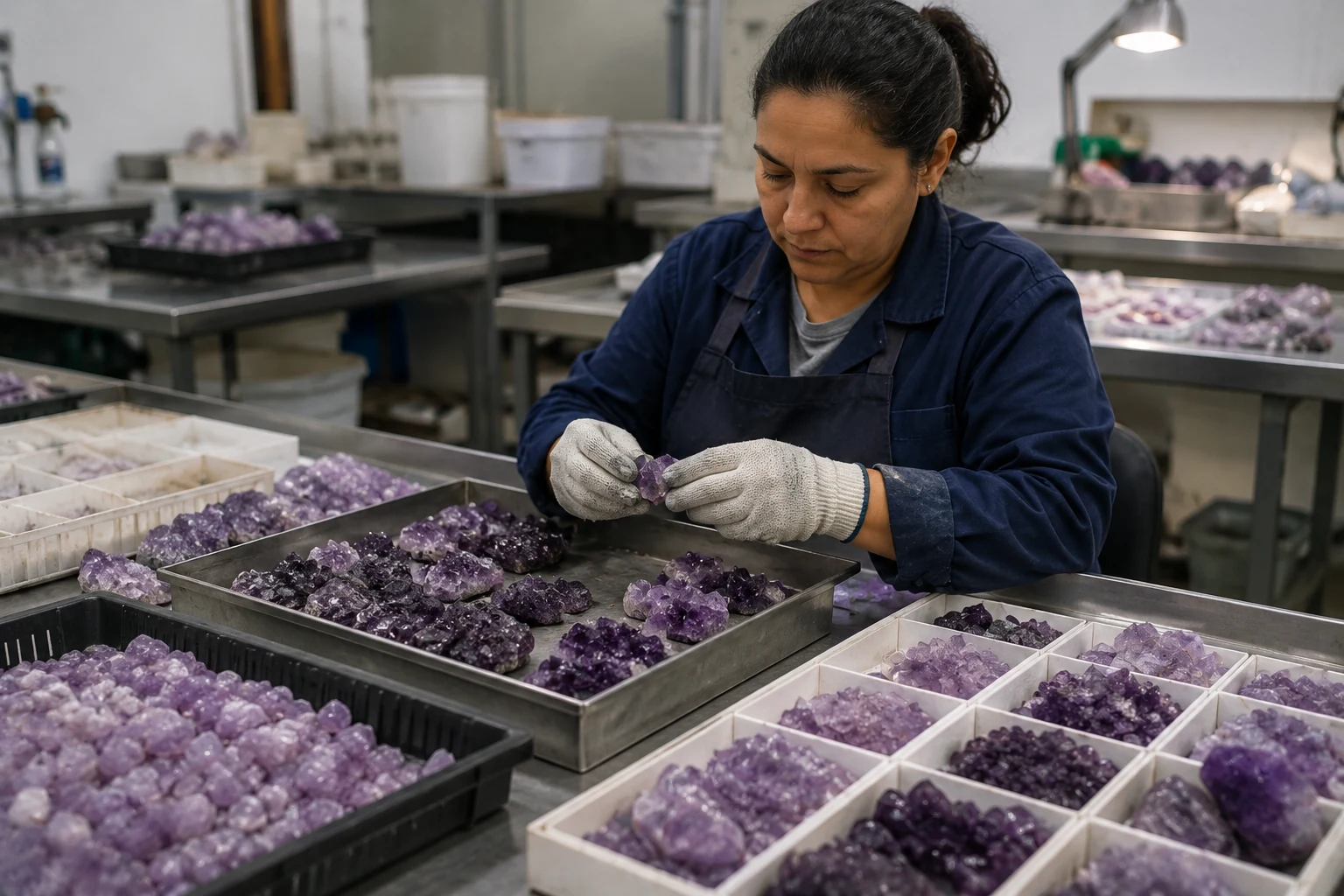
- Screening at the Source: With this brief, our material selection team gets to work. When raw stone blocks arrive at our factory, they are manually sorted. For a brand requiring "A-grade deep purple amethyst," our workers will physically inspect the raw chunks, setting aside any material that is too pale, has undesirable inclusions, or shows hints of yellow or brown.
- Dedicated Material for Production: Only the pre-approved, A-grade material proceeds to the cutting and carving workshops. This disciplined pre-selection is the only way to ensure that the 500 towers you order this month look consistent with the 500 you order in six months.
The hallmark of a high-end private label crystal brand lies in this disciplined restraint. It’s about honoring the natural origin of the stone while curating it with extreme prejudice to fit a consistent brand aesthetic. This level of control is only possible when you work directly with a factory that manages its own raw material supply chain.
What Is Export-Grade Packaging for a Private Label Crystal Brand?
You’ve invested in beautiful, custom-carved crystals. To save money, you source gift boxes from a separate, low-cost packaging factory. The boxes arrive, but they don't quite fit the handmade carvings. During international transit, the stones rattle around and arrive at your warehouse—or worse, at your customer's door—chipped, cracked, or completely broken.
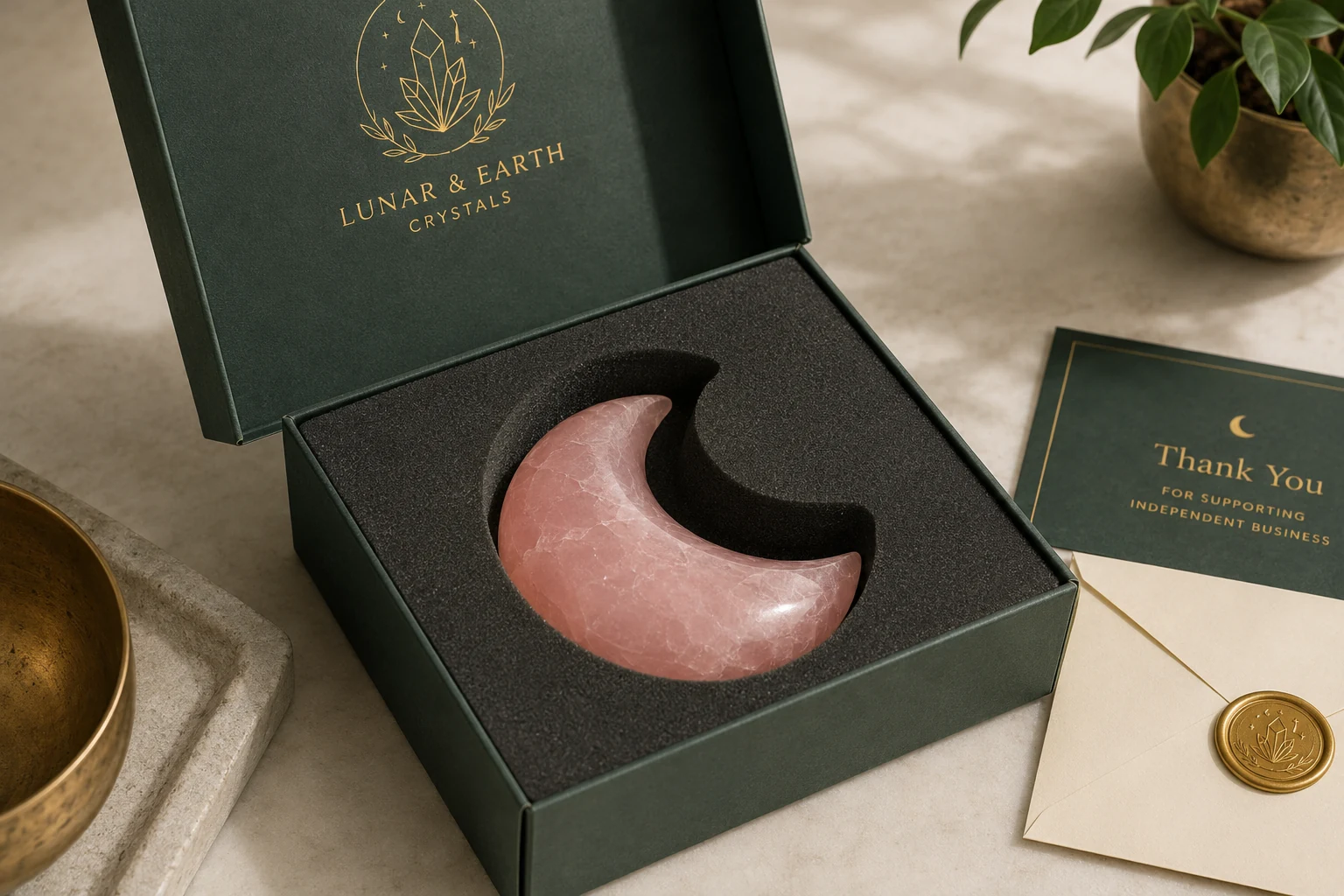
This is a costly and entirely preventable mistake. True export-grade packaging is a turnkey solution where the product and its protective inner packaging are engineered together to ensure a perfect, shock-proof fit for your private label crystal brand.
Dive Deeper: A Turnkey System for Product Protection and Presentation
The unboxing experience is a critical touchpoint for any modern brand.5 For fragile items like crystals, it's also your first line of defense against loss and damage. Relying on separate suppliers for stones and boxes creates a massive gap in accountability and engineering.
As a factory that manages the entire process, we solve this by integrating packaging design into product development. It’s a complete turnkey system.
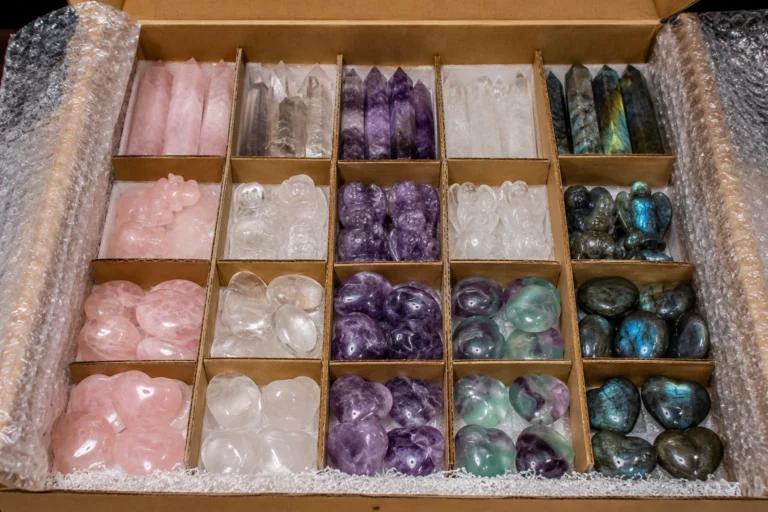
Precision-Fit Inserts
Hand-carved crystals are never perfectly uniform. Each piece has slight variations in dimension and shape. A generic box is a recipe for disaster. Our solution involves creating custom inserts for each specific product:
- 3D Measurement: We take the precise dimensions of your finished custom carving.
- Custom Die-Cutting: We use this data to die-cut high-density inserts from materials like EVA foam or EPE (pearl cotton) foam. These materials are rigid enough to hold the product securely but soft enough to absorb shock and prevent scratches.
- A Perfect Fit: The result is an insert where your crystal carving nests perfectly, with absolutely no room to move, rattle, or bang against the sides of the box during its long journey overseas.
The Outer Defenses
The internal protection is only half the battle. Your retail-ready gift box needs to survive the rigors of global logistics.
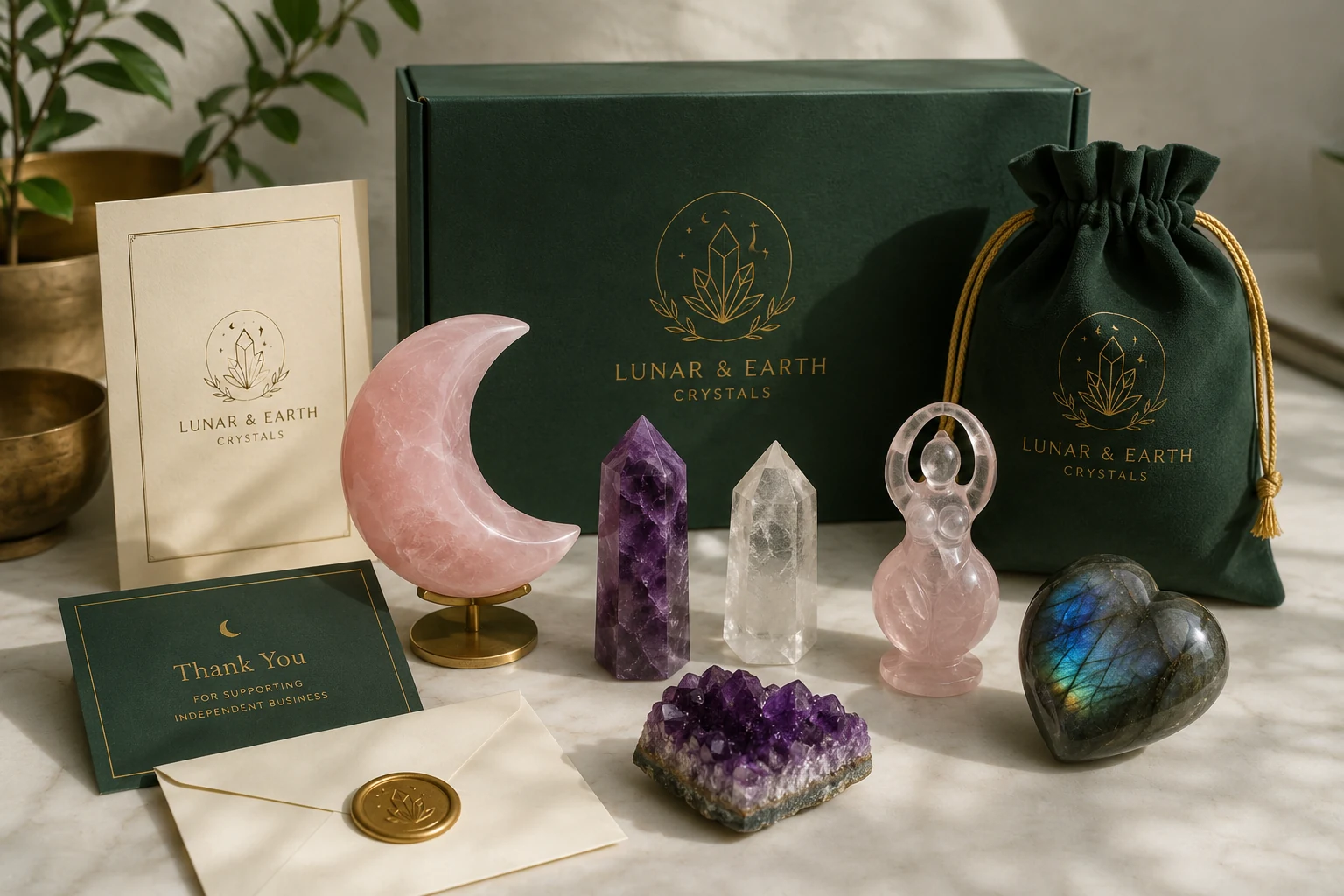
- Branded Retail Box: The box itself is designed with your branding, creating a beautiful presentation for your private label crystal brand.
- Master Carton: For shipment, these individual gift boxes are packed into 5-ply super-hard corrugated export cartons. These master cartons are the industry standard for providing structural integrity and protecting the contents from being crushed during transit.
This integrated approach means the product you receive is not just a loose stone; it's a retail-ready, gift-ready unit that can go directly from the shipping container to your store shelf or fulfillment center.6 It protects your investment, delights your customer, and reinforces the premium quality of your brand.
How Can Startups Afford to Launch a Custom Crystal Line?
You have a brilliant vision for a unique crystal collection, but the thought of high Minimum Order Quantities (MOQs) for full customization is paralyzing. You fear you'll have to invest thousands of dollars in a single product that might not even sell, putting your new business at immense risk.
The key is to work with a flexible manufacturing partner who understands the challenges of a startup.7 You don't have to go "all-in" on full customization from day one. You can start smart by blending custom elements with stock products to test the market and lower your initial investment.
Dive Deeper: Deconstructing the MOQ Barrier with Smart Sourcing
The fear of high MOQs is valid.8 Many large factories are structured for bulk orders and aren't interested in small, developmental runs. However, a partner committed to long-term growth will offer flexible pathways to help you get started. Instead of demanding an order of 2,000 units of a single new design, we can help you build your private label crystal brand incrementally.
Here are a few proven strategies we use to help emerging brands launch:
Strategy 1: Stock Products + Custom Packaging
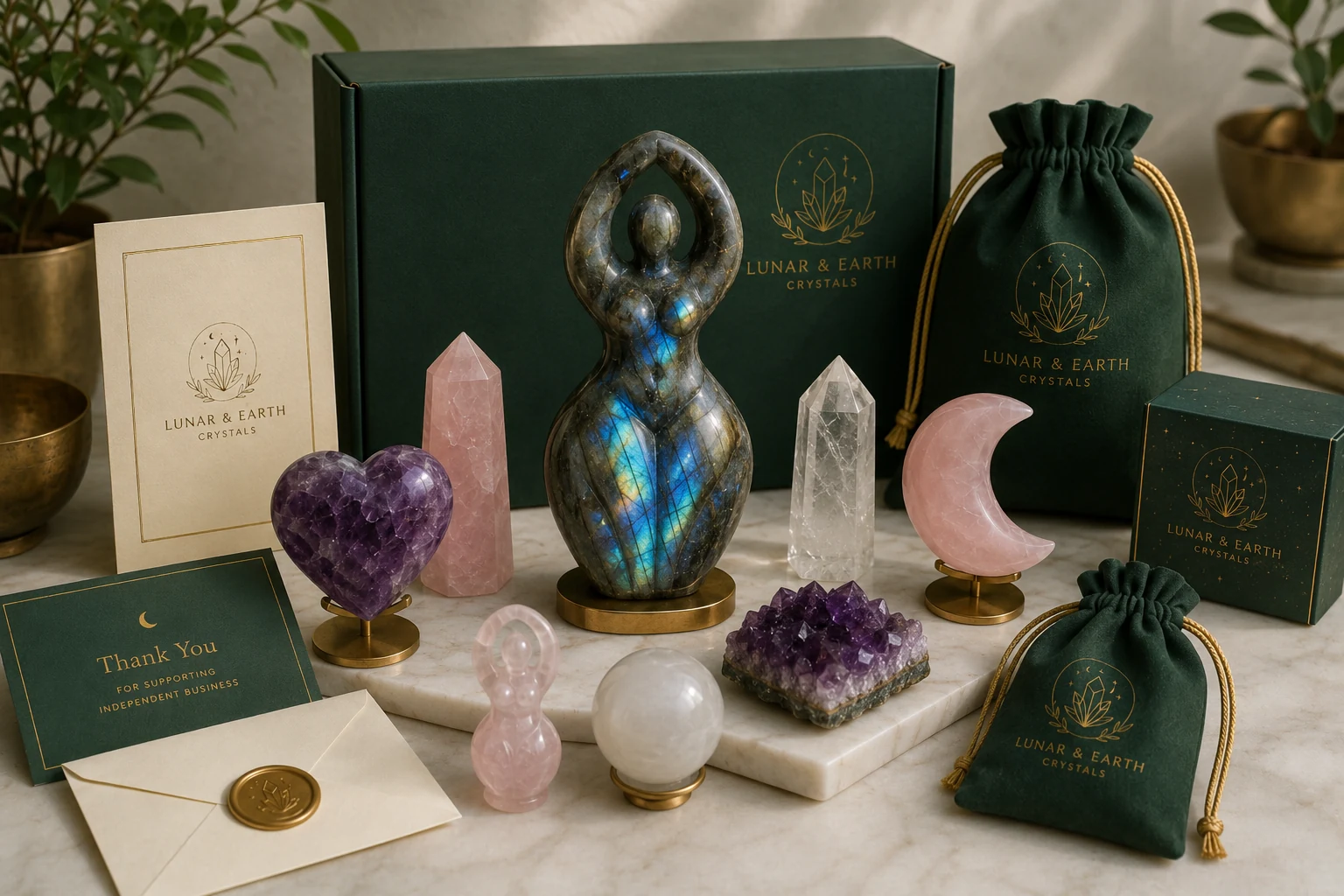
This is the lowest-risk entry point. You can select from our vast inventory of popular, proven sellers—like amethyst points, rose quartz hearts, or clear quartz spheres. We then help you design and produce high-quality branded packaging (boxes, pouches, info cards) for these items.
- Benefit: You get to market quickly with a branded look, test your marketing and sales channels, and build cash flow without the cost of custom molding. The MOQ for custom packaging is typically much lower than for custom carving.
Strategy 2: The "Hero Product" Model
This is the next step up. You invest in creating one single, exclusive custom carving that will be your brand's "hero product." This is the unique item that tells your brand story. To fill out your collection and meet a reasonable total order value, you supplement this one custom piece with a mixed batch of our standard wholesale items.
- Benefit: You can test your unique design with a smaller production run while offering customers a wider collection. This minimizes the financial risk of your custom piece while still giving you a powerful market differentiator.
Strategy 3: The Growth Partnership Approach
A good supplier is invested in your success. We understand that a startup with potential will eventually grow into a major account. That's why we're willing to be flexible. We often support promising new brands by offering very low initial fees for things like mold creation or packaging print plates. By paying a small, one-time setup fee, you unlock the ability to place smaller test orders for your custom products.
As your private label crystal brand grows and you gain confidence in what sells, you can gradually increase your order sizes and expand your line of exclusive carvings. The goal is to build a partnership that allows you to scale intelligently, not to force you into a risky, oversized first order.
Frequently Asked Questions
What's the difference between OEM and private label for crystals?
Private label typically means applying your brand to an existing product from a supplier's catalog. OEM (Original Equipment Manufacturer) is a deeper level of customization where the factory produces a unique product based on your exclusive design and specifications. True brand-building often involves moving from private label to OEM.
How long does it take to develop a custom crystal carving?
The process from initial concept to a finished sample typically takes 3 to 5 weeks.9 This includes time for CAD design, 3D model revisions, mold creation, and producing the first physical sample. The timeline can vary based on the complexity of the design and the number of revisions required.
What's a typical MOQ for a custom crystal product?
MOQs vary widely based on the material, size, and complexity of the carving.10 While some factories might demand 500-1000 pieces per design, we work with startups to find flexible solutions. This can include a lower MOQ in exchange for a mold fee or starting with a mixed order that includes your custom piece.
Can I mix different materials and styles in one private label order?
Absolutely. A flexible supplier should encourage this, especially for new brands. We support mixed material and mixed style orders to help you build a diverse collection without having to meet a high MOQ for every single item. This allows you to test what resonates with your customers before committing to larger volumes.
Conclusion
Building a successful private label crystal brand goes far beyond simply choosing products from a wholesale catalog. It's about creating a unique and defensible identity through thoughtful product design, rigorous quality control, and a premium customer experience. By focusing on the four pillars—exclusive custom carvings, consistent material selection, export-grade branded packaging, and flexible sourcing strategies—you can create a brand that commands loyalty and premium pricing. The key is finding a manufacturing partner who can act as a true collaborator, guiding you through each step of this creative and commercial journey.
If you're ready to move beyond generic wholesale and build a truly unique crystal collection, we're here to help. Contact us today to discuss your brand vision.
Website: https://crystalcarvingswholesale.com/
WhatsApp: +86 150 7540 9178
Email: sales@crystalcarvingswholesale.com
"Package design as a branding tool in the cosmetic industry", https://pmc.ncbi.nlm.nih.gov/articles/PMC9123395/. Educational resources on private label branding emphasize the importance of product differentiation, quality control, and strategic sourcing in building a successful brand. Evidence role: general_support; source type: education. Supports: The four pillars of creating a successful private label brand, including product uniqueness, material consistency, packaging, and sourcing strategies.. Scope note: The source may not specifically address the crystal industry but provides general insights into private label branding. ↩
"How perceived sustainability influences consumers' clothing ...", https://pmc.ncbi.nlm.nih.gov/articles/PMC11576948/. Studies on branding suggest that product differentiation is a key factor in maintaining a premium brand's market position and customer loyalty. Evidence role: general_support; source type: research. Supports: The idea that lack of product differentiation can negatively impact the sustainability of a premium brand.. Scope note: The source may discuss branding in general and not specifically for the crystal industry. ↩
"How to Create a Memorable Brand for a Crystal Shop - Crystal ...", https://crystalcarvingswholesale.com/how-to-create-a-memorable-brand-for-a-crystal-shop/. Research on consumer behavior indicates that unique product offerings can enhance brand loyalty and reduce reliance on price-based competition. Evidence role: general_support; source type: research. Supports: The role of product uniqueness in fostering brand loyalty and reducing price competition.. Scope note: The source may provide general insights rather than specific examples from the crystal industry. ↩
"Colorful Crystals - Sternberg Museum of Natural History", https://sternberg.fhsu.edu/research-collections/geology/colorful-crystals-page.html. According to geological studies, crystals are natural minerals that often exhibit color variations due to differences in their chemical composition and the presence of trace elements. Evidence role: definition; source type: encyclopedia. Supports: The natural occurrence of color variations in crystals.. ↩
"Dropshipping vs. Bulk Sourcing for Crystal Shops: Pros and ...", https://crystalcarvingswholesale.com/dropshipping-vs-bulk-sourcing-for-crystal-shops-pros-and-cons/. Studies on consumer behavior suggest that a well-designed unboxing experience can significantly enhance customer satisfaction and brand perception. Evidence role: general_support; source type: research. Supports: The significance of the unboxing experience as a critical touchpoint for modern brands.. ↩
"How to Build a Crystal E-Commerce Content and Conversion ...", https://crystalcarvingswholesale.com/how-to-build-a-crystal-e-commerce-content-and-conversion-ecosystem/. Research on supply chain management highlights that integrated packaging solutions can improve product safety during transit and enhance retail readiness. Evidence role: general_support; source type: research. Supports: The benefits of an integrated packaging approach in ensuring product protection and retail readiness.. ↩
"The power of partnerships in business: why collaboration works - IENYC", https://www.ienyc.edu/the-blueprint/power-of-partnerships/. Studies on entrepreneurship and manufacturing partnerships indicate that flexibility in production and sourcing is crucial for startups to manage risks and scale effectively. Evidence role: general_support; source type: research. Supports: The importance of flexible manufacturing partnerships in helping startups overcome challenges.. ↩
"Dropshipping vs. Bulk Sourcing for Crystal Shops: Pros and ...", https://crystalcarvingswholesale.com/dropshipping-vs-bulk-sourcing-for-crystal-shops-pros-and-cons/. Research on small business operations highlights that high MOQs can pose significant financial risks and barriers to entry for startups. Evidence role: general_support; source type: research. Supports: The challenges that high Minimum Order Quantities (MOQs) pose for startups.. ↩
"Personalized Crystal Keepsake Ideas for a Baby's ... - Crystal Carvings", https://crystalcarvingswholesale.com/personalized-crystal-keepsake-ideas-for-a-babys-first-christmas/. Industry reports on custom manufacturing suggest that the timeline for creating a custom product sample, including design and production, generally ranges from 3 to 5 weeks. Evidence role: general_support; source type: research. Supports: The typical timeline for developing a custom crystal carving from concept to sample.. Scope note: The source may provide general timelines for custom manufacturing and not specifically for crystal carvings. ↩
"Raw Material Minimum Order Quantity Optimization", https://dspace.mit.edu/bitstream/handle/1721.1/121302/1240293813-MIT.pdf?sequence=1. Manufacturing studies indicate that MOQs are influenced by factors such as material costs, production complexity, and economies of scale. Evidence role: general_support; source type: research. Supports: The factors that influence the variability of Minimum Order Quantities (MOQs) in manufacturing.. ↩
Keep Reading