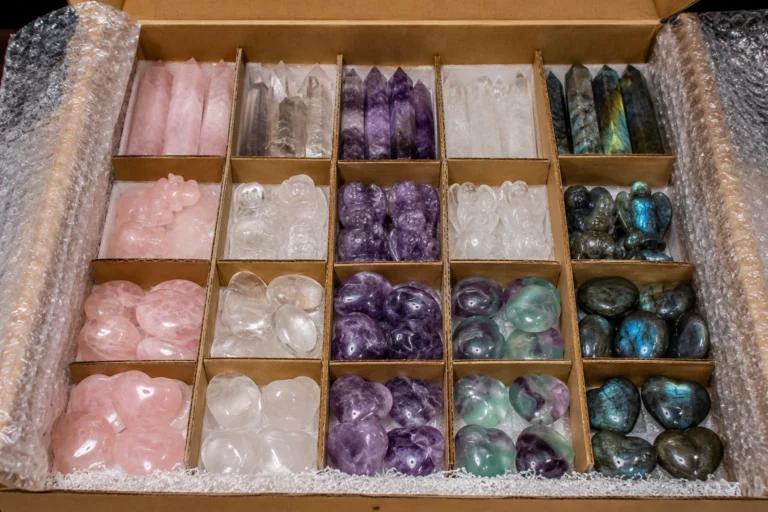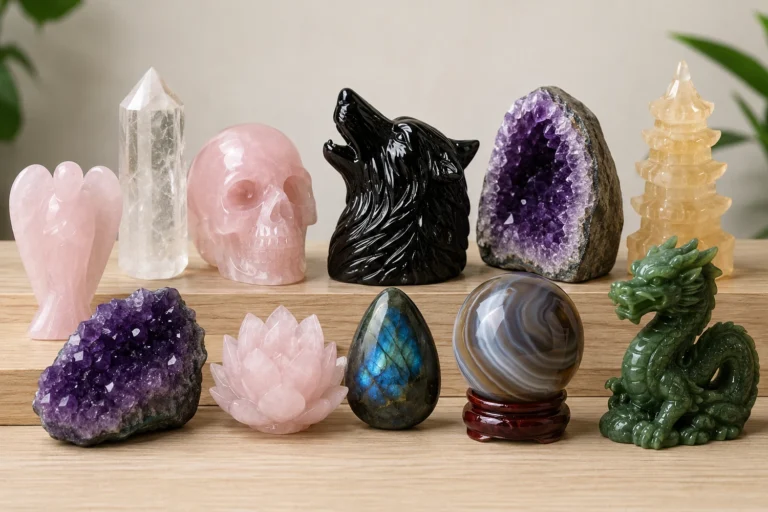
Struggling to make sense of varying quotes for wholesale crystal products? The process of how crystal carvings are made1 can seem mysterious, making it difficult to budget for new collections, understand customization limits, or know if you're paying a fair price. This lack of transparency can leave you feeling uncertain about your sourcing decisions. By understanding the complete production process, you can demystify the costs and empower yourself to source more profitably.
The production of crystal carvings is a multi-stage process that directly translates raw material and labor into the final cost. It begins with selecting and sawing raw crystal blocks, followed by pre-shaping the basic form using machines or by hand. Artisans then add intricate details using specialized tools, and the piece undergoes a final multi-step sanding and polishing process to achieve its luster. Each stage involves material waste, labor time, and tooling costs, which collectively determine the price and quality of the finished product.
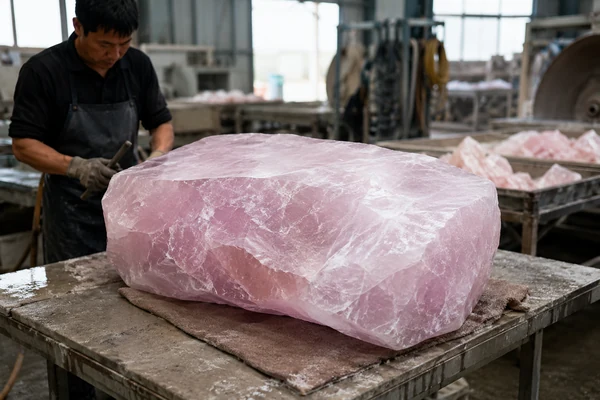
Now that you have the high-level overview, let's dive into each of these four critical stages. Understanding the details of each step—and more importantly, why they matter—is the key to evaluating quotes, setting realistic expectations for custom orders, and collaborating effectively with your wholesale supplier.
How Are Raw Crystal Blocks Prepared for Carving?
You have a vision for a perfect amethyst carving, but not all raw amethyst is created equal. Choosing the wrong grade of raw material can lead to a final product with unwanted inclusions or color inconsistencies, while unexpected material waste during cutting can inflate your costs. The process starts with careful raw material selection and sawing—the foundational step that dictates quality and cost from the very beginning.
The initial preparation involves grading raw, natural stones for their color, clarity, and internal fractures2. Once selected, these large chunks are strategically cut into smaller, manageable blocks or slabs using large, diamond-tipped saws3. This initial cutting is crucial for maximizing usable material (known as yield) and removing heavily flawed sections before any detailed work begins.
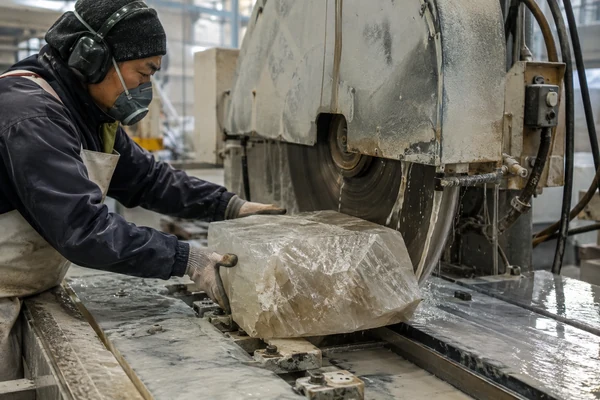
Dive Deeper: The Foundation of Price and Quality
The first two questions we address for any order are about the material: what grade is required, and how can we cut it most efficiently? The answers to these questions set the baseline cost for the entire project.
H3: The Economics of Raw Material Grading
Natural crystals are typically sorted into grades (e.g., A, B, C) based on their aesthetic qualities. For a material like rose quartz, an A-grade piece will have a deep, uniform pink color with high translucency and minimal white clouding or internal fractures. A C-grade piece might be pale, mostly opaque, and have significant inclusions.
Naturally, A-grade raw material is rarer and more expensive. When a client requests a quote for 1,000 "rose quartz hearts," my first question is always about the desired quality. A-grade hearts will have a higher unit cost simply because the raw material is more valuable. Understanding this allows you to make a strategic choice: you might opt for A-grade for a premium, high-margin product line and B-grade for more accessible, everyday items.
H3: Sawing and the Concept of Yield Rate
Sawing is more than just cutting; it's a strategic process to maximize the number of finished carvings from a single raw block. The goal is to achieve the highest possible yield rate4, which is the percentage of the raw block that ends up in the final products. Every cut turns a small amount of stone into dust—this loss, combined with cutting away unusable fractured parts, is the waste rate.
For expensive materials like high-quality labradorite or charoite, maximizing yield is paramount. In our experience, the shape of the carving itself heavily influences waste. For example, carving a 4-inch sphere from a square block inevitably leaves a lot of wasted material in the corners. In contrast, carving rectangular towers from that same block would be far more efficient. This is why a sphere might have a higher unit price than a tower of similar weight—not because it's harder to make, but because it generates more waste from the initial block.
What's the Difference Between Hand-Shaping and Machine-Assisted Shaping?
You might hear "machine-made" and think "cheap," or "hand-made" and think "premium quality," but the reality in modern crystal carving production is far more nuanced. This common misconception can lead you to dismiss efficient production methods or overpay for processes that don't add the right kind of value to your specific product. Understanding the hybrid approach—where machines do the heavy lifting and hands provide the art—is key to getting consistent quality at a fair price.
Machine-assisted shaping uses tools like grinders, lathes, or even computer-numerical-control (CNC) machines to quickly and uniformly create the basic form of a carving (e.g., a sphere, heart, or tower). Pure hand-shaping is typically reserved for unique, one-of-a-kind freeform pieces. For this reason, most wholesale crystal carvings are made using a hybrid approach that leverages machines for efficiency and consistency in the initial stages.
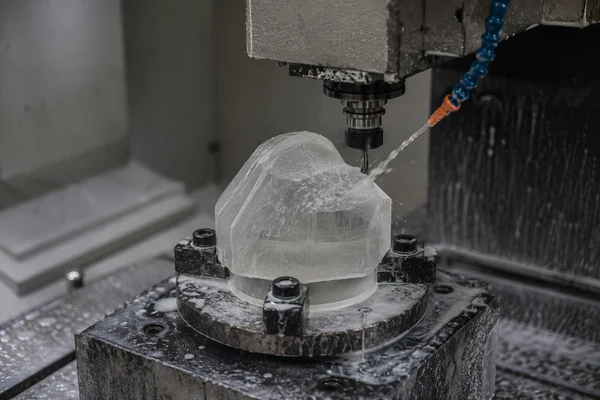
Dive Deeper: Efficiency, Consistency, and the Logic of MOQs
The choice between machine and hand shaping isn't about good versus bad; it's about applying the right tool for the job. For B2B wholesale, consistency is just as important as quality.
H3: The Role of Machines in Efficiency and Consistency
Imagine you need an order of 1,000 amethyst palm stones, all measuring 50mm. Using machines to pre-shape them is the only way to ensure they are all dimensionally consistent. A machine can be calibrated to produce the same basic shape over and over, while 1,000 purely hand-shaped pieces would all be slightly different.
Here's a simple breakdown of how the methods compare for wholesale production:
| Feature | Machine Shaping | Hand Shaping |
|---|---|---|
| Best For | Bulk orders, uniform shapes (spheres, towers, standard hearts) | One-of-a-kind freeforms, artistic pieces |
| Consistency | High | Variable |
| Speed (per unit) | Fast (after setup) | Slow |
| Setup Cost | High (molds, programming) | Low |
| Labor Cost (per unit) | Low | High |
This table shows that for bulk orders requiring uniformity, machine shaping is superior. It ensures that the product your customers see online or in your shop is the same one they receive.
H3: Why "Machine-Made" Isn't Always Cheaper (The MOQ Logic)
Here's a crucial insight for any buyer interested in custom designs. While machine shaping has a lower per-unit labor cost, it has a very high upfront setup cost. Creating a custom mold5 for a unique shape or developing a 3D model and programming it for a CNC machine can cost hundreds or even thousands of dollars.
This setup cost is the primary reason for Minimum Order Quantities (MOQs)6. A supplier isn't trying to be difficult by setting an MOQ of 500 pieces; they are doing the production math. The upfront cost must be distributed across the total number of units produced. If the mold costs $500, that adds $1 to each piece in a 500-unit order. For a 50-unit order, it would add $10 to each piece, making the price uncompetitive. MOQ isn't a sales tactic; it's a direct reflection of manufacturing economics.
How Are Intricate Details Added to Crystal Carvings Made Today?
You've sent your supplier a complex design for a custom carving, like a fairy with delicate wings or a dragon with fine scales. You're worried the factory won't be able to achieve the level of detail you envision, and the final product might look like a cheap, clumsy imitation. The detailed carving stage is where artistry meets engineering, and understanding the tools, techniques, and material limitations will tell you what's truly possible.
Intricate details are typically added using a combination of hand-held, high-speed rotary tools7 (similar to a Dremel) fitted with various diamond-coated burrs and bits. For some highly repeatable patterns or surface-level designs, laser engraving or CNC detailing may also be used. The final choice of method depends on the design's complexity, the crystal's physical properties, and the order quantity.
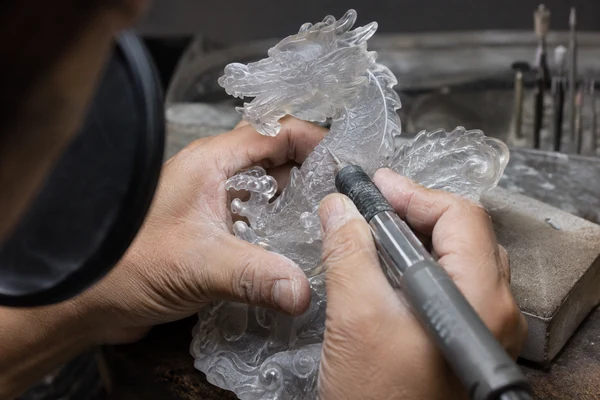
Dive Deeper: Where Art, Physics, and Labor Costs Intersect
This is the stage where labor costs can rise significantly. While pre-shaping can be heavily automated, detailed work still relies heavily on the steady hand and trained eye of a skilled artisan.
H3: The Material is the Boss: Hardness and Brittleness Matter
A design's feasibility is fundamentally constrained by the physical properties of the crystal itself. The most important factor is hardness, often measured on the Mohs scale8.
- Softer Stones: Materials like Fluorite (Mohs 4), Howlite (Mohs 3.5), or Selenite (Mohs 2) are prone to chipping, flaking, and fracturing. Carving very fine, sharp details into them is extremely difficult and risky. The breakage rate is high, so we must factor more material waste and labor time into the quote.
- Harder Stones: Materials like Quartz varieties (Amethyst, Rose Quartz, Clear Quartz) and Agate are a 7 on the Mohs scale. They can hold very fine, crisp details beautifully. However, their hardness means they are tougher to carve. It takes more time, and the diamond tools wear down faster, which also contributes to the cost.
I often have to explain to clients that a design that is perfectly viable for an agate carving may be physically impossible to execute on fluorite. This isn't a reflection of our artisans' skill, but a simple matter of physics.
H3: Hand-Detailing: The Value-Add Stage
This is where the hybrid production model truly shines. After a machine has efficiently pre-shaped 500 identical cat figures, a team of artisans takes over. Using hand-held rotary tools, they carve the eyes, whiskers, fur texture, and expressions that bring the piece to life.
This is pure, skilled labor. The more complex the details, the more hours an artisan must spend on each individual piece. When buyers ask me why two crystal animals of the same size and material have vastly different prices, the answer is almost always the number of hours spent on hand-detailing. A simple, smooth cat figure might take 15 minutes to detail, while a complex, textured dragon could take over an hour.
What Does the Final Polishing Process for Crystal Carvings Involve?
You've received product samples, and you notice some have a brilliant, gem-like gloss while others look dull or show faint scratches under light. This inconsistency in finish can severely impact the perceived value of your products and lead to negative customer feedback. The final polishing stage is what transforms a roughly shaped stone into a finished, marketable gem, and knowing the different methods is crucial for quality control.
Polishing is a multi-step process designed to smooth the carved surface until it reflects light, creating a glossy finish. It begins with sanding using progressively finer grits of abrasive paper or powder, followed by a final buff with a specialized polishing compound, often cerium or tin oxide. This entire process can be done in bulk using a machine or painstakingly by hand.
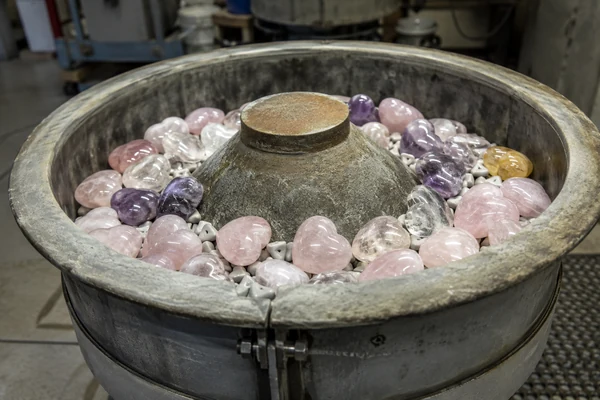
Dive Deeper: The Final Touch That Defines Quality
A poor polish can make an expertly carved, A-grade crystal look cheap. This final step is non-negotiable for creating a product that commands a good retail price. The method used depends on a trade-off between cost, efficiency, and the shape of the item.
H3: Tumbling vs. Hand-Polishing
- Vibratory Tumbling: This is the most cost-effective method for polishing large quantities of carvings with smooth, rounded surfaces. Items like palm stones, worry stones, and small spheres are placed in a large vibratory tumbler bowl along with water and abrasive media. The machine vibrates for hours or even days, tumbling the stones against the media, which gradually smooths and polishes them. It's highly efficient but has one drawback: it can slightly round off very sharp edges or delicate details.
- Hand-Polishing: This labor-intensive method is reserved for high-value items, carvings with intricate details that would be damaged in a tumbler, or pieces with large, flat surfaces that require a perfect, distortion-free sheen (like an obsidian scrying mirror). An artisan uses polishing wheels, buffing pads, and polishing compounds to carefully work on each piece individually. This delivers the highest possible quality finish but adds significant labor cost.
H3: The Importance of Progressive Grits
You cannot achieve a mirror shine in a single step. Polishing is a process of refinement. A carved piece is first sanded to remove the deeper scratches left by the carving tools, typically starting with a coarse grit (e.g., 220). It is then sanded again and again with progressively finer grits (e.g., 400, 600, 1200, 3000). Each step removes the scratches from the previous one, creating a smoother and smoother surface.
Skipping grits to save time is a common shortcut in low-quality production. When I inspect a finished batch for a client, one of the first things I do is examine a piece under a bright, direct light. If I can see a web of fine, swirling micro-scratches beneath the glossy surface, it's a clear sign that the polishing process was rushed.
Frequently Asked Questions
How does the type of crystal affect the carving price?
The crystal type impacts price in three ways: rarity (rare materials cost more), grade (A-grade, high-quality material is more expensive than B- or C-grade), and hardness. Harder stones (like quartz) take more time and tool wear to carve, while softer stones (like fluorite) have a higher breakage rate, both of which increase production costs.
Why do custom crystal carvings have a Minimum Order Quantity (MOQ)?
MOQs exist to cover the high upfront setup costs of custom production. Creating a new 3D model, programming a CNC machine, or making a new physical mold costs money. This fixed cost is spread across all the units in an order, so a larger order (like 500 pieces) makes the per-unit setup cost affordable.
Can you replicate a design exactly across hundreds of pieces?
We can replicate the size, shape, and carving details with very high consistency using machine-assisted shaping9 and skilled artisans. However, because we use natural stone10, the internal patterns, color depth, and inclusions will vary slightly from piece to piece. This ensures every single carving remains unique, which is part of the appeal of natural crystals.
What's the difference between a crystal carving and a crystal sculpture?
While the terms are sometimes used interchangeably, in the wholesale industry "carving" usually refers to smaller, often standardized or repeatable decorative items like animals, hearts, or spheres. "Sculpture" typically implies larger, more complex, and often one-of-a-kind artistic pieces that are primarily shaped by hand.
Conclusion
Understanding how crystal carvings are made is more than just satisfying a curiosity; it's a powerful business tool. The journey from a raw stone to a polished product—through grading, sawing, shaping, detailing, and polishing—is a story of cost at every step. Each stage adds value through labor, consumes material through waste, and requires specific tooling.
Knowing this process empowers you to have more effective conversations with suppliers. You can better evaluate quotes, set realistic expectations for your custom designs, and appreciate the fine balance between material properties, labor costs, and production technology. This knowledge ultimately allows you to make more informed, profitable sourcing decisions and build a crystal collection that stands out for its quality and value.
If you are looking for a reliable wholesale partner who provides this level of transparency and expertise, please feel free to reach out to us at Crystal Carvings Wholesale. We are here to help you navigate the production process and bring your product vision to life. You can contact us via WhatsApp at +86 150 7540 9178 or email us at sales@crystalcarvingswholesale.com.
<!--[googlesitekit-end-of-content]-->
"How to Choose a Crystal Carving Manufacturer in China", https://crystalcarvingswholesale.com/how-to-choose-a-crystal-carving-manufacturer-in-china/. Educational resources on gemstone and crystal carving processes confirm that production involves raw material selection, shaping, detailing, and polishing, each contributing to the final cost. However, specific cost breakdowns may vary by region and manufacturer. Evidence role: general_support; source type: education. Supports: The multi-stage process of crystal carving production and its influence on cost.. Scope note: Cost implications may differ based on local labor rates and material availability. ↩
"How to Choose a Crystal Carving Manufacturer in China", https://crystalcarvingswholesale.com/how-to-choose-a-crystal-carving-manufacturer-in-china/. Research on gemstone grading practices indicates that color, clarity, and structural integrity are key factors in determining the suitability of stones for carving. These criteria are widely used in the industry. Evidence role: mechanism; source type: research. Supports: The process of grading natural stones based on color, clarity, and internal fractures.. Scope note: Specific grading standards may vary by material type and intended use. ↩
"Diamond blade", https://en.wikipedia.org/wiki/Diamond_blade. Studies on gemstone cutting tools confirm that diamond-tipped saws are commonly used for their ability to cut hard materials like quartz efficiently. However, their cost and maintenance requirements can impact production economics. Evidence role: mechanism; source type: research. Supports: The use of diamond-tipped saws for cutting raw crystal blocks.. Scope note: The efficiency of diamond-tipped saws may vary depending on the hardness of the material being cut. ↩
"Colored Gemstone Value Factors", https://www.gia.edu/gia-news-research/value-factors-design-cut-quality-colored-gemstone-value-factors. Educational materials on gemstone manufacturing explain that yield rate measures the efficiency of material usage, directly impacting production costs and waste management. Evidence role: definition; source type: education. Supports: The definition and importance of yield rate in crystal carving production.. Scope note: Yield rates can vary significantly depending on the shape and size of the final product. ↩
"Personalized Crystal Keepsake Ideas for a Baby's ... - Crystal Carvings", https://crystalcarvingswholesale.com/personalized-crystal-keepsake-ideas-for-a-babys-first-christmas/. Industry research on manufacturing costs indicates that custom mold creation and CNC programming can range from hundreds to thousands of dollars, depending on complexity and material requirements. Evidence role: statistic; source type: research. Supports: The cost range for creating custom molds and CNC programming in crystal carving production.. Scope note: Costs may vary significantly based on regional labor rates and technological capabilities. ↩
"Raw Material Minimum Order Quantity Optimization", https://dspace.mit.edu/bitstream/handle/1721.1/121302/1240293813-MIT.pdf?sequence=1. Educational resources on manufacturing economics explain that MOQs help distribute setup costs, such as mold creation and programming, across larger orders, making production economically viable. Evidence role: general_support; source type: education. Supports: The rationale behind Minimum Order Quantities in custom crystal carving production.. Scope note: MOQ thresholds may vary depending on the complexity of the design and production methods. ↩
"Shop Gemstone Carving Tools & Accessories at SUVA ...", https://suvalapidary.com/collections/gemstone-carving-accessories. Research on gemstone carving techniques confirms that rotary tools equipped with diamond-coated burrs are commonly used for detailed work due to their precision and adaptability. Evidence role: mechanism; source type: research. Supports: The use of rotary tools with diamond-coated burrs for adding intricate details to crystal carvings.. Scope note: The effectiveness of rotary tools may vary depending on the hardness and brittleness of the material. ↩
"Hardstone carving", https://en.wikipedia.org/wiki/Hardstone_carving. Encyclopedic entries on the Mohs scale confirm its widespread use in assessing mineral hardness, which directly affects carving difficulty and tool wear. Evidence role: definition; source type: encyclopedia. Supports: The use of the Mohs scale to measure hardness and its impact on carving feasibility.. Scope note: The Mohs scale does not account for other factors like brittleness or fracture patterns. ↩
"Quartz crystal hourglass carving experiment", https://www.facebook.com/groups/LapidaryGroup/posts/9369888076464123/. Research on modern gemstone carving techniques highlights the role of CNC machines and other tools in achieving uniformity and efficiency in bulk production. These methods are particularly useful for standardized shapes. Evidence role: mechanism; source type: research. Supports: The use of machine-assisted shaping tools like CNC machines in crystal carving.. Scope note: Machine-assisted shaping may not be suitable for highly intricate or artistic designs. ↩
"5 Stunning Truths About Natural Stone Color Variation", https://stone-mart.com/the-truth-natural-stone-color-variation/. Encyclopedic entries on natural stone properties confirm that variations in patterns, color, and inclusions are common due to geological formation processes. Evidence role: general_support; source type: encyclopedia. Supports: The inherent variability in natural stone patterns, color depth, and inclusions.. Scope note: The degree of variability may depend on the specific type of stone and its source. ↩
Keep Reading