
Sourcing crystals for your business is exciting, but it can also be nerve-wracking. You’ve spent hours choosing products and a supplier, but a nagging fear remains: what if the products that arrive are nothing like the beautiful photos you saw? This anxiety over receiving unsellable inventory is a major risk. A thorough pre-shipment inspection process is the key to protecting your investment and ensuring your wholesale crystal shipment aligns perfectly with your commercial expectations.
The primary goal of a pre-shipment inspection is to collaboratively verify that the finished goods meet your order's commercial requirements for quantity, material, dimensions, and overall quality. It's a final confirmation between you and your supplier to manage risk and ensure the products are sellable for your specific market before they are packed and dispatched.

A simple checklist, however, doesn't tell the whole story. The real value comes from understanding why discrepancies can happen and how a transparent supplier partnership helps you navigate the natural characteristics of these beautiful products. Let's dive deeper into what a truly effective inspection process looks like.
Why Do Crystal Shipments Sometimes Differ from Expectations?
You found a supplier with stunning product photos, but you've heard horror stories from other business owners about receiving goods that look completely different. This is a common fear, and it's rooted in a few understandable realities of the crystal industry. Why does this "expectation vs. reality" gap happen?
Discrepancies often arise not from bad intentions, but from the natural uniqueness of stones1, differences in photography lighting and screen color2, legitimate batch-to-batch variations in raw materials3, and—most commonly—mismatched definitions of quality grades.
The Beauty of Natural Variation
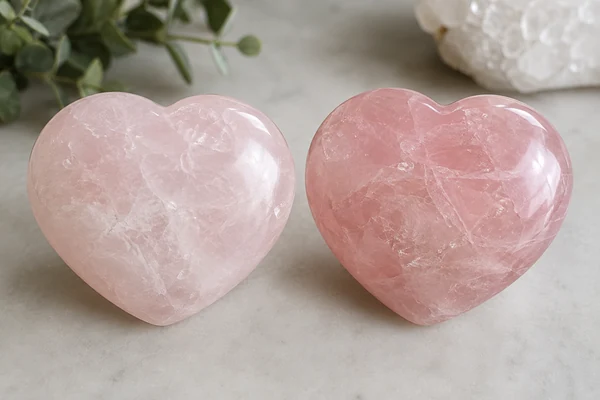
The first and most important thing to remember is that we are dealing with natural products formed in the earth over millennia. Unlike factory-made plastic or glass, no two crystals are identical. Each piece will have its own unique color saturation, pattern, clarity, and internal features.
A client once expressed concern about a dark spot within an amethyst tower from their order. We were able to clarify that it wasn't a flaw, but a natural goethite inclusion—a feature that many experienced collectors actually seek out for its unique character. What one person sees as an "imperfection," another sees as a mark of authenticity.
A good supplier helps you understand these nuances. The goal isn't to eliminate variation, but to ensure the variations fall within an acceptable, and sellable, range.
The "Digital vs. Reality" Gap
We've all experienced this when shopping online for clothes—the color just isn't the same when it arrives. The same is true for crystals, but amplified. The appearance of a crystal can change dramatically based on:
- Lighting: Professional studio lighting used for product photos is very different from the lighting in your office, warehouse, or retail store. A stone like labradorite, for example, can look dull and grey in one light and explode with color when the light hits it at the right angle.
- Screen Calibration: The colors you see on your monitor or phone are not the same as what I see on mine. A vibrant pink on an iPhone might look more muted on a PC monitor.
- Photography: The angle, focus, and even the background can influence how a crystal is perceived.
This is why relying solely on a single, perfect product photo for a bulk order is risky. You need to see the reality of the batch.
Understanding Batch-to-Batch Differences
A supplier doesn't have an infinite supply of the exact same raw stone. They buy large blocks or lots of raw material from mines. A block of rose quartz mined in March may have a deeper, richer pink color than a block from the same mine that was extracted in September.
This means that even if your sample from six months ago was a certain shade, the new production batch might be slightly lighter or darker. This is not a "bait and switch." It's a normal part of the manufacturing process for natural goods. A transparent supplier will be upfront about this and communicate any significant differences in the raw material they are using for your current order.
The Problem with Vague Quality Grades
This is perhaps the biggest source of disputes in the industry. What does "A-Grade" or "AA-Grade" actually mean? The honest answer is: it means whatever the seller decides it means. There is no universal, internationally recognized grading standard4 for most carved crystals.
One supplier's "A-Grade" might be another's "B-Grade." One might grade based on color, another on clarity, and a third on the absence of surface blemishes. Without a clear, visual definition, these grades are meaningless. This is why you must move beyond vague labels and insist on seeing what the quality looks like for your specific batch.
What Should a Supplier's Internal Quality Control Process Look Like?
You shouldn't be the only one responsible for checking quality. Your supplier is your partner and should be your first line of defense against defects. So what does a reliable supplier do to ensure quality before the order is even presented to you for final approval?
A trustworthy supplier has a multi-stage internal Quality Control (QC) process5 that runs throughout production. This typically includes inspecting raw materials upon arrival, checking for errors during the carving and polishing stages, and performing a final comprehensive review before classifying the batch as ready for client inspection.
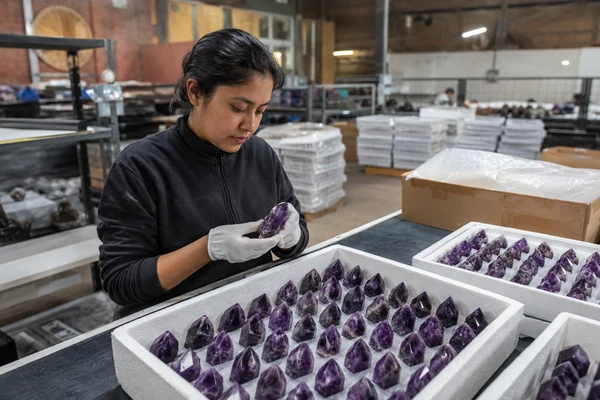
At Crystal Carvings Wholesale, we see ourselves as your eyes and ears at the factory. Our clients trust us to manage quality on their behalf, and that trust is built on a rigorous internal process. If we wait for the client to find a problem, we have already failed. Here’s a breakdown of what that process looks like.
H3: Raw Material Inspection
Quality starts with the source. Before a single piece is carved, our team inspects the incoming raw stone blocks and slabs. We are looking for major issues that would make the material unsuitable for the intended product. This includes:
- Structural Instability: Large, deep cracks or fissures that could cause the finished product to break during carving or shipping.
- Undesirable Material: For example, if an order is for deep purple amethyst, we will reject raw stones that are mostly white quartz with only a hint of purple.
- Incorrect Material: Ensuring the raw stone is genuine and matches the order (e.g., verifying it's true fluorite, not colored glass).
Catching issues at this stage saves enormous time and resources and is the first step in ensuring the final batch is consistent.
H3: In-Process Checks
As the raw stone moves through production, our artisans and supervisors conduct ongoing checks. A product may be handled by several different craftspeople for cutting, shaping, carving, and polishing. At each step, we look for:
- Shaping & Dimension Errors: Is the heart shape symmetrical? Is the tower the correct height? Is the sphere perfectly round?
- Surface Damage: Has the piece been accidentally chipped or scratched during handling?
- Polish Quality: Is the surface smooth and glossy, or are there dull spots and rough patches?
This continuous feedback loop allows us to correct errors early and maintain a consistent standard throughout the production run.
H3: Final Internal Review: Variation vs. Defect
This is the most critical internal step. Once the full order is finished, but before we contact you, our dedicated QC team performs a final review of the entire batch. They compare the finished goods against your order specifications, reference samples, and our shared quality standards.
This is where we distinguish between an acceptable natural variation and an actual defect6. Our team uses a clear framework:
| Feature | Acceptable Variation | Defect (Rejected Internally) |
|---|---|---|
| Color | Lighter or darker shade within the stone's known natural range. | Wrong material or color entirely (e.g., green aventurine instead of rose quartz). |
| Inclusions | Natural internal features like veils, rainbows, mineral spots (e.g., goethite in amethyst). | Large, structurally compromising cracks that reach the surface. |
| Shape | Minor asymmetry or dimensional variance (e.g., +/- 2mm) due to hand-crafting. | Wrong shape, or dimensions that fall far outside the agreed-upon tolerance. |
| Surface | Tiny, barely visible surface pitting that is a natural part of the stone. | Obvious chips, deep scratches, or large unpolished sections. |
Any piece that falls into the "Defect" column is pulled from your order and replaced. Only the products that pass this rigorous internal inspection are then prepared for your final review.
How Can You Verify Your Wholesale Crystal Shipment Before It Leaves the Factory?
Even with a supplier who has a strong internal QC process, you need that final peace of mind. But you can't fly to the factory for every order. So how can you get ironclad confirmation that the right products are in the box before it's sealed and shipped?
The single most effective and modern solution is a collaborative pre-shipment confirmation process7. This is where your supplier provides high-resolution photos and detailed videos of your actual, finished order for your personal review and approval before anything is packed.
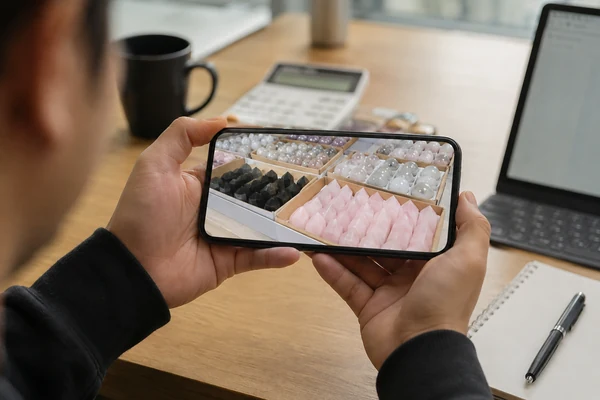
This step is non-negotiable for us and should be for you, too. It transforms the relationship from a simple transaction into a true partnership built on transparency. Here’s how you can make the most of this crucial process.
H3: The Power of Pre-Shipment Photos and Videos
When we tell a new client we’re ready for their pre-shipment inspection, here is what they receive from us via WhatsApp or email:
- Batch Overview Photos: We lay out the entire order on a large table or on the floor. This allows you to see the overall consistency of the batch in terms of color, size, and shape.
- Detailed Walk-Through Videos: We take a video where we slowly pan across all the products, often picking up individual pieces to show them from all angles. For stones like labradorite or moonstone, we move them in the light to show you the flash.
- Close-Up Shots: We take photos of a few random pieces up close so you can inspect the polish quality and surface details.
- Scale & Quantity Confirmation: We often include a ruler or our hand in the shots to give you an undeniable sense of scale. We will also show you the products grouped and counted, or even the sealed inner cartons, to confirm the quantity is correct.
H3: What to Look for in These Visuals
Reviewing these visuals is your final chance to raise questions. Look for:
- Overall Consistency: Does the batch, as a whole, meet the expectation set by the samples and your order? Don't fixate on one slightly lighter piece; look at the collective impression.
- Red Flags: Do you see any obvious damage, incorrect shapes, or the wrong materials mixed in? This is your chance to point it out.
- Match to Order: Pull up your purchase order. Are you seeing 100 amethyst towers and 200 rose quartz hearts, as requested? Do the sizes look right?
H3: Transforming the Transaction into a Partnership
This process is fundamentally about communication and trust. Recently, a client who runs a popular Etsy shop was preparing for her first big wholesale crystal shipment with us. She was concerned about the color variation in a batch of fluorite palm stones she saw in the pre-shipment photos.
Instead of just telling her "it's normal," we sent her a new video. We took five pieces from across the color spectrum of the batch—from deep purple to light green—and showed them side-by-side. We explained that this range is what makes fluorite so popular and that offering this variety would appeal to more customers. Seeing the pieces together and understanding the context gave her the confidence to approve the shipment. She later reported that the fluorite palm stones were one of her bestsellers.
This is the power of a transparent process. It allows for a dialogue to happen before the goods are 10,000 miles away, turning a moment of anxiety into an opportunity for collaboration and business growth.
Frequently Asked Questions
What's the difference between a natural inclusion and a crack?
A natural inclusion is an internal feature that was formed with the crystal, such as mineral deposits, veils, or phantoms. A crack is typically surface-reaching damage that occurred after formation. A good supplier can help clarify this in pre-shipment videos by showing how light reflects off the surface.
Can I request only "A-Grade" crystals?
Yes, but it is crucial to first define what "A-Grade" means to you and your supplier. The best practice is to use photos or a physical sample as a benchmark. Requesting "A-Grade" without a shared visual definition is a common source of misunderstanding.
What happens if I find an issue during the pre-shipment video inspection?
This is the exact reason for the inspection! A transparent supplier will welcome your questions. If you spot a piece with obvious damage that was missed by their internal QC, they should be willing to replace it. If it's a question of natural variation, it opens a dialogue to ensure you are comfortable with the batch.
Is it expensive to have this pre-shipment inspection?
For our clients, this comprehensive photo and video confirmation is a standard part of our service and comes at no extra charge. We believe it is an essential part of our responsibility as a supplier. It prevents much more expensive problems, like returns or unsellable inventory, down the line.
Conclusion
The inspection of your crystals before they leave the factory is not about a hunt for theoretical perfection. It's a critical business process for managing commercial risk. The goal is to move beyond the fear of the unknown by establishing a partnership with a supplier who prioritizes transparency. By focusing on clear communication, understanding the nature of the products, and leveraging modern tools like pre-shipment videos, you can eliminate surprises. A successful wholesale crystal shipment isn't just one that arrives safely; it's one that arrives as expected, ready to delight your customers and grow your business.
Ready to source crystals with the confidence that comes from total transparency? Contact us at Crystal Carvings Wholesale. We provide clear, pre-shipment photo and video approvals for every single order. Reach out via WhatsApp (+86 150 7540 9178) or email (sales@crystalcarvingswholesale.com) to discuss your next collection.
<!--[googlesitekit-end-of-content]-->
"Gemstone", https://en.wikipedia.org/wiki/Gemstone. According to geological studies, natural stones exhibit inherent variations in color, pattern, and clarity due to their formation processes, which can affect their appearance in commercial applications. Evidence role: general_support; source type: encyclopedia. Supports: Natural variation in stones can lead to differences in appearance and quality in crystal shipments.. Scope note: The source may not address specific discrepancies in wholesale shipments. ↩
"Carnelian Crystal Carvings: Color, Quality and Wholesale Buying Tips", https://crystalcarvingswholesale.com/carnelian-crystal-carvings-color-quality-and-wholesale-buying-tips/. Research on visual perception confirms that lighting conditions and screen calibration can alter the perceived color and texture of objects, including crystals. Evidence role: mechanism; source type: research. Supports: Lighting and screen calibration significantly influence the perceived appearance of crystals in photographs.. Scope note: The study may focus on general objects rather than crystals specifically. ↩
"Turquoise Carvings: Natural vs Stabilized Material and Buying ...", https://crystalcarvingswholesale.com/turquoise-carvings-natural-vs-stabilized-material-and-buying-guide/. Educational resources on geology explain that variations in mineral composition and extraction conditions can lead to differences in raw material batches. Evidence role: general_support; source type: education. Supports: Batch-to-batch variations in raw materials are common in the mining and processing of natural stones.. Scope note: The source may not address specific implications for wholesale shipments. ↩
"Smoky Quartz Carvings: Color Grades, Quality ... - Crystal Carvings", https://crystalcarvingswholesale.com/smoky-quartz-carvings-color-grades-quality-and-wholesale-guide/. Gemological institutions confirm that grading standards for carved crystals vary widely and are often subjective, depending on the supplier. Evidence role: expert_consensus; source type: institution. Supports: The absence of universal grading standards for carved crystals is acknowledged by industry experts.. Scope note: The source may focus on gemstones rather than carved crystals specifically. ↩
"An Introduction to Gem Treatments", https://www.gia.edu/gem-treatment. Studies on manufacturing processes highlight the importance of multi-stage quality control to ensure consistency and reduce defects in natural stone products. Evidence role: mechanism; source type: research. Supports: Multi-stage QC processes are standard practices in the production of natural stone products.. Scope note: The source may not specifically address carved crystals. ↩
"Colored Gemstone Value Factors", https://www.gia.edu/gia-news-research/value-factors-design-cut-quality-colored-gemstone-value-factors. Educational resources on quality control explain that acceptable variations are inherent to natural stones, while defects are structural or aesthetic issues that compromise the product. Evidence role: general_support; source type: education. Supports: Distinguishing between natural variations and defects is a standard practice in quality control for natural stone products.. Scope note: The source may not specifically address carved crystals. ↩
"Preshipment Inspection | United States Trade Representative", https://ustr.gov/trade-agreements/wto-multilateral-affairs/wto-issues/customs-issues/preshipment-inspection. Trade institutions recommend pre-shipment inspections as a best practice for managing quality and reducing disputes in wholesale transactions. Evidence role: case_reference; source type: institution. Supports: Pre-shipment confirmation processes are widely used in the gemstone and crystal trade to ensure quality and accuracy.. Scope note: The source may focus on general trade practices rather than crystals specifically. ↩