Struggling with inconsistent smoky quartz quality from suppliers? Vague terms like 'AAA' lead to costly mistakes.1 The key isn't chasing grades, but creating a clear, business-focused purchase specification.
The best way to "grade" smoky quartz for wholesale is to ignore seller-specific marketing terms like 'AAA' or 'Premium'. Instead, define your quality requirements using five concrete factors: 1) Color Range, 2) Clarity, 3) Structural Condition, 4) Workmanship, and 5) Batch Consistency. This creates a clear standard for your supplier.
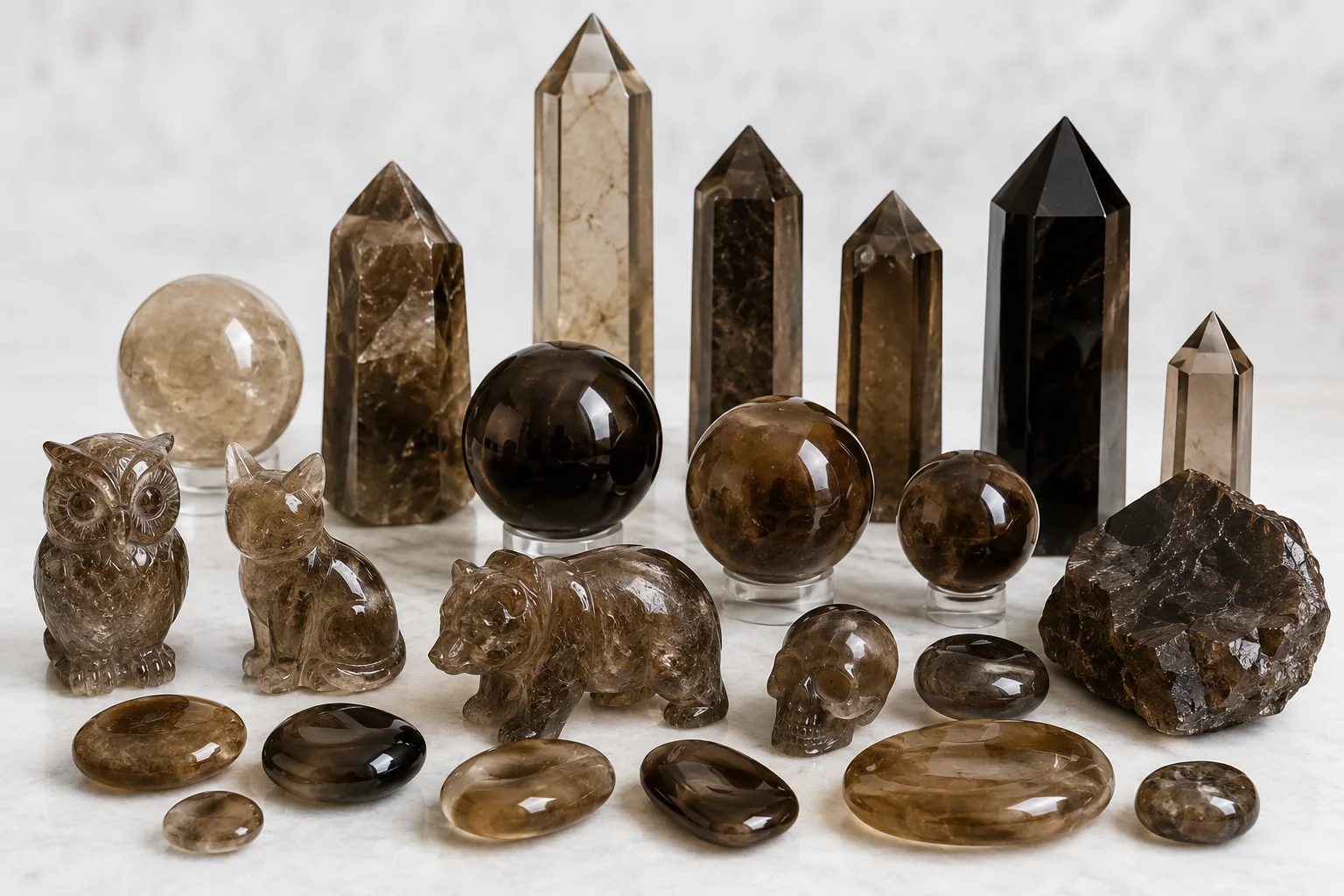
As a supplier, I see many buyers get frustrated. They approve a beautiful sample, only to receive a bulk order that looks completely different. They focus on a single photo, not realizing that color and quality can vary hugely within the same batch. This article is based on my experience helping overseas buyers move past this confusion. We will break down how to evaluate smoky quartz carvings not as a geologist, but as a business owner. The goal is to help you source a consistent, sellable product that your customers will love, and to do it without guesswork. Let's build a reliable sourcing process together.
What Are the Real Commercial Color Ranges for Smoky Quartz?
Confused by marketing names like "Morion" or "Premium Dark"? These terms are not standardized and can be misleading. You order "dark" and receive nearly black, opaque material that hides flaws.
Instead of relying on a seller's subjective terms, we classify smoky quartz by its light transmission. This practical method uses four categories: Light, Medium, Deep, and Near-Black. This helps you define an acceptable color range for your specific product and market, ensuring you get what you expect.
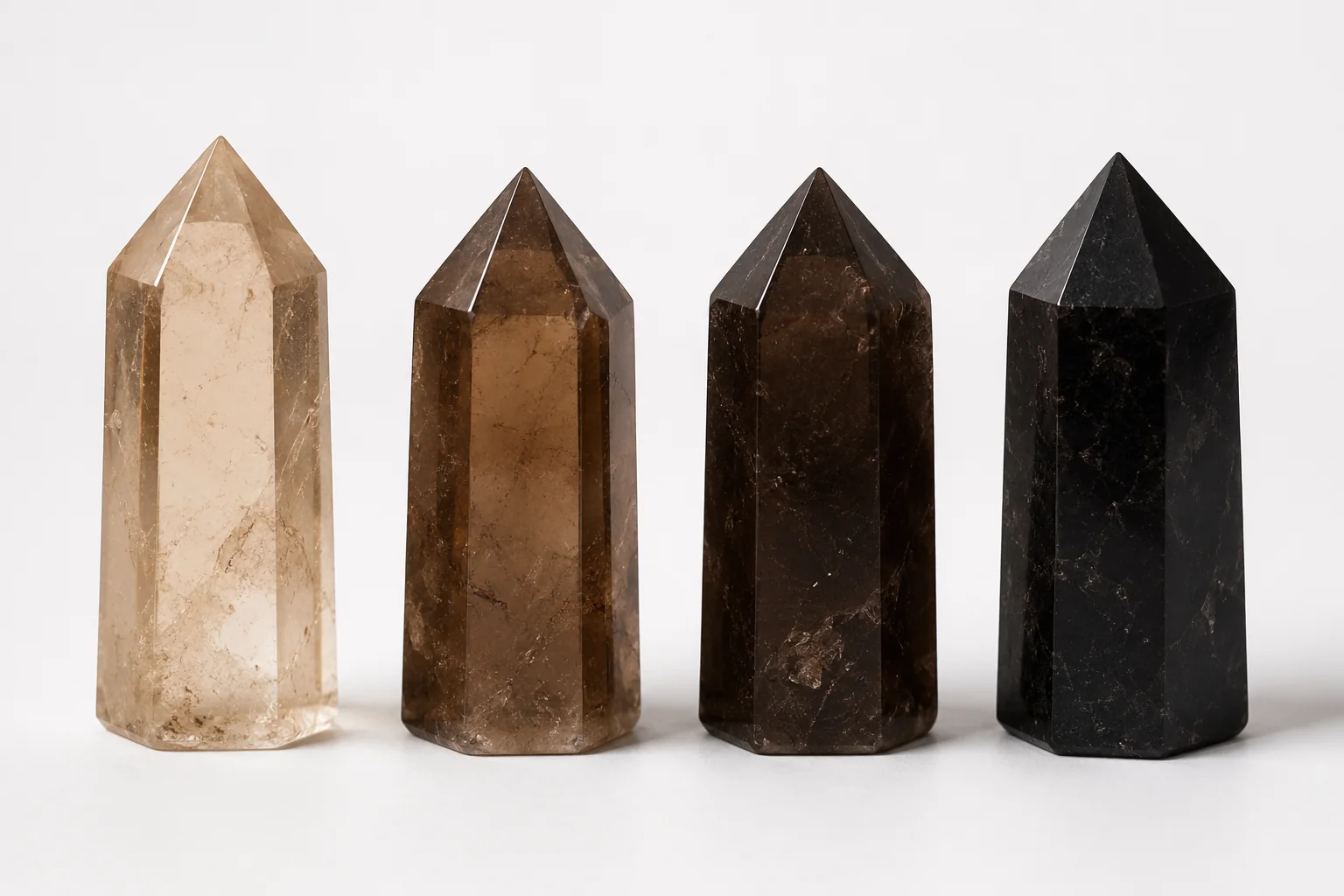
When we discuss color with a buyer, we don't use fancy names. We use practical terms that describe how the crystal interacts with light. This is what truly matters for a finished product's appearance and commercial value. A dark color is not automatically better; in fact, extremely dark, nearly opaque material can easily hide polishing scratches, chips, or even significant internal fractures. The key is to find the right balance of color and transparency for your product line. For example, a lighter, more transparent smoky quartz is often preferred for items like palm stones or jewelry, where customers want to see the inner world of the crystal. Darker, richer tones might be perfect for statement decor pieces like large spheres or skulls.
Here is a simple table we use to help buyers specify their needs:
| Commercial Color Range | Description | Best For |
|---|---|---|
| Light | Pale, champagne to light tea color. Highly transparent. | Faceted jewelry, small carvings, products where high clarity is the main feature. |
| Medium | Classic smoky brown. Good transparency and rich color. | All-purpose use: points, palm stones, hearts, spheres. This is the most common range. |
| Deep | Rich, dark chocolate or coffee brown. Still has some light passing through. | Larger statement pieces like towers, freeforms, and skulls where a bold look is desired. |
| Near-Black (Morion) | Almost completely opaque. Light only passes through the thinnest edges. | Specific decorative items where a solid black-brown look is intended. Use with caution. |
The goal isn't to pick one perfect color, but to define an acceptable range for your supplier. For instance, you might specify "Medium to Deep" for your crystal towers. This gives the supplier clear guidance while allowing for natural material variation.
How Do You Evaluate Smoky Quartz Carving Quality Beyond Just Color?
You found a carving with the perfect dark color. But when it arrives, you discover it's poorly polished or has a crack near the tip. A great color cannot make up for poor overall quality.
To avoid this, you must evaluate smoky quartz carvings using a 5-factor system. True quality is a balance of 1) Color Suitability, 2) Clarity & Light Transmission, 3) Structural Condition, 4) Carving & Polishing Workmanship, and 5) Batch Consistency. This holistic view ensures you get a beautiful and durable product.
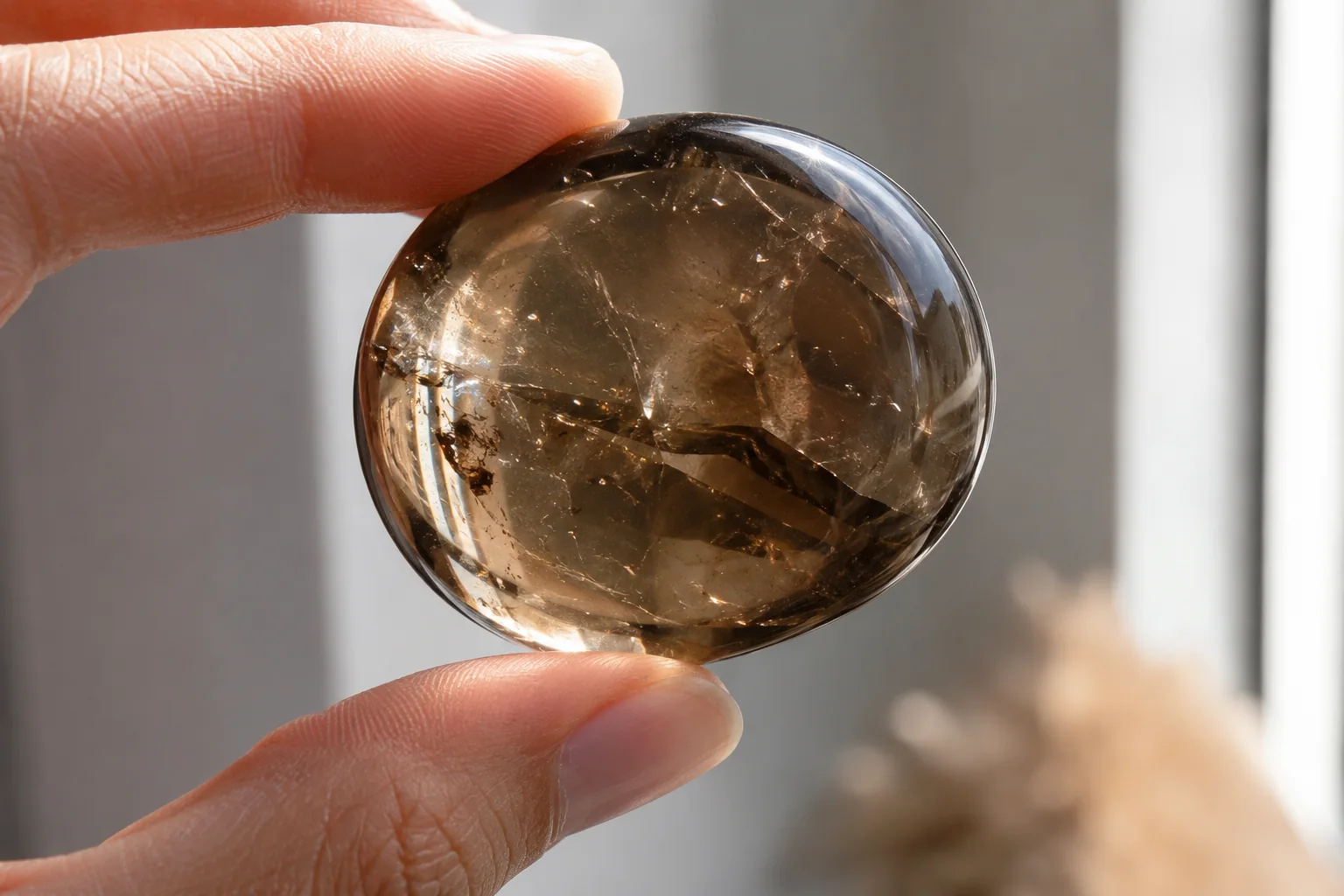
During our own internal quality checks, color is only the first step. A carving has to pass inspection on all five points before it's approved for an order. From a supplier's perspective, a product that fails on any of these points is a potential problem for our customers. For example, a beautifully colored tower with a chipped tip is a defective product. A batch of hearts with inconsistent shapes and sizes is a headache for a retailer.2 We break down the quality assessment into these key areas to ensure the final product is commercially viable for you.
1. Color Suitability
This isn't about "good" or "bad" color, but the right color for your target market and product type. A US-based crystal shop might find that Medium, classic smoky tones sell best, while a European home decor brand may prefer Deep, dramatic pieces. Define what works for your business.
2. Clarity & Light Transmission
Clarity refers to the presence of internal features. It's important to distinguish between acceptable and unacceptable characteristics.
- Acceptable: Natural veils, wispy inclusions, and phantoms that add character.3
- Unacceptable: Large, dark mineral deposits or cloudy patches that block all light and make the piece look "muddy."
3. Structural Condition
This is about durability. A piece must be stable and free of flaws that could cause it to break. We look for:
- Surface-Reaching Fractures: These are the biggest red flag. If you can feel a crack with your fingernail, it compromises the carving's strength, especially on points or thin parts.
- Deep Internal Fractures: While not on the surface, large internal cracks can look like damage and may be weak points.
4. Carving & Polishing Workmanship
This is where skilled labor shows. For a tower, we check for sharp, symmetrical points and even faces. For a sphere, it must be perfectly round with no flat spots. The polish should be a consistent, high-gloss "wet look" across all surfaces. Dull patches or visible scratches are signs of rushed work.
5. Batch Consistency
For wholesale, this is critical. If you order 100 hearts, they need to be reasonably consistent in size, shape, color range, and overall quality. A single perfect sample is meaningless if the bulk production doesn't match. We manage this by defining tolerances with the buyer beforehand.
Are My Smoky Quartz Carvings Natural or Treated?
You see a very dark, uniform smoky quartz and worry it might be artificially irradiated. This uncertainty is frustrating, especially when you can't tell for sure just from a supplier's photo.
Stop guessing. You cannot reliably identify irradiated smoky quartz by sight alone.4 The only effective strategy for a buyer is to require written disclosure from your supplier. Ask them directly to confirm the material's origin and state whether it has been artificially treated. A trustworthy partner will be transparent.
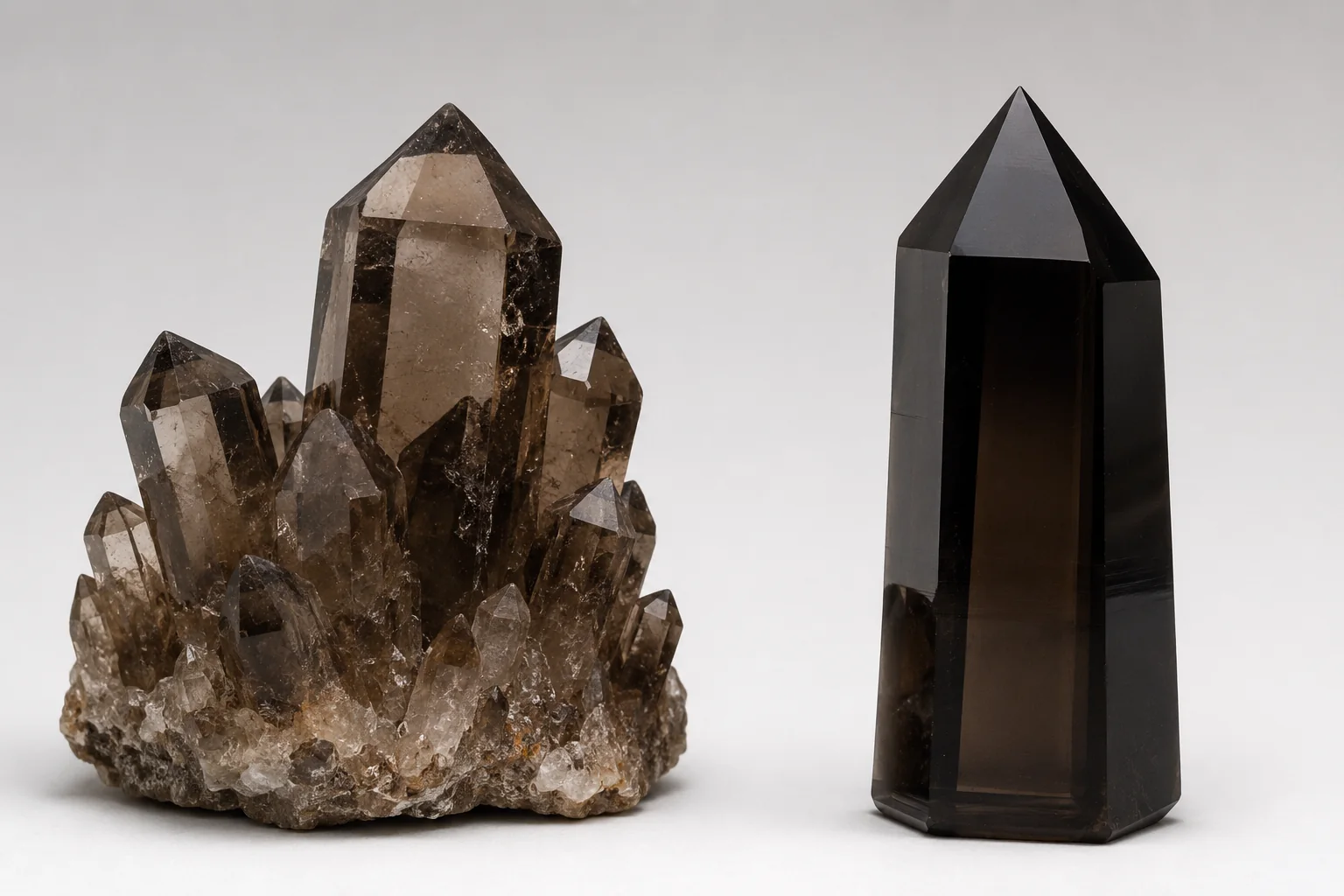
Let's be clear: both natural and treated smoky quartz are common in the market. Natural smoky quartz gets its color from natural gamma radiation from surrounding minerals over millions of years.5 Artificial irradiation is a lab process that uses a concentrated source to turn pale or clear quartz into smoky quartz, speeding up the process.6 Some irradiated material has a very dense, uniform, near-black color, often with a grayish base, but this is not a foolproof indicator. Natural smoky quartz can also be very dark.7
As a sourcing specialist, my expertise is in supply chain transparency, not gemological identification. Therefore, I advise my clients not to try and become experts at spotting treatment. It's not a reliable business strategy. Your time is better spent on vetting your suppliers.8 A good supplier should know their materials and be willing to stand behind their claims in writing.
Here's how to approach it:
- Ask Direct Questions: When placing an order, include this in your communication: "Can you please confirm in writing that this batch of smoky quartz is of natural color and has not been artificially irradiated?"
- Ask About Origin: Knowing the origin can sometimes provide clues, but it's not a guarantee. Ask, "What is the origin of this raw smoky quartz material?"
- Focus on the Partnership: A supplier who avoids these questions or gives vague answers is a red flag. The goal is to build a relationship based on trust and clear communication. Your business reputation depends on the claims you make to your own customers, so make sure those claims are backed by your supplier.
What Are the Most Common Wholesale Sourcing Mistakes to Avoid?
You're ready to place a bulk order, but past experiences have made you cautious. Small mistakes in wholesale sourcing can lead to big losses, wasted time, and inventory you can't sell.
The most frequent errors we see are trusting vague "AAA" grades, approving an order from a single perfect sample photo, and not providing a detailed purchase specification. These mistakes stem from a lack of a clear, documented quality standard between the buyer and supplier.
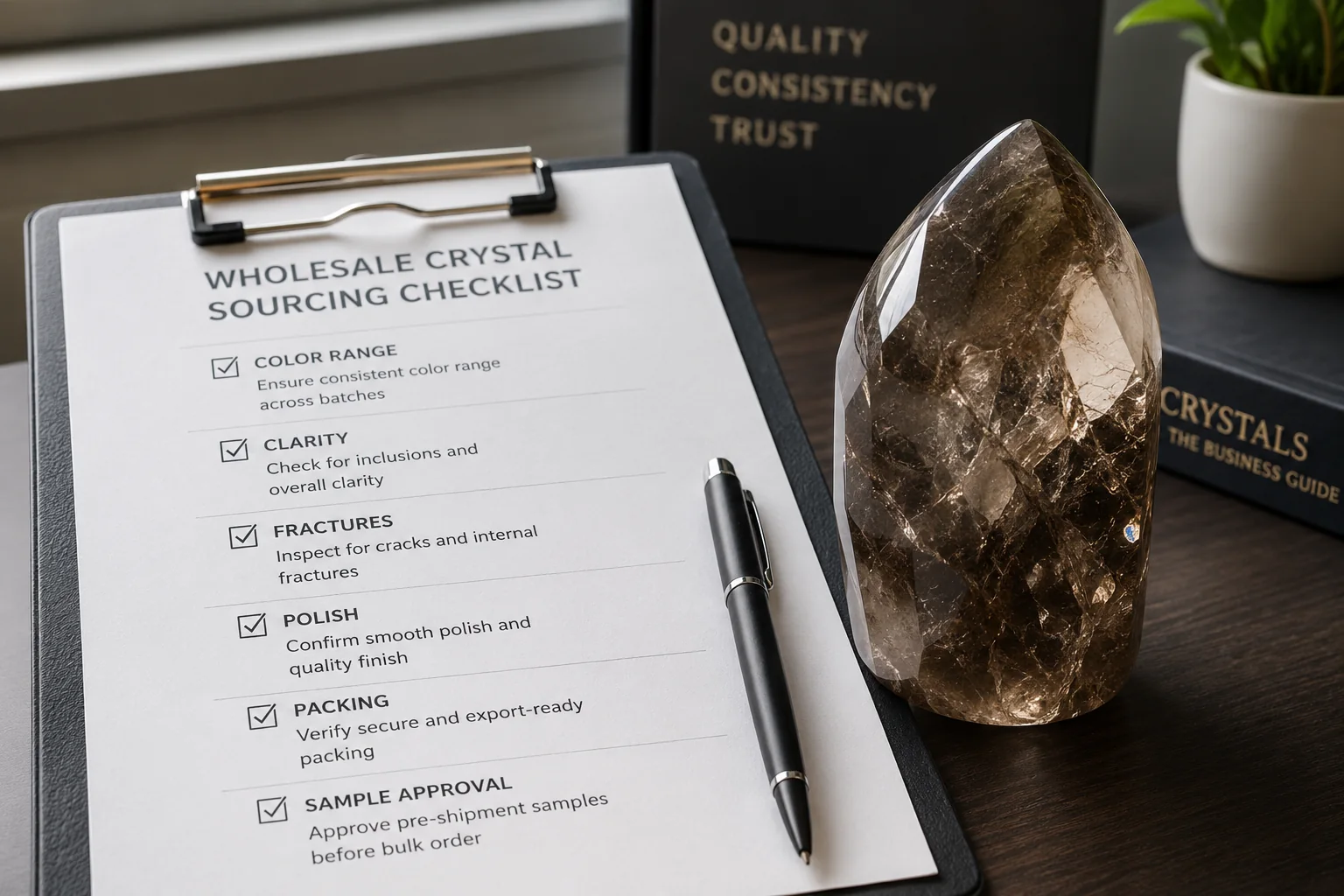
From my position managing orders, I see the same preventable problems happen over and over. A buyer falls in love with a professionally lit photo of a single, flawless carving. They say "I want 100 pieces just like this." The factory then produces 100 pieces from the available raw material, which naturally has variations. When the shipment arrives, the buyer is disappointed because the batch isn't identical to that one "hero" sample. This entire issue can be avoided by setting clear expectations from the start. A few simple process changes can save you thousands of dollars and build a much more reliable supply chain.
Here is a checklist of common mistakes and how to correct them:
| Common Mistake | How to Correct It |
|---|---|
| 1. Trusting 'AAA' or 'A-Grade' Labels | Ignore them. Create your own specification with defined color, clarity, and size. |
| 2. Ordering from Professional Photos | Always ask for raw, unfiltered videos taken by a phone under different lighting (indoor and outdoor). |
| 3. Approving a Single "Perfect" Sample | Ask the supplier to send photos or a video of the current bulk lot you will be receiving from. |
| 4. Not Defining a Color Range | Provide example photos of the lightest and darkest shades you will accept. |
| 5. Failing to Give Size Tolerances | Instead of "8cm", specify "7.5cm to 8.5cm". This accounts for hand-carving variations. |
| 6. Assuming Darker is Better | Personally inspect videos of dark pieces. Check for hidden fractures or poor polishing. |
| 7. Not Discussing Acceptable Flaws | Clarify that minor internal veils are okay, but surface-reaching cracks or large chips are not. |
| 8. Vague Communication | Put all specifications in writing. Use simple language, bullet points, and reference photos. |
By treating your purchase order like a clear instruction manual for the supplier, you eliminate guesswork and dramatically improve the consistency and quality of the products you receive.
How Do I Create a Purchase Specification for Smoky Quartz Carvings?
Your supplier sent you something different from what you expected, again. This inconsistency makes it impossible to manage your inventory and forecast sales, creating constant stress for your business.
The solution is to provide every order with a clear, written purchase specification. This document acts as a contract and instruction manual for your supplier, removing ambiguity and ensuring everyone is on the same page.
A strong purchase specification includes the product name, material, exact dimensions with tolerances (e.g., 80-100mm), an acceptable color range (with photo examples), clarity requirements, and notes on workmanship and unacceptable flaws. It is your most powerful tool for quality control.
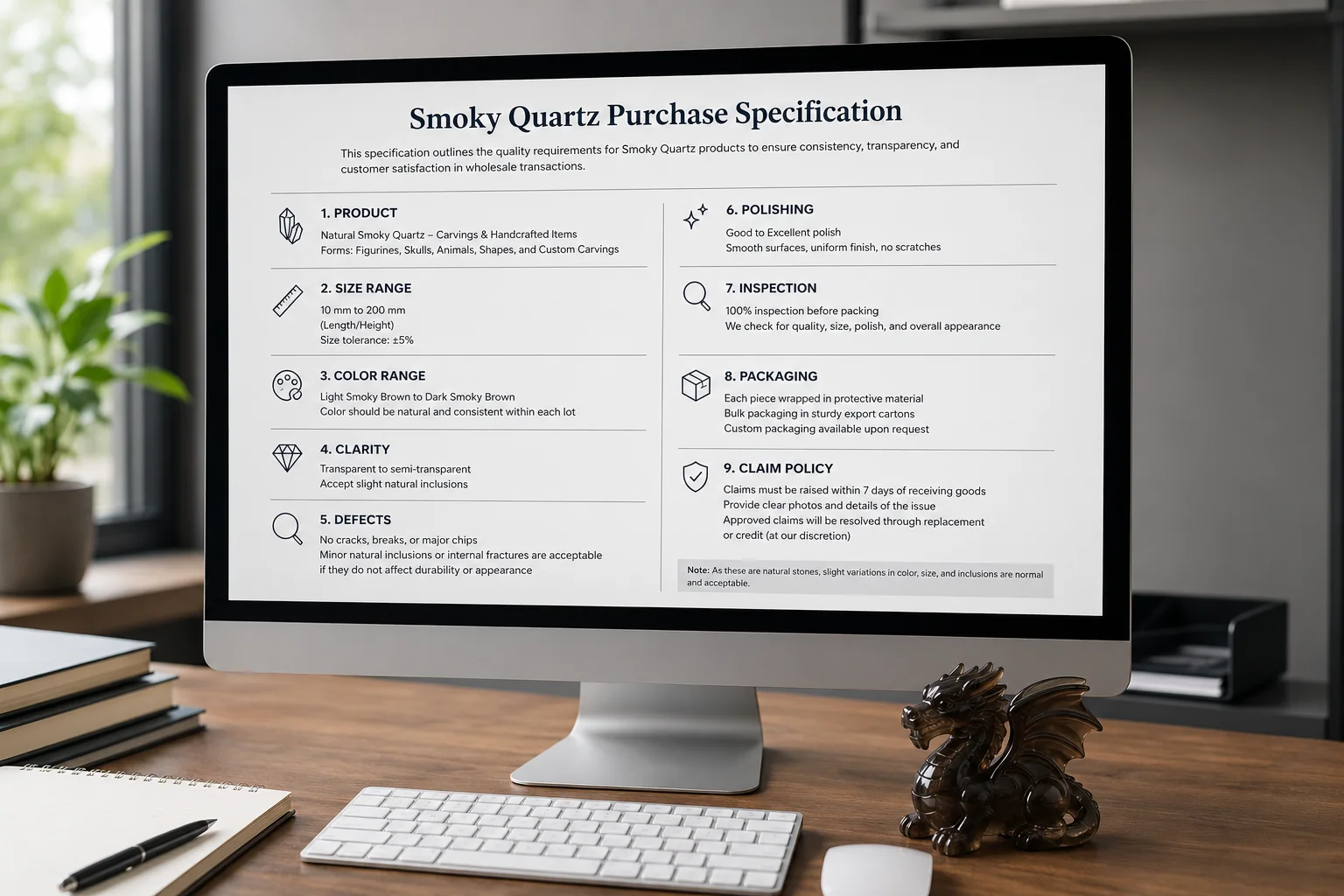
Whenever we receive a vague order like "50 smoky quartz towers, good quality," my first step is to contact the buyer for more details. "Good quality" means different things to different people. Without specifics, we are forced to guess, and that's a recipe for disappointment. However, when a buyer sends us a detailed spec sheet, our job becomes much easier. We can check the raw material, instruct the carving workshop precisely, and perform quality control against a clear standard. This process protects both the buyer and the supplier. It ensures you get the product you envisioned, and it allows us to produce it efficiently without costly re-work or disputes.
Here is a simple template you can adapt for your own orders.
Example Purchase Specification: Smoky Quartz Towers
- Product: 6-Sided Generator Point / Tower
- Material: Smoky Quartz
- Dimensions:
- Height: 80mm - 100mm (8-10cm)
- Base Width: 25mm - 35mm (2.5-3.5cm)
- Color Specification:
- Acceptable Range: Medium to Deep Smoky. Must have good light transmission.
- Reference Photos: [Attach 2-3 photos showing the lightest acceptable shade and the darkest acceptable shade]
- Unacceptable: Near-black/opaque or very pale/colorless material.
- Clarity & Internal Features:
- Acceptable: Good overall transparency. Natural internal veils and wispy inclusions are acceptable and expected.
- Unacceptable: Large, opaque mineral spots or excessive "muddy" areas that block more than 30% of the crystal.
- Workmanship & Finish:
- Shape: Symmetrical form with 6 clean faces. Point must be sharp and centered, not chipped or blunted.
- Polish: High-gloss, "wet look" polish on all faces and the base. No dull spots, deep scratches, or visible polishing marks.
- Unacceptable Flaws (Automatic Rejection):
- Any chip larger than 2mm on the point, edges, or base.
- Any fracture that can be felt with a fingernail on the surface.
- Repaired/glued pieces.
- Packaging: Each tower must be individually wrapped in foam or bubble wrap to protect the point.
Conclusion
Stop chasing confusing grades. The key to successfully sourcing smoky quartz carvings is to define your own quality standards with a clear, written purchase specification for your supplier.
<!--[googlesitekit-end-of-content]-->
"Colored Gemstone Value Factors", https://www.gia.edu/gia-news-research/value-factors-design-cut-quality-colored-gemstone-value-factors. Research indicates that non-standardized grading terms such as 'AAA' in the gemstone industry can lead to miscommunication and financial losses for buyers due to inconsistent quality expectations and delivery. However, the extent of these issues may vary depending on the supplier and buyer's experience. Evidence role: general_support; source type: research. Supports: Vague grading terms like 'AAA' can lead to misunderstandings and financial losses in the gemstone industry.. Scope note: The evidence may not specifically address smoky quartz but applies broadly to the gemstone industry. ↩
"Shopping for others: how does inconsistency in online reviews ...", https://pmc.ncbi.nlm.nih.gov/articles/PMC12231527/. Studies on retail supply chain management emphasize the importance of product consistency for maintaining inventory control and meeting customer expectations. Evidence role: general_support; source type: research. Supports: Inconsistent shapes and sizes in wholesale gemstone carvings can lead to challenges in retail operations, such as inventory management and customer satisfaction.. Scope note: The source may not specifically address smoky quartz carvings but applies to wholesale products in general. ↩
"An Introduction to Gem Treatments", https://www.gia.edu/gem-treatment. Gemological studies and expert opinions suggest that natural inclusions like veils and phantoms can enhance the aesthetic and unique appeal of smoky quartz. Evidence role: expert_consensus; source type: education. Supports: Natural veils, wispy inclusions, and phantoms are often considered desirable features that add character to smoky quartz.. ↩
"An Introduction to Gem Treatments - GIA", https://www.gia.edu/gem-treatment. Gemological education resources confirm that visual inspection is insufficient to distinguish between natural and irradiated smoky quartz, as both can appear similar. Evidence role: expert_consensus; source type: education. Supports: Irradiated smoky quartz cannot be reliably identified by sight alone due to the similarity in appearance to natural smoky quartz.. ↩
"Smoky quartz", https://en.wikipedia.org/wiki/Smoky_quartz. Educational resources on mineralogy explain that smoky quartz derives its color from natural gamma radiation interacting with aluminum impurities in the crystal lattice over geological time scales. Evidence role: mechanism; source type: education. Supports: Natural smoky quartz gets its color from exposure to natural gamma radiation over millions of years.. ↩
"How do you tell if smoky quartz has been irradiated?", https://earthscience.stackexchange.com/questions/15989/how-do-you-tell-if-smoky-quartz-has-been-irradiated. Research on gemstone treatments confirms that artificial irradiation is a common method to enhance or alter the color of quartz, mimicking natural processes in a controlled environment. Evidence role: mechanism; source type: research. Supports: Artificial irradiation is a process used to alter the color of quartz by exposing it to a concentrated radiation source.. Scope note: The source may not specifically address the term 'speeding up the process' but will confirm the use of irradiation for color alteration. ↩
"Smoky quartz", https://en.wikipedia.org/wiki/Smoky_quartz. Educational sources on mineralogy confirm that natural smoky quartz can exhibit very dark coloration due to high levels of natural radiation exposure over time. Evidence role: general_support; source type: education. Supports: Natural smoky quartz can achieve very dark coloration under certain geological conditions.. Scope note: The source may not differentiate between natural and irradiated quartz in all cases. ↩
"Supply Chain Transparency and Beneficiation | Gems & Gemology", https://www.gia.edu/gems-gemology/spring-2018-gemnews-supply-chain-transparency-and-beneficiation. Research on gemstone supply chains highlights the importance of supplier transparency and vetting to ensure material authenticity and quality. Evidence role: general_support; source type: research. Supports: Vetting suppliers is a more effective strategy than relying on visual inspection to identify treated smoky quartz.. Scope note: The source may discuss supplier vetting broadly rather than focusing solely on smoky quartz. ↩
Keep Reading