Struggling with inconsistent sodalite quality from suppliers? You order "royal blue" but receive something else entirely, wasting time and money on stock that is difficult to sell.
Sourcing quality sodalite means creating a detailed purchasing specification that covers your acceptable range for color, calcite patterns, structural integrity, and carving workmanship. This moves you beyond unreliable marketing grades like "A" or "AA" and ensures you get product that fits your business needs.
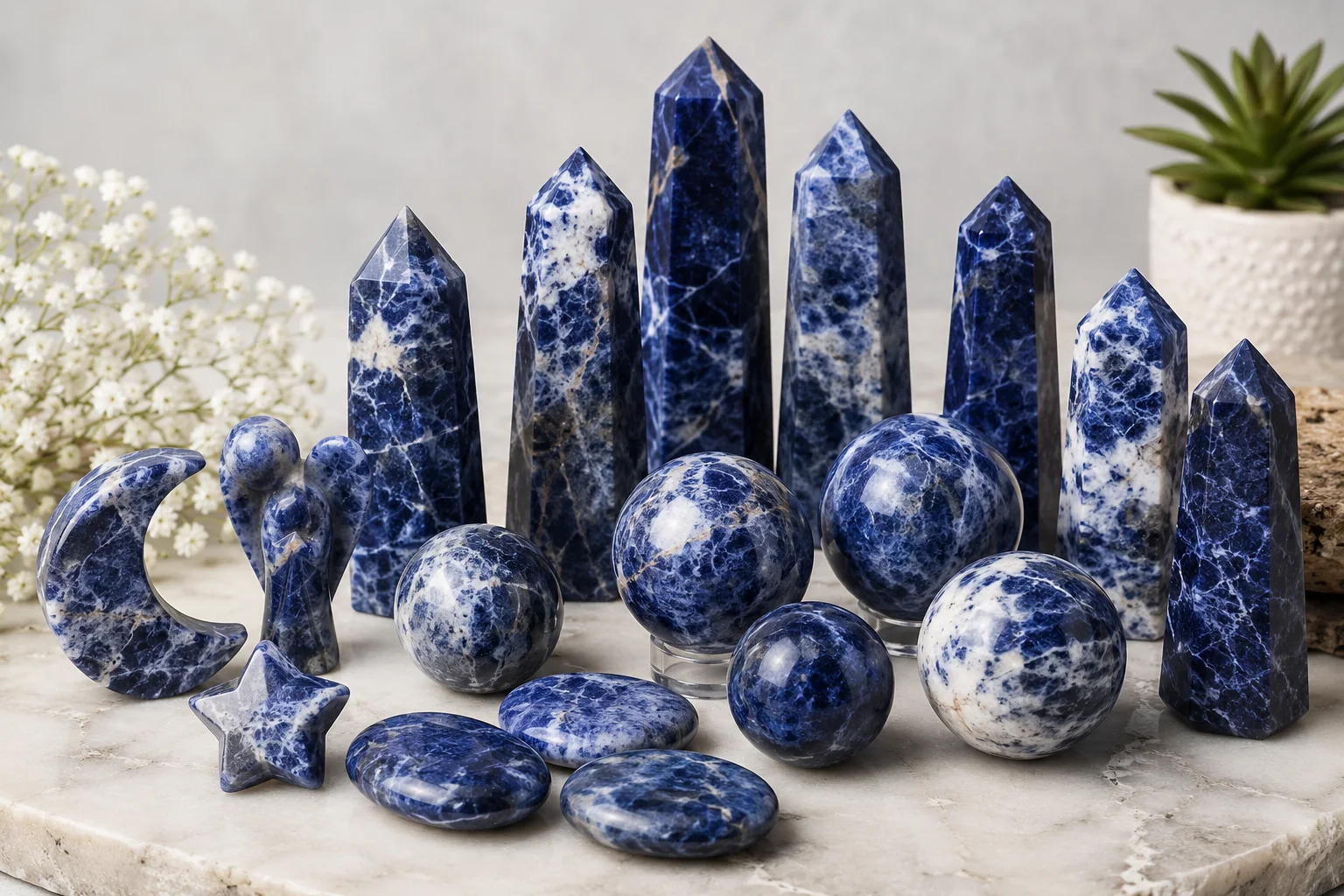
We've worked with hundreds of buyers, and a common frustration is the huge gap between the sodalite they see in a supplier's photo and what arrives in the box. The key isn't to find a magical "AAA grade" supplier, because a universal standard for sodalite doesn't exist1. Instead, the solution is to learn how to communicate your exact needs clearly. It's about building a specification that works for your products, your customers, and your price point. Once you can define what quality means for you, you can source with confidence and build a profitable collection. Let's break down how you can do this.
How Do You Judge Sodalite Color and Pattern Correctly?
You order stunning "royal blue" sodalite carvings, but the shipment arrives with washed-out, grayish pieces. This mismatch leads to customer disappointment and inventory that sits on your shelves.
Judge sodalite by defining your ideal color range and acceptable calcite pattern. The "best" quality is relative; deep blue with high-contrast white patterns suits large decor, while consistent blue with minimal white is better for uniform items like bracelets. Focus on suitability for the product, not a single ideal.
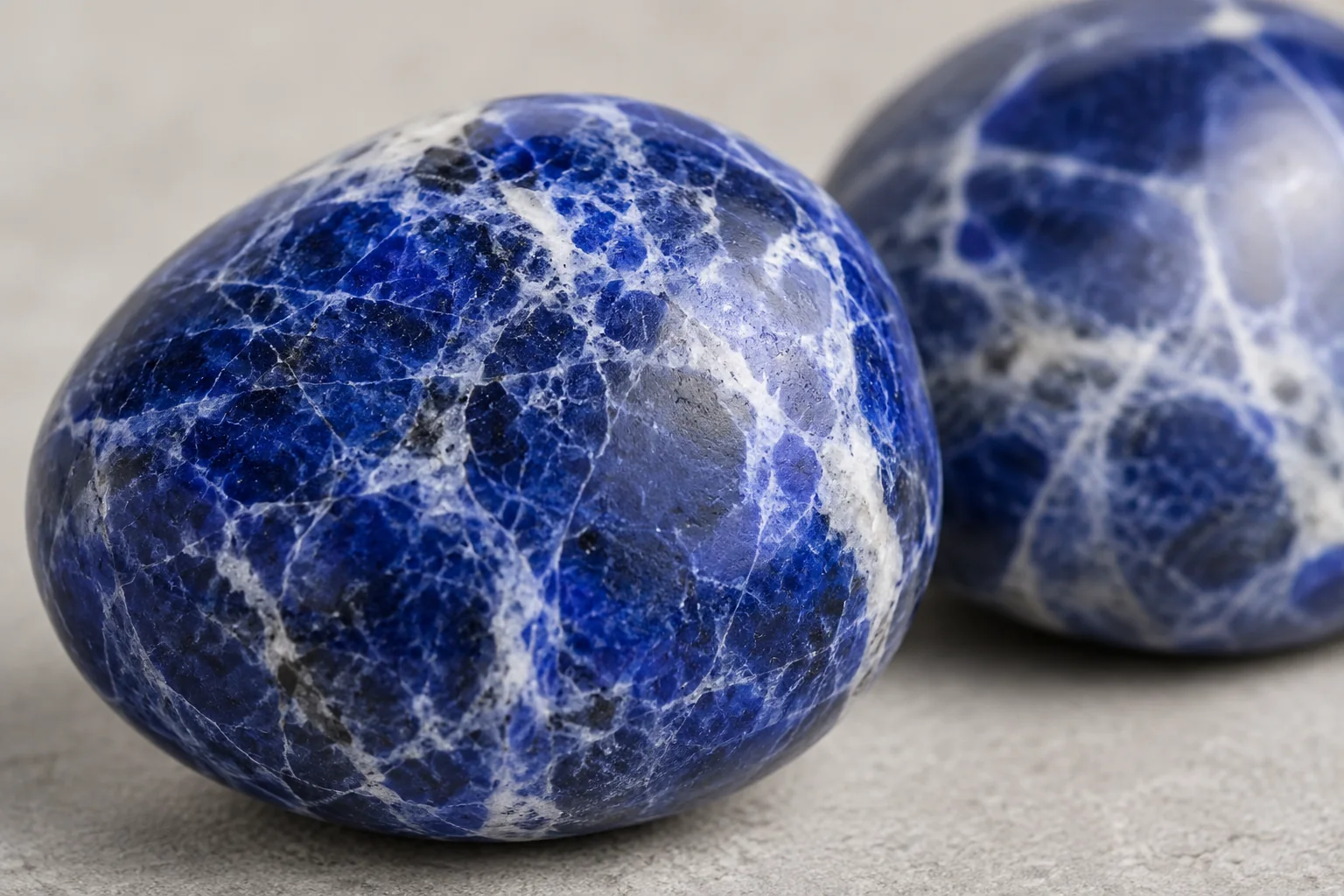
Many sellers use terms like "Royal Blue" or "Deep Blue" as marketing descriptions, not technical standards. The reality is that sodalite naturally occurs in a spectrum of blues2, from a deep, rich indigo to a lighter, grayish-blue denim color. The white you see is calcite3, and its presence is a feature, not a flaw. The trick is to match the pattern style to the product you are selling. For example, a buyer creating a line of premium, one-of-a-kind skulls or freeforms might specifically request material with dramatic, high-contrast white and black patterns. These unique pieces can command higher prices. Conversely, a brand selling sodalite palm stones or bracelets needs consistency. For them, sodalite with minimal white calcite is more valuable because it creates a uniform look across hundreds of units.
Matching Pattern to Product Type
| Product Type | Recommended Sodalite Style | Why It Works |
|---|---|---|
| Large Freeforms, Skulls | High-contrast, bold white calcite patterns | Creates unique, one-of-a-kind statement pieces that command higher prices and visual interest. |
| Towers, Spheres, Hearts | Consistent, fine veining or classic blue | Offers a balanced, marketable look for standard collections. Consistency across pieces is key for retailers. |
| Bracelets, Tumbled Stones | Minimal to no white calcite | Ensures uniformity in small, mass-produced items where customers expect a consistent appearance. |
Finally, it's important to distinguish sodalite from lapis lazuli. While they can look similar, lapis lazuli often contains flecks of golden pyrite4, whereas sodalite's veining is typically white or gray calcite. Be clear with your supplier about which material you are purchasing to ensure accurate product listings.
What Defines True Sodalite Carving Quality Beyond Its Color?
You found sodalite material with beautiful color, but the final carvings arrived chipped, misshapen, or dull. Now you are stuck with inventory that is nearly impossible to sell.
True quality combines good material with skilled workmanship. You must assess the carving's structural integrity for cracks, the accuracy of its shape, the smoothness of its polish, and the consistency across the entire batch. Poor carving can easily ruin even the best sodalite material.
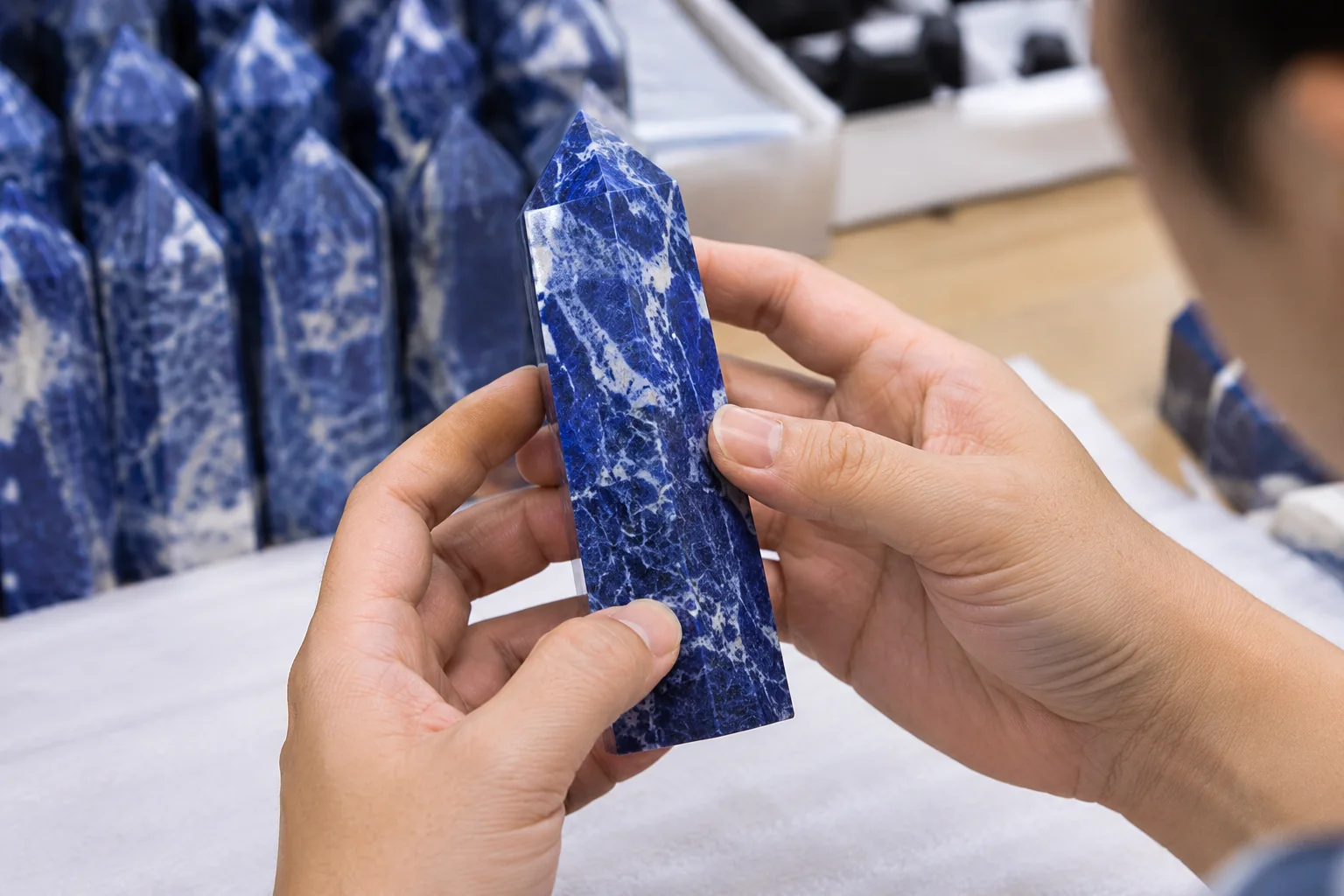
A common situation we see is a buyer who approves a beautiful sodalite sample, only to receive a bulk order with significant quality issues. The color is right, but the execution is poor. This happens when the focus is solely on the raw material, ignoring the manufacturing process. Sodalite is a relatively brittle material5 with a Mohs hardness of 5.5 to 66, making it susceptible to chipping and internal fractures if not handled correctly7 during carving and polishing. A beautiful deep blue color means nothing if the sphere is lopsided, the tower has a dull finish, or half the pieces have chipped edges. That's why we guide our clients to use a more holistic evaluation that covers both the stone and the craftsmanship.
Our 6-Factor Quality Checklist
- Color Suitability: Does the blue hue and saturation meet the aesthetic of your brand and the expectations of your target customers?
- Calcite Pattern: Is the pattern style (e.g., bold streaks, fine veins, or minimal white) appropriate for the specific product type you are ordering?
- Structural Integrity: Inspect pieces carefully for internal fractures, surface pits, and chipped corners8. A good supplier will pre-screen for unstable pieces that could break easily.
- Carving Accuracy: Is the shape symmetrical and well-proportioned? A tower should stand straight, a heart should have even lobes, and an animal carving should have clear details.
- Polish & Finish: The surface should be smooth and consistently reflective9. Look for dull spots, scratches, or unpolished areas, which indicate rushed workmanship.
- Batch Consistency: How much variation is there between individual pieces in a bulk order? This is vital for online sellers whose customers expect the product to look like the photo.
By evaluating every order against these six points, you can catch problems before they end up as unsellable stock in your warehouse.
How Can You Create a Reliable Sodalite Sourcing Process?
Your supplier's photos looked perfect, but the product that arrived was completely different. You're now stuck with inventory that doesn't match your listings and disappoints your customers.
Build a reliable process by moving beyond single, edited photos. Request videos in neutral, natural light to see the true color and finish. Ask for "range samples" that show the full spectrum of variation you can expect in a bulk order, and always provide a clear purchasing specification.
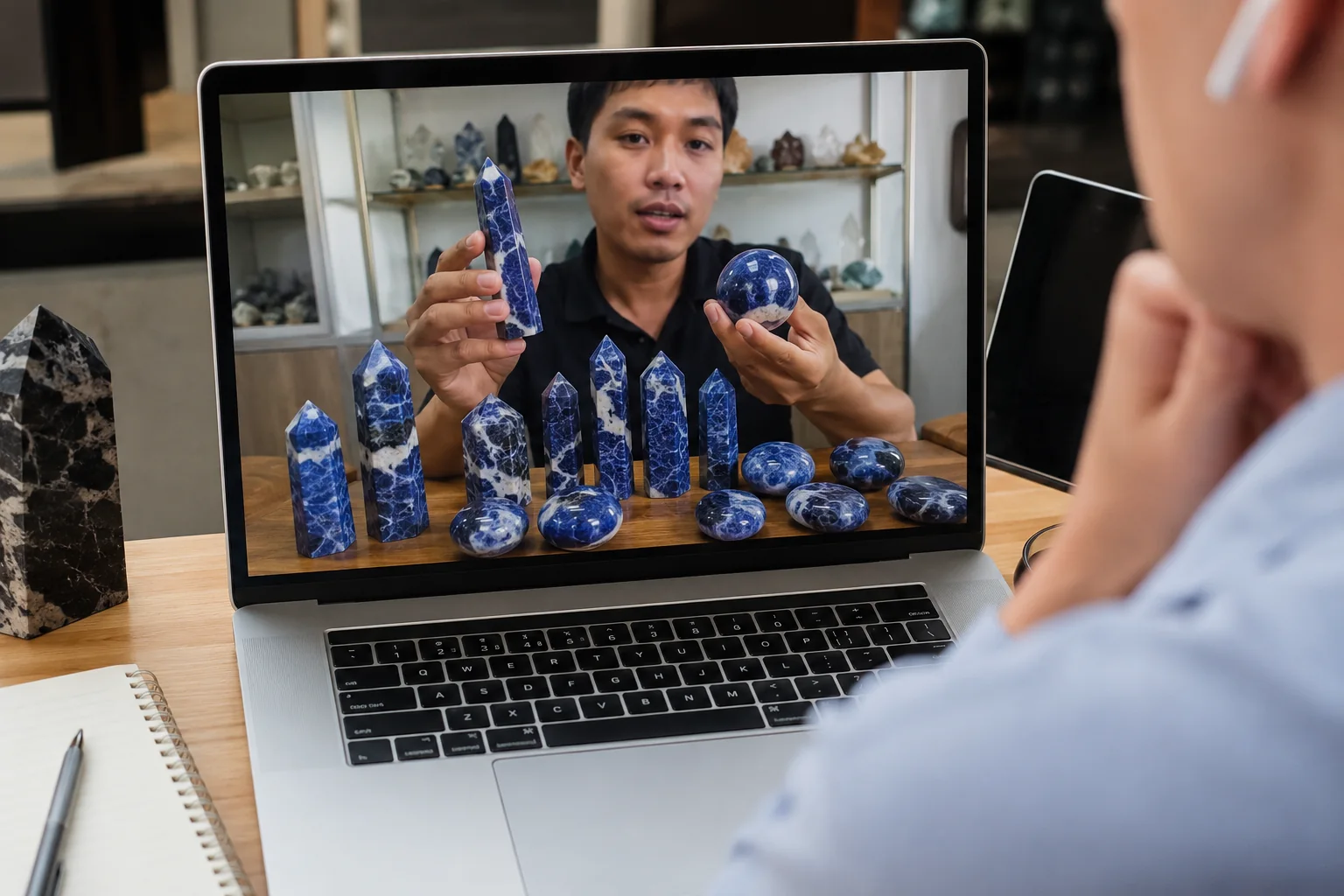
The biggest trap in sourcing is relying on a single "perfect" photo. Professional sellers use ideal lighting and often edit images10 to make the sodalite appear deeper blue and more vibrant than it is in reality. To counter this, your sourcing process must be built on verification. Don't just approve a sample; approve a range. We often help buyers who received sodalite that looked much darker in photos. By simply asking their next supplier for a short video taken near a window in natural daylight, they got a much more realistic view of the product before committing to a large order. A trustworthy supplier should have no problem providing this. Your goal is to create a clear, written purchasing specification that acts as a contract, protecting both you and the supplier from misunderstandings.
Key Questions to Ask Your Supplier
- "Can you send me a video of a few random pieces from the batch under neutral daylight, not just under bright spotlights?" This helps you see the true color.
- "Can you show me the typical range of color and pattern I can expect in my order?" This manages expectations for natural variation.
- "What is your quality control process for checking for internal cracks or unstable fractures before shipping?" This assesses their attention to structural integrity.
- "How do you pack sodalite carvings to prevent chipping and breaking during transit?11" This is crucial given the material's brittleness.
By asking these specific, practical questions, you shift from a passive buyer to an active partner in the quality control process. You show the supplier that you are a professional buyer who understands the material's nuances, which encourages them to provide you with better service and more consistent products.
Conclusion
Sourcing great sodalite means defining your needs with a clear spec, evaluating both material and workmanship, and using a rigorous verification process. This ensures profitable, consistent inventory for your business.
<!--[googlesitekit-end-of-content]-->
"GIA 4Cs Clarity", https://www.gia.edu/gia-about/4cs-clarity. Gemological institutions like the GIA note that while grading systems for diamonds are standardized, quality grading for colored gemstones is more complex, with trade terms like 'A' or 'AA' lacking universal definition and varying significantly between suppliers. Evidence role: general_support; source type: institution. Supports: The claim that universal grading standards for sodalite do not exist.. ↩
"Sodalite - Wikipedia", https://en.wikipedia.org/wiki/Sodalite. Mineralogical sources describe sodalite as typically occurring in shades of blue, including royal blue, grey-blue, and greenish-blue, often appearing mottled with white veins or patches. Evidence role: definition; source type: encyclopedia. Supports: The claim that sodalite occurs in a spectrum of blue colors.. ↩
"Yellow Fluid Inclusions in Transparent Sodalite", https://www.gia.edu/gems-gemology/summer-2021-yellow-fluid-inclusions-in-transparent-sodalite0. Geological and mineralogical databases confirm that sodalite frequently occurs in association with calcite, which forms the white veins and patches commonly seen in commercial-grade material. Evidence role: definition; source type: encyclopedia. Supports: The claim that the white material often found in sodalite is calcite.. ↩
"Lapis Lazuli Description", https://www.gia.edu/lapis-lazuli-description-v1. According to gemological resources, lapis lazuli is a rock composed of multiple minerals, primarily lazurite, calcite, and sodalite. The presence of golden-colored pyrite inclusions is considered a characteristic feature of most lapis lazuli. Evidence role: definition; source type: institution. Supports: The claim that lapis lazuli often contains pyrite, which helps distinguish it from sodalite.. ↩
"Sodalite - Wikipedia", https://en.wikipedia.org/wiki/Sodalite. Mineralogy databases classify sodalite's tenacity as brittle. This property, combined with its uneven to conchoidal fracture, means it can chip or break under pressure, requiring care during carving and handling. Evidence role: definition; source type: encyclopedia. Supports: The claim that sodalite is a brittle material.. ↩
"Sodalite", https://en.wikipedia.org/wiki/Sodalite. Mineral databases such as Mindat.org and gemological institutions confirm that sodalite has a hardness ranging from 5.5 to 6 on the Mohs scale, making it comparable in hardness to glass. Evidence role: statistic; source type: encyclopedia. Supports: The claim that sodalite has a Mohs hardness of 5.5 to 6.. ↩
"Sodalite", https://en.wikipedia.org/wiki/Sodalite. Lapidary guides note that sodalite's moderate hardness and brittle tenacity, along with its poor cleavage, make it prone to chipping and fracturing during cutting and polishing. This requires careful handling and sharp tools to achieve a smooth finish. Evidence role: mechanism; source type: other. Supports: The claim that sodalite is susceptible to chipping and fractures when being worked.. ↩
"Sodalite", https://en.wikipedia.org/wiki/Sodalite. Gemological evaluation of opaque stones like sodalite includes assessing surface condition and structural integrity. The presence of surface-reaching fractures, pits, or chips can affect both the appearance and durability of the finished piece. Evidence role: general_support; source type: institution. Supports: The claim that fractures, pits, and chips are important factors to check when evaluating sodalite quality.. ↩
"Colored Stone Cut Quality: What to Look For", https://www.gia.edu/gia-news-research-colored-stone-cut-quality-what-to-look-for. In lapidary arts, the quality of the polish, or luster, is a key indicator of workmanship. A well-finished piece should have a consistent, highly reflective surface free from dull spots, scratches, or undercutting, which can indicate rushed or improper polishing techniques. Evidence role: general_support; source type: other. Supports: The claim that a smooth, consistent polish is a mark of quality in carved gemstones.. ↩
"How to Photograph Gems & Jewelry", https://www.gia.edu/gem-photography. E-commerce and photography guides explain that product images are typically shot under professional lighting and are often color-corrected and edited to appear as appealing as possible. This can lead to discrepancies between the photo and the product's appearance in normal daylight. Evidence role: general_support; source type: other. Supports: The claim that product photos are often enhanced, affecting perceived color.. ↩
"FMF - Preparing minerals for shipping", https://www.mineral-forum.com/message-board/viewtopic.php?t=1088. Guides for shipping mineral specimens and artifacts emphasize that brittle materials should be individually wrapped in soft tissue or foam and placed in a sturdy box with ample cushioning to prevent movement and absorb shocks, which could otherwise cause chipping or fractures. Evidence role: general_support; source type: other. Supports: The claim that sodalite requires careful packing to prevent damage during transit.. ↩
Keep Reading