Struggling to understand sunstone grades and pricing? You're sourcing a beautiful stone, but inconsistent quality and confusing terms are hurting your business and causing customer complaints.
Stop asking for "AAA grade" sunstone. Instead, create a detailed purchase specification covering body color, sparkle type, structural integrity, and workmanship. This ensures you receive a commercially viable product that matches your specific business needs, not a supplier's vague marketing label.
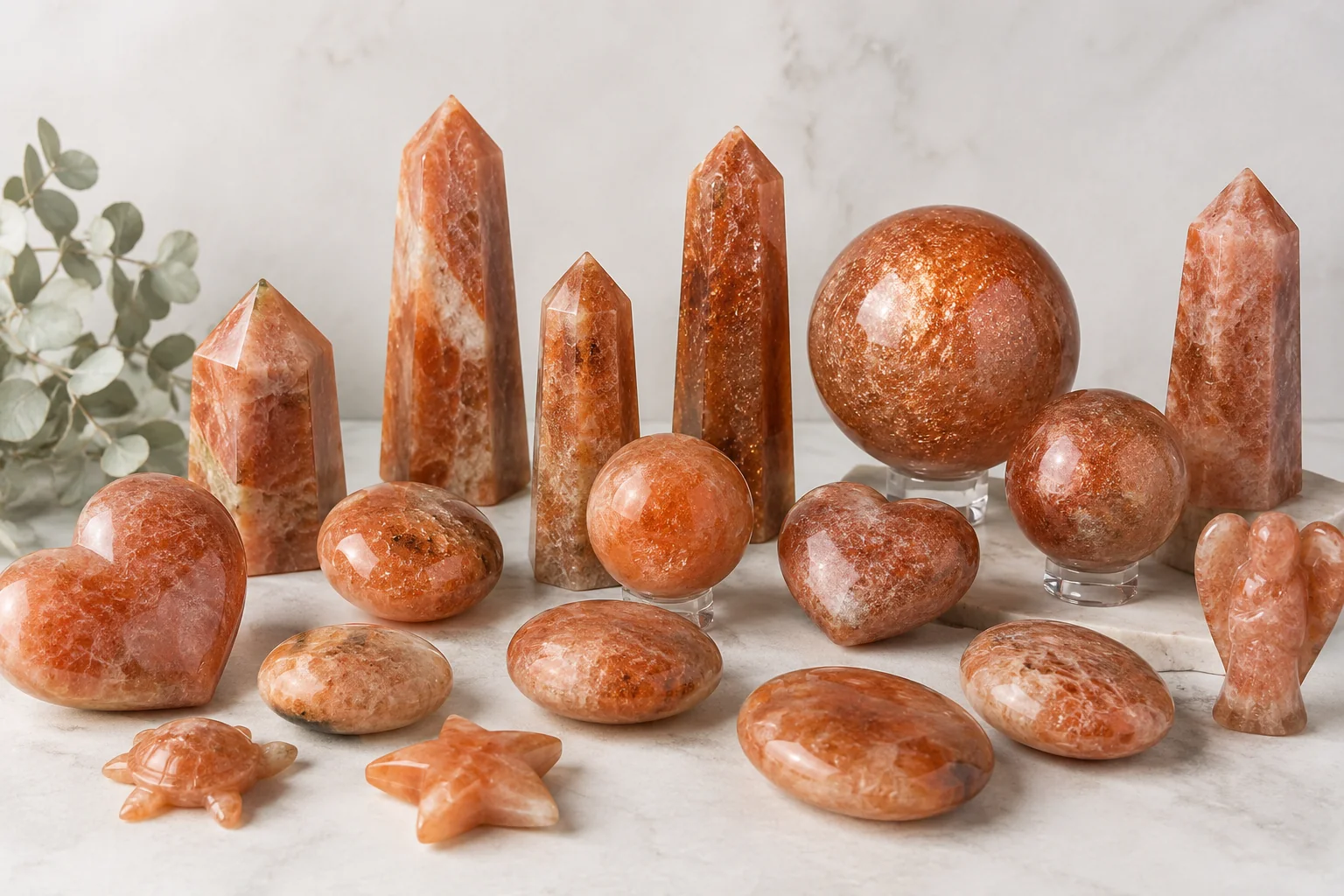
This might sound like a lot of work. You just want to buy beautiful sunstone carvings that your customers will love. I understand. As a supplier, I see buyers make the same mistakes over and over. They focus on finding the "best grade" instead of defining what "best" means for their shop, their customers, and their price point. The truth is, profitability in the crystal business doesn't come from finding a secret, perfect grade. It comes from building a reliable, repeatable sourcing process. I'm going to show you exactly how to do that, based on our daily experience inspecting thousands of carvings. This is the framework we use to help our clients build sellable and profitable sunstone product lines.
What Does Sunstone Actually Mean in the Wholesale Market?
Confused by all the different "sunstones" you see? You want to stock natural crystals, but you're worried about accidentally buying man-made glass or a different material entirely.
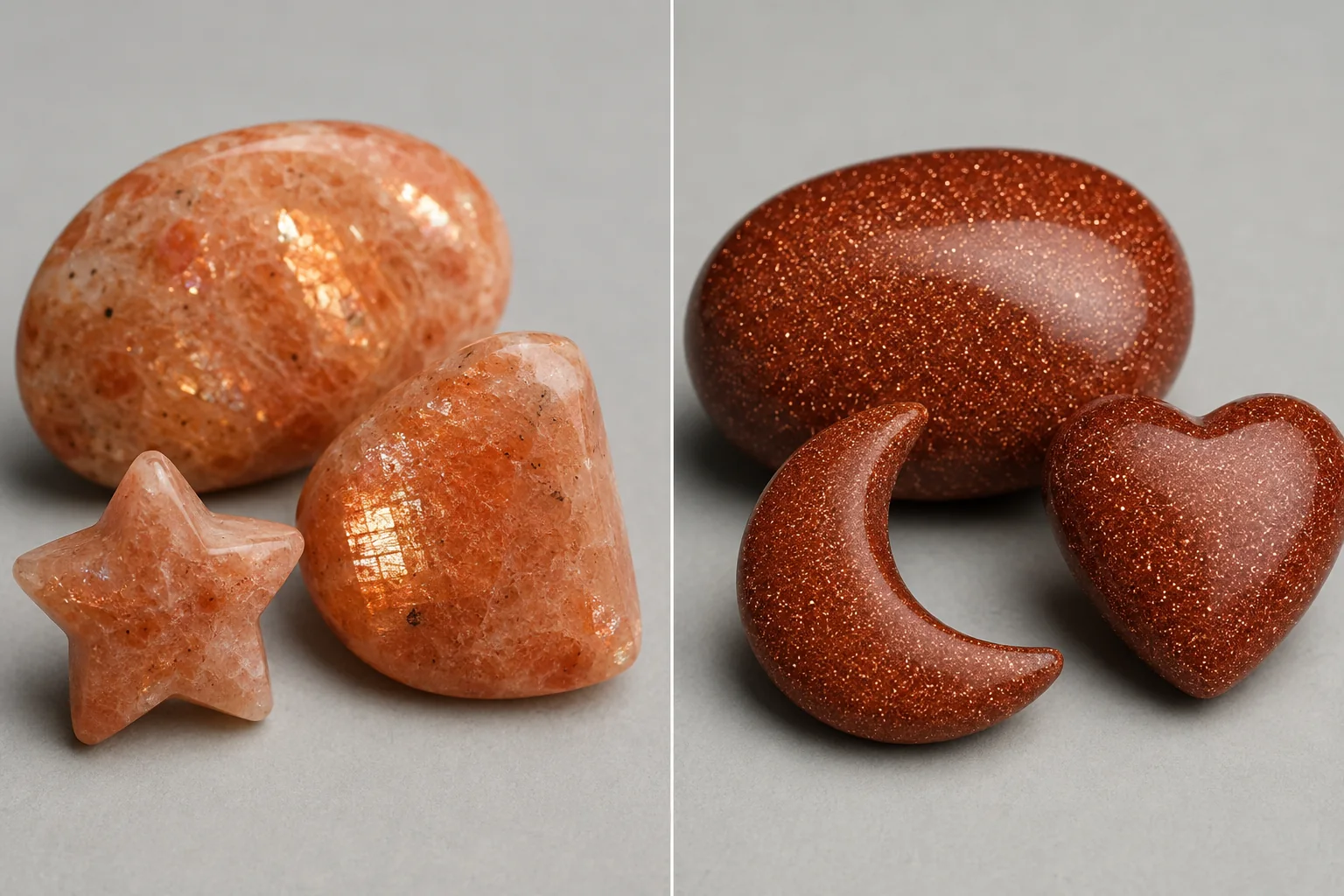
"Sunstone" is a commercial name for several feldspar minerals with a sparkling effect. It's crucial to distinguish natural sunstone from Goldstone (man-made glass) and other lookalikes. Always ask your supplier for precise material identification to ensure you're buying what you think you are.1
Dive deeper Paragraph:
In the wholesale world, "sunstone" isn't a single, strictly defined material. It's a trade term for feldspars that show a spangled, glittering effect called aventurescence. This can include different varieties like oligoclase or orthoclase feldspar. The sparkle comes from tiny, flat mineral inclusions, usually hematite or goethite.2
A major risk for new buyers is confusing natural sunstone with Goldstone.3 They are not the same.
| Feature | Natural Sunstone | Goldstone (Man-Made) |
|---|---|---|
| Material | Natural feldspar mineral | Man-made glass with copper filings |
| Sparkle | Irregular, flaky, often directional | Uniform, fine, dense glitter |
| Body | Can have internal textures, lines, zoning | Perfectly uniform, smooth glass body |
| Value | Varies widely based on natural quality | Inexpensive and consistent |
The problem isn't Goldstone itself—it's a valid product. The problem is misrepresentation. When you order "sunstone," you expect a natural mineral. We always tell buyers to ask upfront: "Is this natural feldspar sunstone or is it Goldstone?" This simple question protects your business's credibility.
Is There An Official Sunstone Grading System?
You see listings for "A," "AA," and "AAA Grade" sunstone and assume it's a reliable standard. But when the products arrive, the quality is completely different from what you expected.
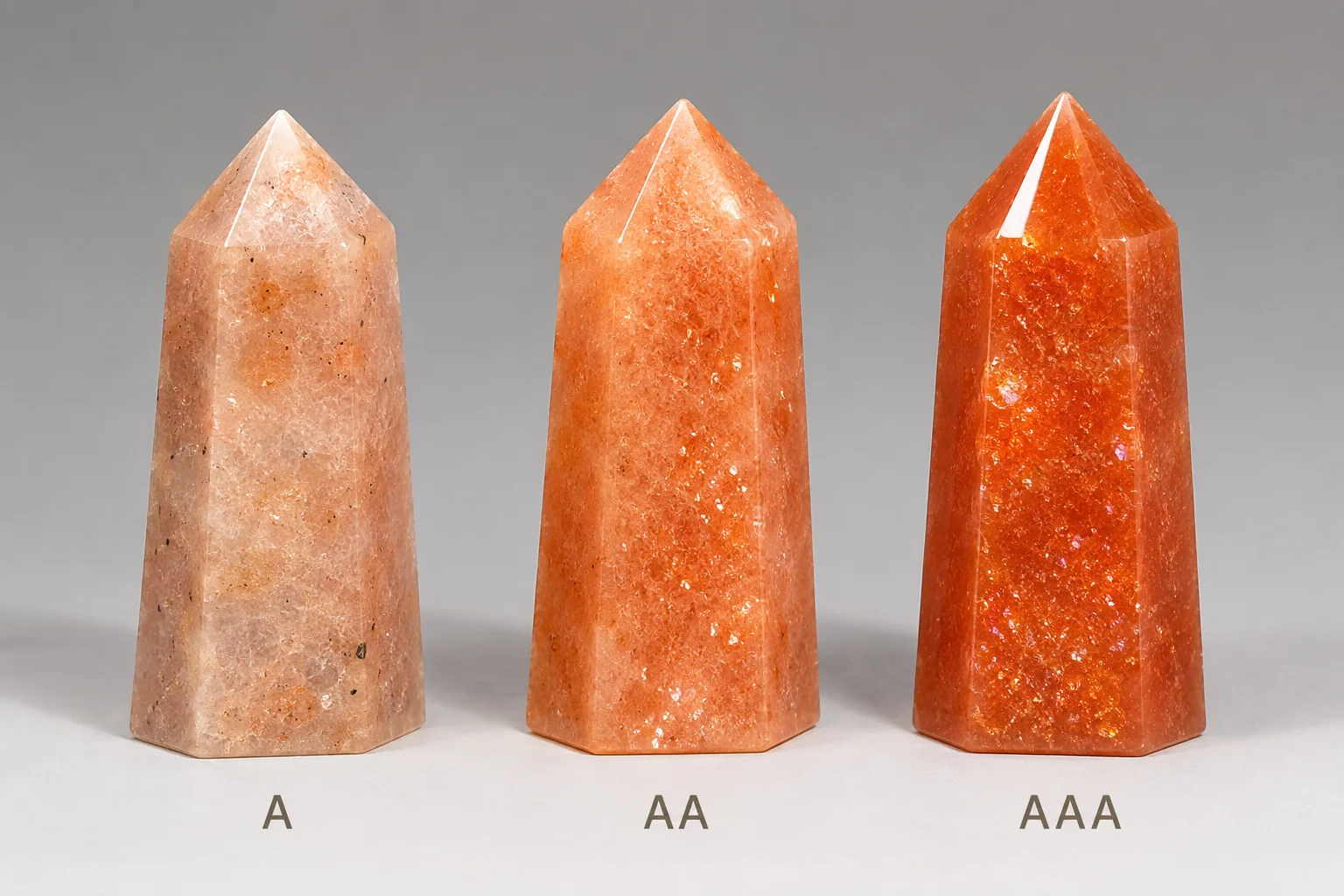
No, there is no universally accepted, official grading system for sunstone.4 Terms like "AAA Grade" or "High Flash" are marketing labels defined by individual sellers. They are inconsistent and unreliable for B2B sourcing.
Dive deeper Paragraph:
A frequent question we get is, "What grade is this?" The honest answer is that those grades don't mean much between suppliers. One supplier's "AAA" might be another's "A" grade. These terms are subjective and used for marketing, not for consistent quality control. Relying on them is a recipe for disappointment and financial loss.
The professional approach is to stop using these vague labels and start using a detailed purchase specification. This is a written document that clearly defines what you will and will not accept. Instead of asking for "high quality," you specify it. Your purchase spec should include:
- Acceptable Color Range: e.g., "Warm peach to light orange, no brown or grey tones."
- Minimum Sparkle Visibility: e.g., "Fine sparkle must be visible under normal indoor lighting from 1 foot away."
- Structural Integrity: e.g., "No surface-reaching fractures longer than 5mm. No visible repairs or fillers."
- Workmanship Standards: e.g., "Towers must have a stable base and centered tip. Carvings must be symmetrical."
- Treatment Disclosure: "Supplier must disclose any treatments, including dyeing or filling."
This shifts the conversation from a subjective guess to an objective, verifiable standard.
How Can You Categorize Sunstone Colors for Sourcing?
Trying to describe the exact shade of orange you want for your sunstone order feels impossible. You need a simple way to communicate color requirements to your supplier to avoid receiving a batch that's too pale or too dark.
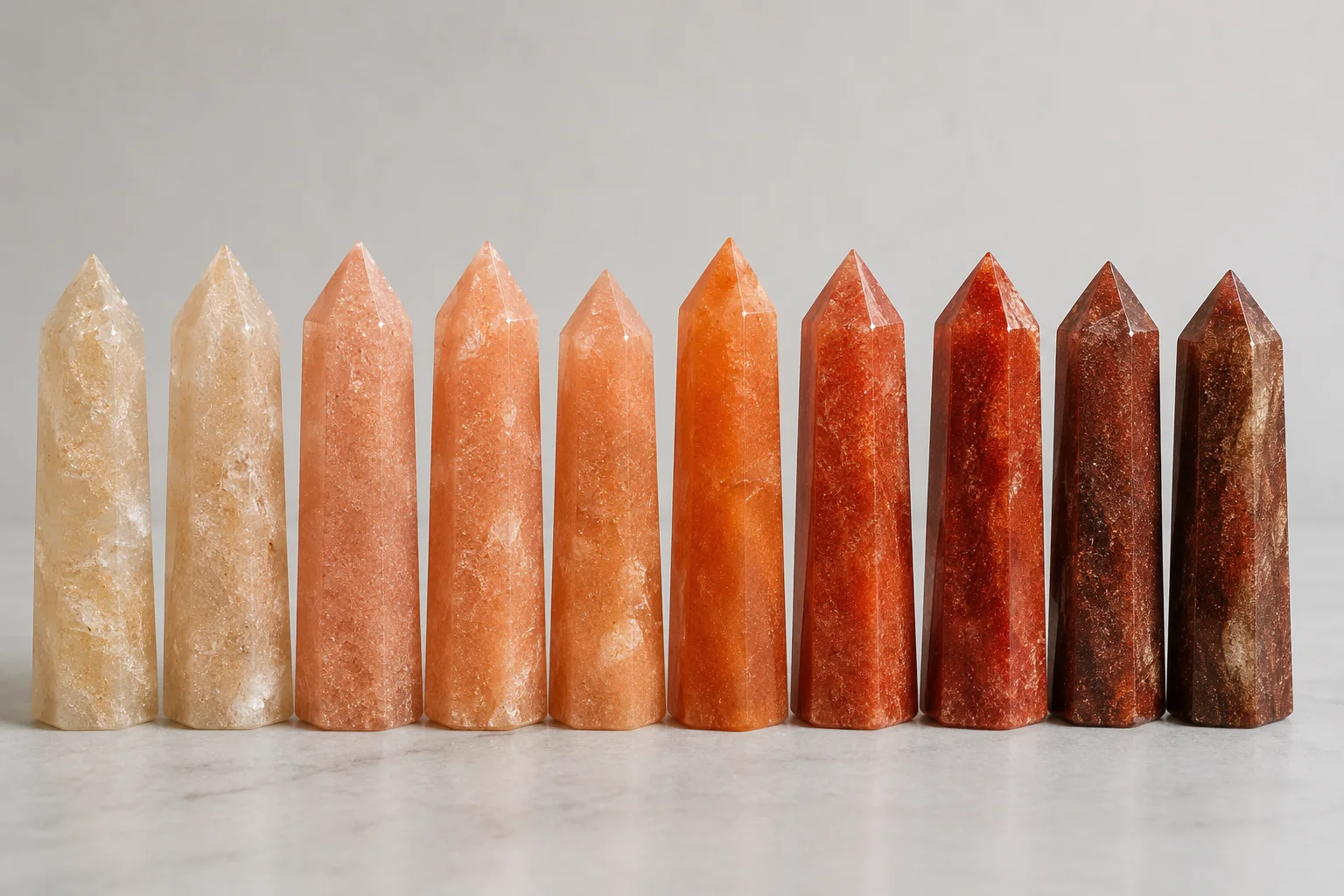
Use a practical commercial framework to categorize sunstone body color.5 This helps you specify your needs clearly and understand the sourcing risks associated with each color, from pale champagne to deep reddish-orange.
Dive deeper Paragraph:
To make communication easier, we group sunstone into practical commercial categories. This isn't a geological standard, but a shared language for sourcing. It helps buyers define what they want and helps us select the right raw material for their products.
| Commercial Color Category | Typical Appearance | Recommended Product Applications | Main Sourcing Risk |
|---|---|---|---|
| Pale Peach / Champagne | Light, subtle color. May appear whitish. | Beads, small tumbled stones, affordable pieces. | Can look washed out or be mistaken for moonstone. |
| Warm Peach to Orange | The most "classic" sunstone color. | All product types: towers, spheres, hearts, carvings. | High demand can mean higher prices; consistency is key. |
| Deep Orange / Reddish | Strong, saturated color. | Premium carvings, pendants, statement pieces. | Color can hide internal fractures; may be too dark to show sparkle. |
| Brown / Bronze / Earthy | Often has strong Schiller effect (sheen). | Palm stones, freeforms, skulls, masculine jewelry. | May be perceived as "muddy" or less vibrant by some customers. |
| Red / Green / Multicolor | Often from Oregon, USA. Copper inclusions. | High-end collector specimens, faceted gems. | Very expensive and rarely used for standard wholesale carvings. |
When you place an order, instead of saying "orange," you can say, "I need the 'Warm Peach to Orange' category, but please avoid any pieces that lean into the 'Brown/Bronze' range." This is a much more effective way to communicate.
How Should You Evaluate Sunstone's Sparkle and Aventurescence?
Your product photos show amazing sparkle, but customers complain the stones look dull in person. You're struggling to capture and sell a product based on a visual effect that seems to change with the light.
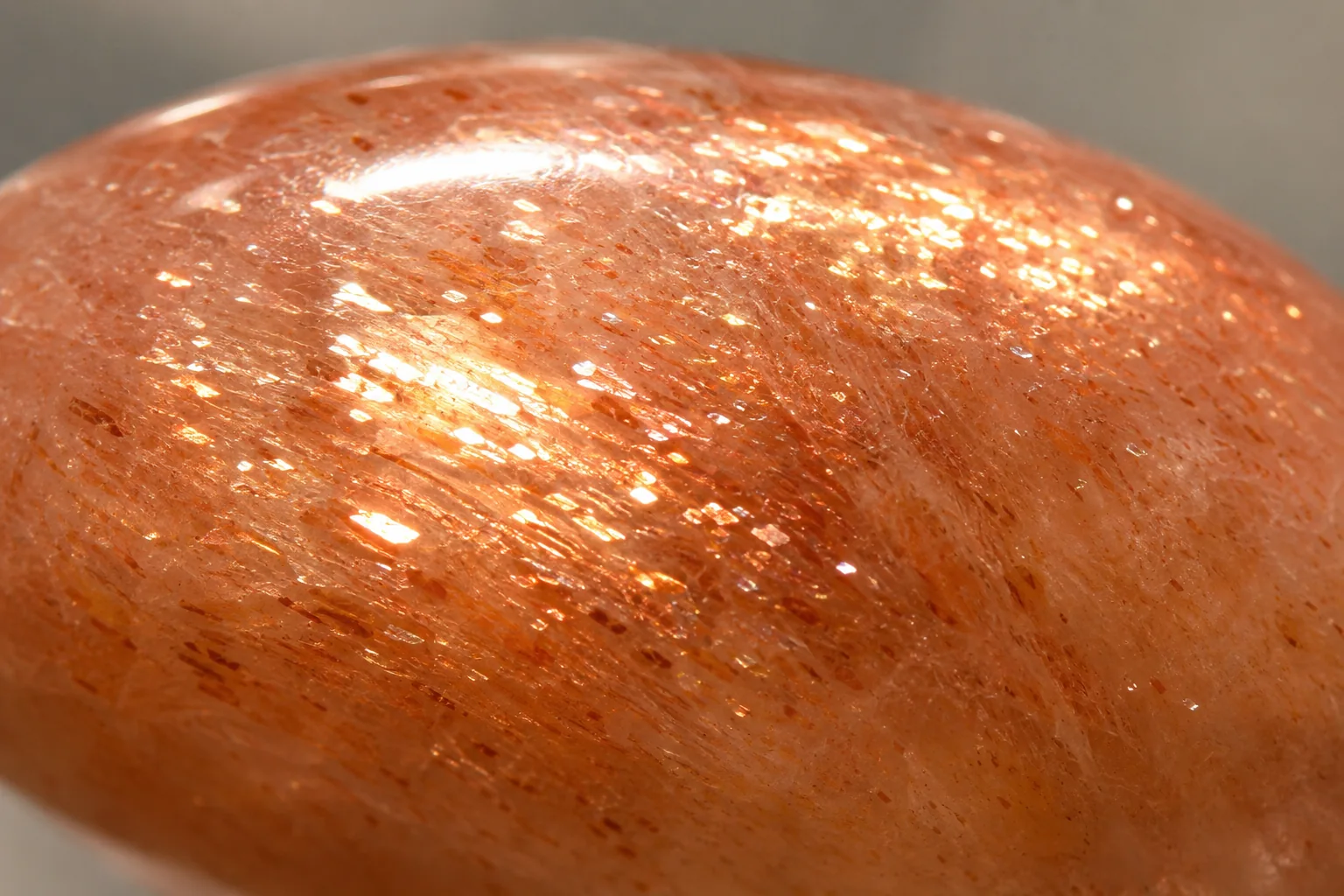
Evaluate sparkle based on its type, density, and visibility in normal light, not just under spotlights.6 Understand that different sparkle types have different commercial implications for photography and customer satisfaction.
Dive deeper Paragraph:
The "sparkle" in sunstone is everything, but it's also tricky. A common mistake we see is buyers getting excited about a video taken with a strong flashlight. The reality in a customer's hand can be very different. You need to assess sparkle in a more practical way. We break it down into categories to evaluate a batch.
| Sparkle Type | Visual Effect | Best Use | Photography Concern | Batch-Consistency Concern |
|---|---|---|---|---|
| No Obvious Sparkle | A solid-colored stone, may have a sheen. | Could be sold as peach moonstone/feldspar. | Easy to photograph, but don't market as sunstone. | High consistency. |
| Fine Scattered Sparkle | Tiny, glitter-like sparkles throughout. | Beads, bracelets, where overall color is important. | Can look dusty or muted if not well-lit. | Generally consistent. |
| Directional Flash | Large, plate-like flashes that appear and disappear as the stone moves. | Pendants, palm stones, items meant to be handled. | Very hard to capture in one photo; video is essential. | Can be very inconsistent. |
| Dense Aventurescence | A rich, full coverage of sparkle. | High-end carvings, spheres, premium pieces. | Can make the stone look opaque or dark. | Rare and expensive; hard to get consistently. |
| Patchy / Uneven Sparkle | Sparkle is concentrated in some areas and absent in others. | Lower-cost items, character pieces. | Can look like a flaw or a "dead spot" in photos. | A common feature in lower-cost material. |
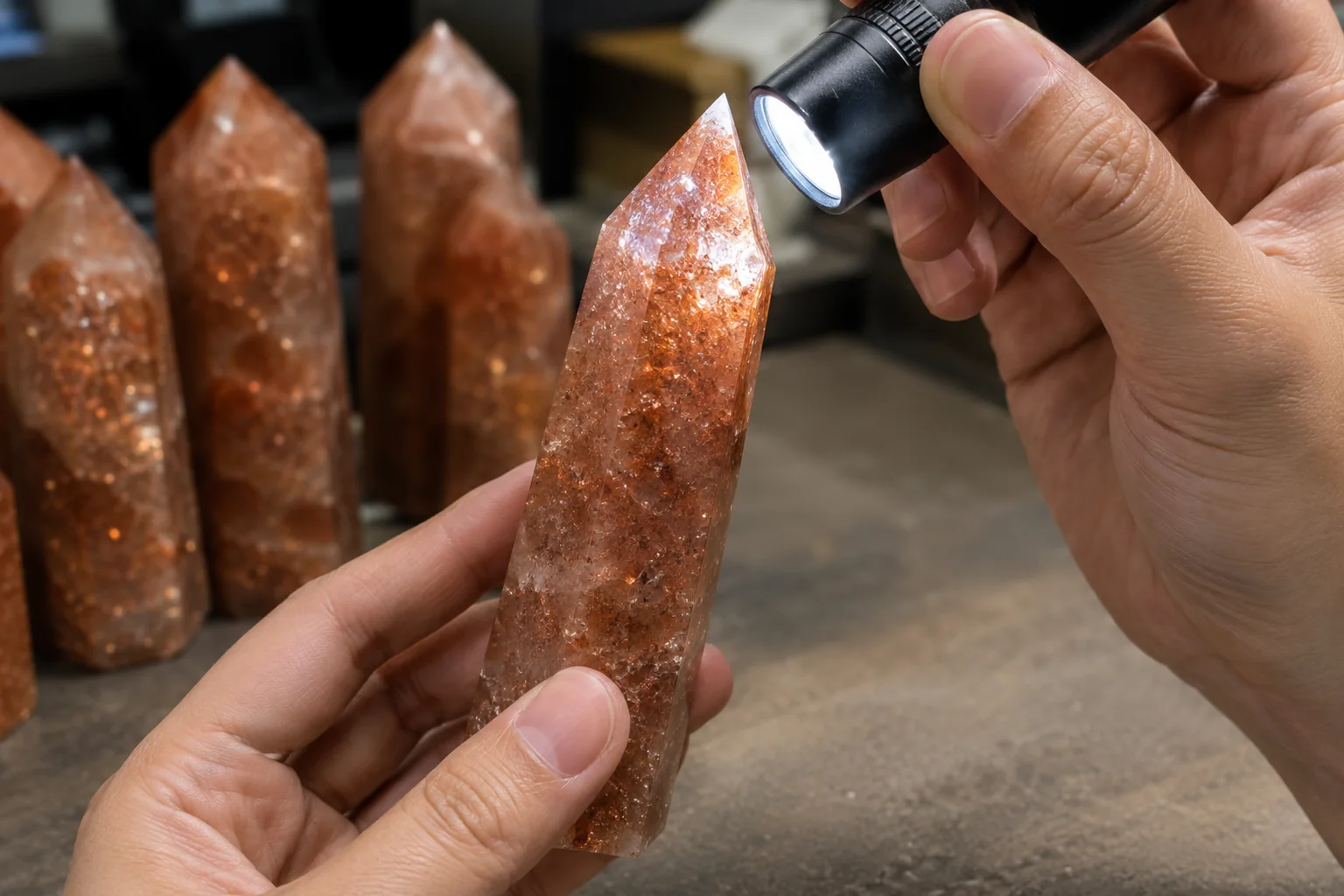
When inspecting, we always check under three conditions: a strong direct light, normal indoor room light, and near a window with natural daylight. If the sparkle only shows up with a flashlight, it will likely lead to disappointed customers.
What Seven Factors Determine the Quality of a Sunstone Carving?
You've found a sunstone with beautiful color and sparkle, but the carving itself is lopsided or poorly polished. How do you evaluate the entire piece, not just the raw material?
Use a 7-part framework to evaluate sunstone carvings. Assess Body Color, Sparkle (Strength & Distribution), Transparency, Structural Condition, Workmanship, and overall Batch Consistency. A great carving requires a balance of all these factors.7
Dive deeper Paragraph:
A great piece of sunstone raw material can be ruined by poor workmanship. Conversely, excellent carving can't save ugly, fractured material. When we inspect a batch for our clients, we look at the whole picture. Here's our 7-point checklist:
- Body Color: Is the color appealing and within the agreed-upon range? Is it even or patchy?
- Sparkle Strength: Is the sparkle visible without a spotlight?
- Sparkle Distribution: Is the sparkle evenly distributed, or is it patchy and distracting?
- Transparency & Internal Appearance: Is the stone clear or cloudy? Do internal textures add character or look like flaws?
- Structural Condition: Are there chips, deep cracks, or visible repairs?
- Carving & Polishing Workmanship: Is the shape symmetrical? Are the details crisp? Is the polish smooth and glossy?
- Batch Consistency: Do all the pieces in the batch fall within an acceptable range of quality?
It's also crucial to distinguish between a natural feature and a commercial defect.
| Feature | Usually Acceptable | Requires Approval | Usually Unacceptable | Commercial Reason |
|---|---|---|---|---|
| Internal Textures | Included as part of natural stone appearance. | Heavy cloudiness that dulls sparkle. | Large, dark internal spots. | Looks like a flaw to customers. |
| Surface Pits | Minor, shallow pits from polishing. | Clusters of pits on a main face. | A deep pit on a carving's "face." | Distracts from the design. |
| Fractures | Fine internal lines that don't reach the surface. | A fracture that reaches the surface but is stable. | A deep crack that compromises the stone's stability. | High risk of breaking during shipping or handling. |
How Does Product Type Change the Meaning of "Good Quality"?
You're trying to apply the same quality standards to sunstone beads and large sunstone towers. This approach isn't working, as the requirements for each product are completely different.
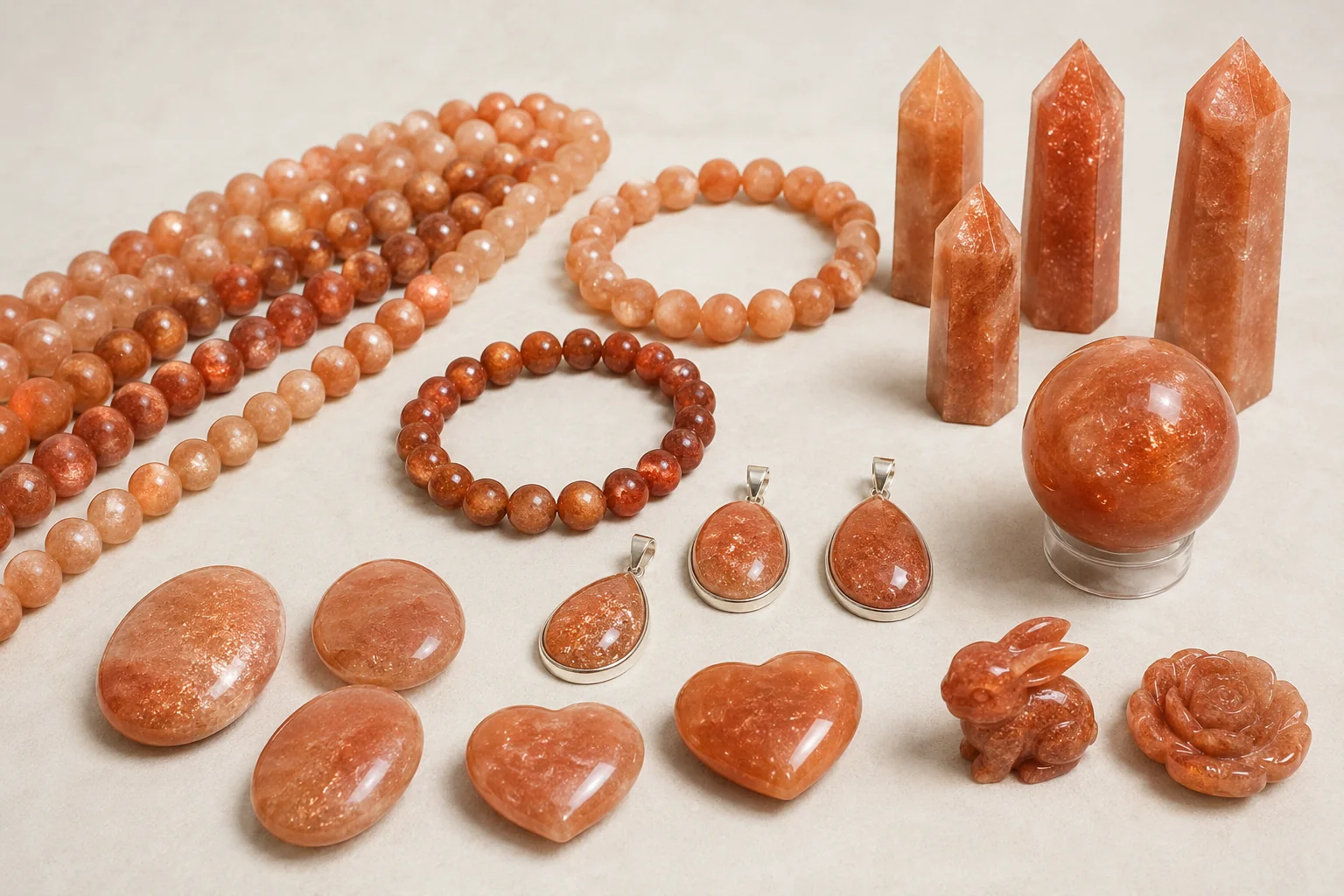
The definition of "good quality" sunstone is not universal; it depends entirely on the final product. Quality criteria for beads (color consistency) are different from towers (stable base) or animal carvings (structural integrity of details).
Dive deeper Paragraph:
One of the biggest mistakes we see is buyers evaluating material in isolation from its final form. A piece of sunstone that is perfect for a palm stone might be terrible for a bracelet. You must adapt your quality criteria to the specific product you are ordering. For example, directional flash that looks stunning on a large sphere can be completely lost on a tiny 6mm bead. Here’s a quick guide we use to help clients focus their specifications.
| Product Type | Preferred Color | Preferred Sparkle | Main Structural Concern | Workmanship Priority | Packaging Priority |
|---|---|---|---|---|---|
| Beads / Bracelets | Consistent color across the strand. | Fine, scattered sparkle. | Drill hole integrity, no cracking. | Uniform size and shape. | Strung or bagged to prevent loss. |
| Towers / Points | Even color, attractive zoning. | Visible from the front face. | Stable, flat base; no chipping on the tip. | Symmetrical shape, centered tip. | Tip protection is essential. |
| Palm Stones / Hearts | Engaging color and pattern. | Directional flash or dense sparkle. | No sharp edges or surface fractures. | Smooth, ergonomic feel; good polish. | Individual wrapping to prevent scratches. |
| Animal Carvings | Color that complements the animal. | Sparkle that enhances, not distracts. | Integrity of thin parts (ears, tails, legs). | Recognizable details, stable posture. | Padding for delicate protrusions. |
| Spheres | Interesting patterns, good color. | All-over sparkle or directional flash. | No major flat spots or surface cracks. | Perfect roundness, high polish. | Secure stand or divot to prevent rolling. |
By specifying your needs based on the product type, you give your supplier clear instructions to source and manufacture items that are not just beautiful, but also functional and sellable.
What Common Mistakes Can Ruin Your Sunstone Order?
You've placed a big wholesale order for sunstone, but it's a disaster. The items don't match the photos, half are broken, and the quality is all over the place. What went wrong?
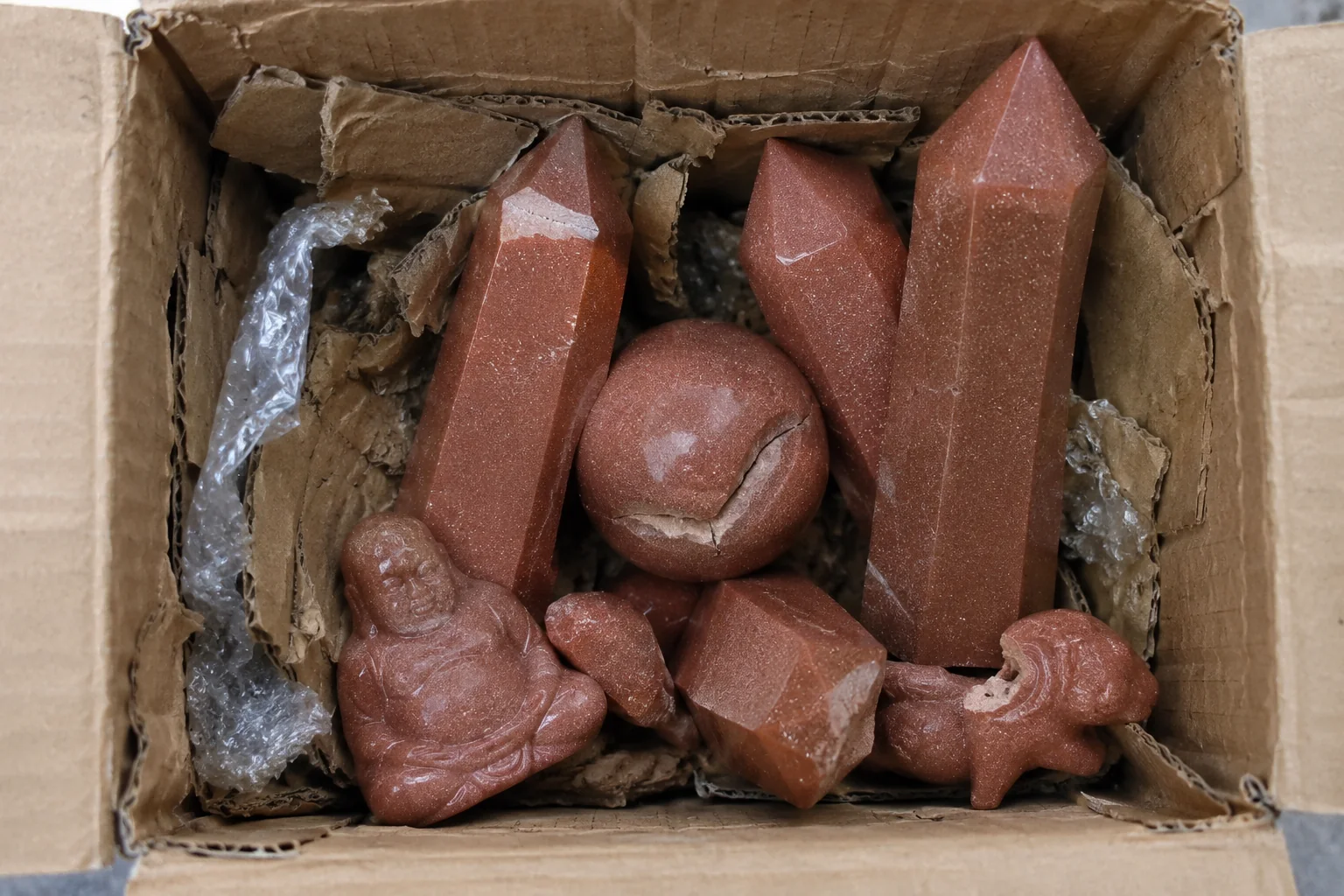
Many buying mistakes stem from relying on photos, misunderstanding natural variation, and not providing a clear specification.8 Avoid traps like the "hero sample," confusing sunstone with Goldstone, and ignoring workmanship.
Dive deeper Paragraph:
From our perspective as a supplier, we see the same preventable mistakes repeatedly. Learning from them can save you thousands of dollars and a lot of frustration.9 Here are some of the most common situations we see:
- The "Hero Sample" Trap: A buyer approves an order based on a single, perfect photo of the best piece in a batch. The reality is that a wholesale lot will always have variation. The solution is to ask for a "range approval" video showing the best, average, and weakest pieces you should expect.
- Sunstone vs. Goldstone Confusion: A buyer orders "cheap sunstone" and receives man-made Goldstone. They didn't ask for the material identification upfront. Always clarify: "Is this natural feldspar sunstone?" before you talk about price.
- Beautiful Material, Poor Workmanship: A buyer focuses only on the material's color and sparkle. The order arrives, and the tower tips are off-center, and the animal carvings are lopsided. Material quality cannot save a poorly made product. Your spec must include workmanship standards.
- Repeat-Order Inconsistency: A buyer places a reorder expecting it to be identical to their last batch from six months ago. Natural materials are mined in different veins and lots. The new batch might have a slightly different color or sparkle pattern. Always ask for current-lot photos and videos before confirming a reorder.
How Do You Create a Purchase Specification That Actually Works?
You're ready to stop relying on vague grades, but you're not sure how to write a professional purchase order. What questions should you ask and what should the final document look like?
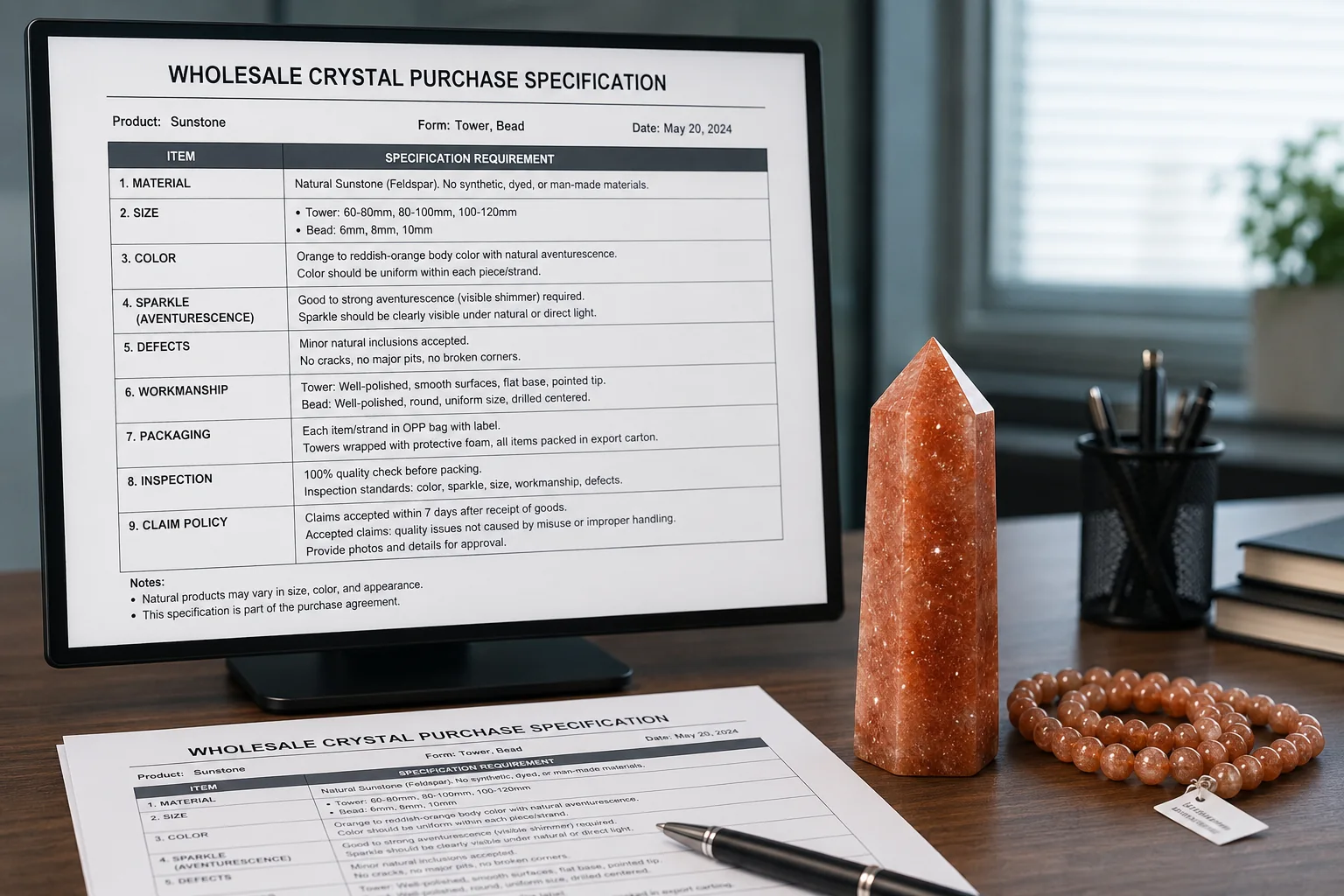
Create a functional purchase specification by asking your supplier detailed questions first, then documenting the agreed-upon standards.10 Use a simple template covering material, size, color, sparkle, defects, and workmanship to ensure clarity.
Dive deeper Paragraph:
A good purchase specification is your best tool for successful sourcing. It begins by asking the right questions before you place an order. Here are some of the most important ones:
- Is this natural feldspar sunstone or man-made Goldstone?
- Can you send me a video of the current lot under natural light and with a flashlight?
- Can you show me the strongest and weakest pieces that would be in my order?
- What is your policy on chips, cracks, and repairs?
- How do you protect fragile items like tower tips during shipping?
Once you have the answers, you can create a simple specification. It doesn't need to be complicated.
Example Wholesale Purchase Specification: Sunstone Towers
- Product: Sunstone Towers
- Material ID: Natural Feldspar Sunstone (Not Goldstone)
- Size: 8-10 cm height, +/- 5mm tolerance.
- Color: Warm Peach to Orange commercial range. No significant brown, grey, or white patches.
- Sparkle: Fine scattered sparkle or directional flash must be visible on at least one main face under normal indoor light.
- Fracture Policy: No surface-reaching cracks on the main body. Minor internal fractures are acceptable. Tip must be free of chips.
- Workmanship: Must stand stable on a flat base. Shape must be symmetrical with a centered tip. Polish must be smooth and glossy.
- Treatment Disclosure: Supplier to confirm no dyes or fillers are used.
This simple document transforms you from a passive buyer into a professional sourcing partner. It protects both you and your supplier by creating clear, shared expectations.
Conclusion
Stop chasing vague grades. Define what your business needs, create a clear specification, and partner with a supplier who understands and can meet your requirements. That is the key to profitability.
<!--[googlesitekit-end-of-content]-->
"Sunstone Gemstone | Sunstone Stone – GIA Gem Encyclopedia", https://www.gia.edu/sunstone/buyers-guide. Studies on gemstone trade practices emphasize the need for material identification to prevent misrepresentation, particularly between natural and synthetic materials. Evidence role: general_support; source type: research. Supports: Highlights the importance of material identification to distinguish natural sunstone from Goldstone.. ↩
"Aventurescence", https://en.wikipedia.org/wiki/Aventurescence. Research on feldspar minerals identifies hematite and goethite inclusions as the primary cause of aventurescence in sunstone. Evidence role: mechanism; source type: paper. Supports: Explains that aventurescence in sunstone is caused by hematite or goethite inclusions.. ↩
"[PDF] Complaint v. Larry A. Goldstone et al. - SEC.gov", https://www.sec.gov/files/litigation/complaints/2012/comp-pr2012-42.pdf. Market studies have reported instances of buyers mistaking Goldstone for natural sunstone due to their similar appearance. Evidence role: case_reference; source type: research. Supports: Documents cases where buyers confuse natural sunstone with Goldstone.. ↩
"Sunstone Stone", https://www.gia.edu/sunstone/buyers-guide. Gemological institutions confirm that sunstone grading lacks universal standards, with terms like 'AAA Grade' being subjective and supplier-specific. Evidence role: expert_consensus; source type: institution. Supports: Confirms the absence of a standardized grading system for sunstone and the subjective nature of grading terms.. ↩
"Sunstone Quality Factors", https://www.gia.edu/sunstone-quality-factors. Educational resources on gemstone trading suggest using standardized color categories to improve communication and sourcing accuracy. Evidence role: general_support; source type: education. Supports: Describes the use of commercial frameworks for categorizing sunstone colors in the gemstone trade.. ↩
"Sunstone Stone – GIA Gem Encyclopedia", https://www.gia.edu/sunstone. Gemological training materials recommend assessing sparkle in gemstones under various lighting conditions to ensure accurate evaluation. Evidence role: general_support; source type: education. Supports: Provides criteria for evaluating sunstone sparkle, including type, density, and visibility.. ↩
"Sunstone Quality Factors - GIA", https://www.gia.edu/sunstone-quality-factors. Gemstone evaluation guidelines emphasize the importance of balancing material quality and craftsmanship in carvings. Evidence role: expert_consensus; source type: education. Supports: Lists factors like color, sparkle, and workmanship as key to evaluating sunstone carvings.. ↩
"Colored Gemstone Value Factors - GIA", https://www.gia.edu/gia-news-research/value-factors-design-cut-quality-colored-gemstone-value-factors. Case studies in gemstone trade highlight frequent errors like over-reliance on photos and unclear purchase specifications. Evidence role: case_reference; source type: research. Supports: Identifies common mistakes in gemstone sourcing, such as reliance on photos and lack of clear specifications.. ↩
"The Color of Responsibility: Ethical Issues and Solutions in ... - GIA", https://www.gia.edu/gems-gemology/summer-2016-color-responsibility-ethical-issues-solutions-colored-gemstones. Research on gemstone trade practices indicates that avoiding common sourcing errors can significantly reduce financial losses and operational inefficiencies. Evidence role: statistic; source type: research. Supports: Provides data on the financial and operational impact of common sourcing mistakes in the gemstone industry.. ↩
"The Importance of Purchase Orders - Finance Division", https://www.cmu.edu/finance/news/archve/fy23/po-importance.html. Educational resources on gemstone sourcing emphasize the importance of detailed purchase specifications for clear communication and quality assurance. Evidence role: general_support; source type: education. Supports: Recommends creating detailed purchase specifications to improve sourcing outcomes.. ↩
Keep Reading