Struggling to navigate the confusing world of quartz grades when sourcing for your shop? You're often presented with vague terms like "AAA" or "A-grade," leaving you unsure of what you’re actually buying. This ambiguity can lead to inconsistent inventory, disappointed customers, and wasted investment. The solution is to move beyond marketing labels and adopt a commercial classification for the types of quartz used for crystal carvings.
The main types of quartz used for crystal carvings are commercially classified by their sourcing behavior, not just mineralogy. These include: Group A (High-Volume) like Clear and Rose Quartz for stable collections; Group B (Color/Treatment-Sensitive) like Amethyst and Citrine where treatment disclosure is key; Group C (Inclusion-Based) like Garden and Rutilated Quartz for unique pieces; and Group D (Premium/Limited-Yield) for high-clarity, high-margin collector items. Success depends on matching the right group to your product and business model.
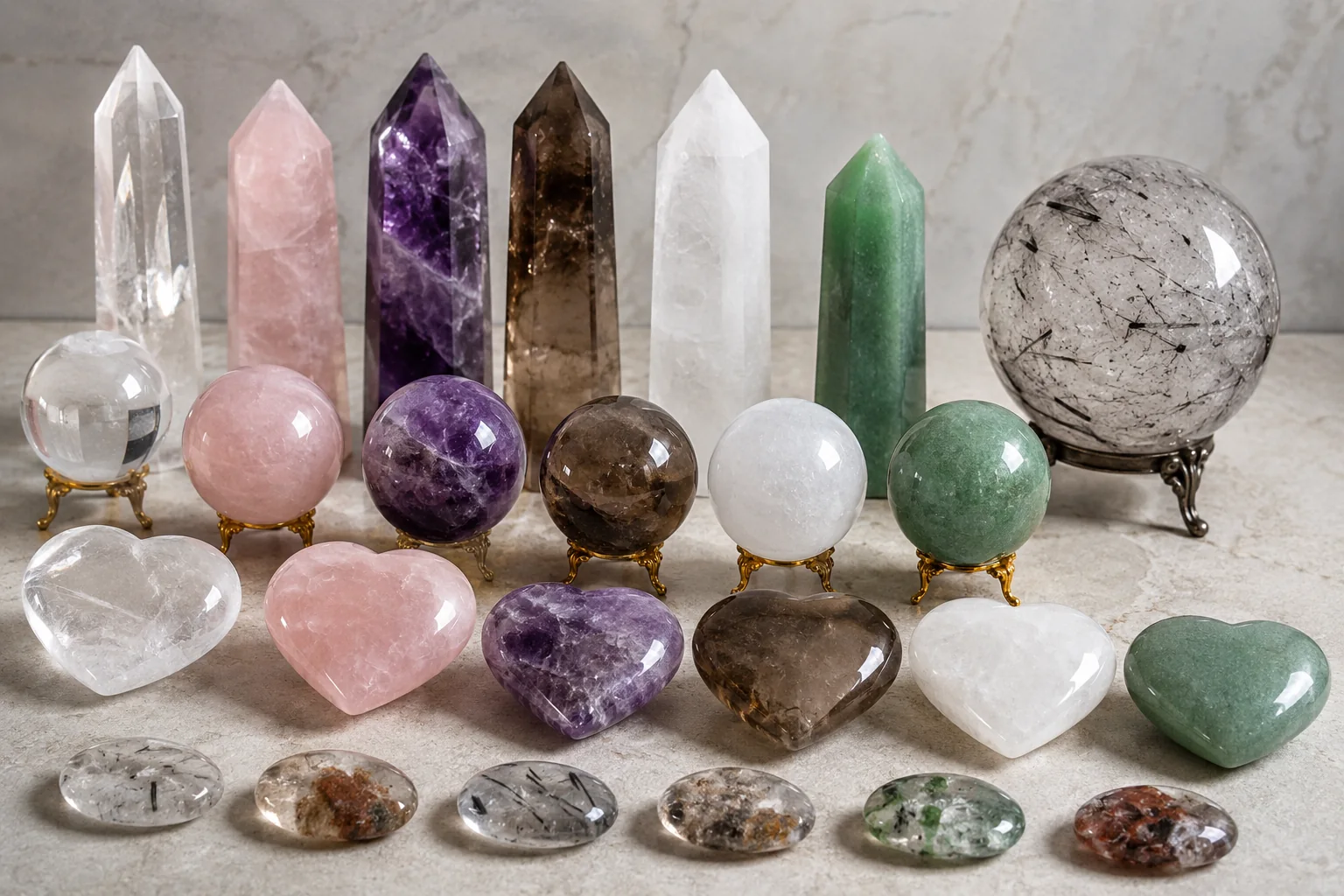
Now that you have a basic framework, you might be wondering how this commercial approach works in practice. It’s about shifting your focus from chasing an elusive "best" quality to creating a clear, verifiable purchase specification. Let's dive into how this method protects your business and helps you build a profitable crystal collection.
Why Is a Commercial Classification Better Than Geological Grades?
A frequent question we receive from new buyers is, "What grade is this rose quartz?" It's a natural question, but from a wholesale supplier’s perspective, it’s the wrong one to ask. There is simply no universally accepted, standardized grading system for quartz.
Terms like A, AA, and AAA are internal marketing labels that vary dramatically from one supplier to another.1 One factory's "AAA" might be another's "B" grade. Relying on these terms is a recipe for disappointment. The real solution lies in creating a detailed purchase specification—a document that turns vague quality claims into a verifiable checklist.
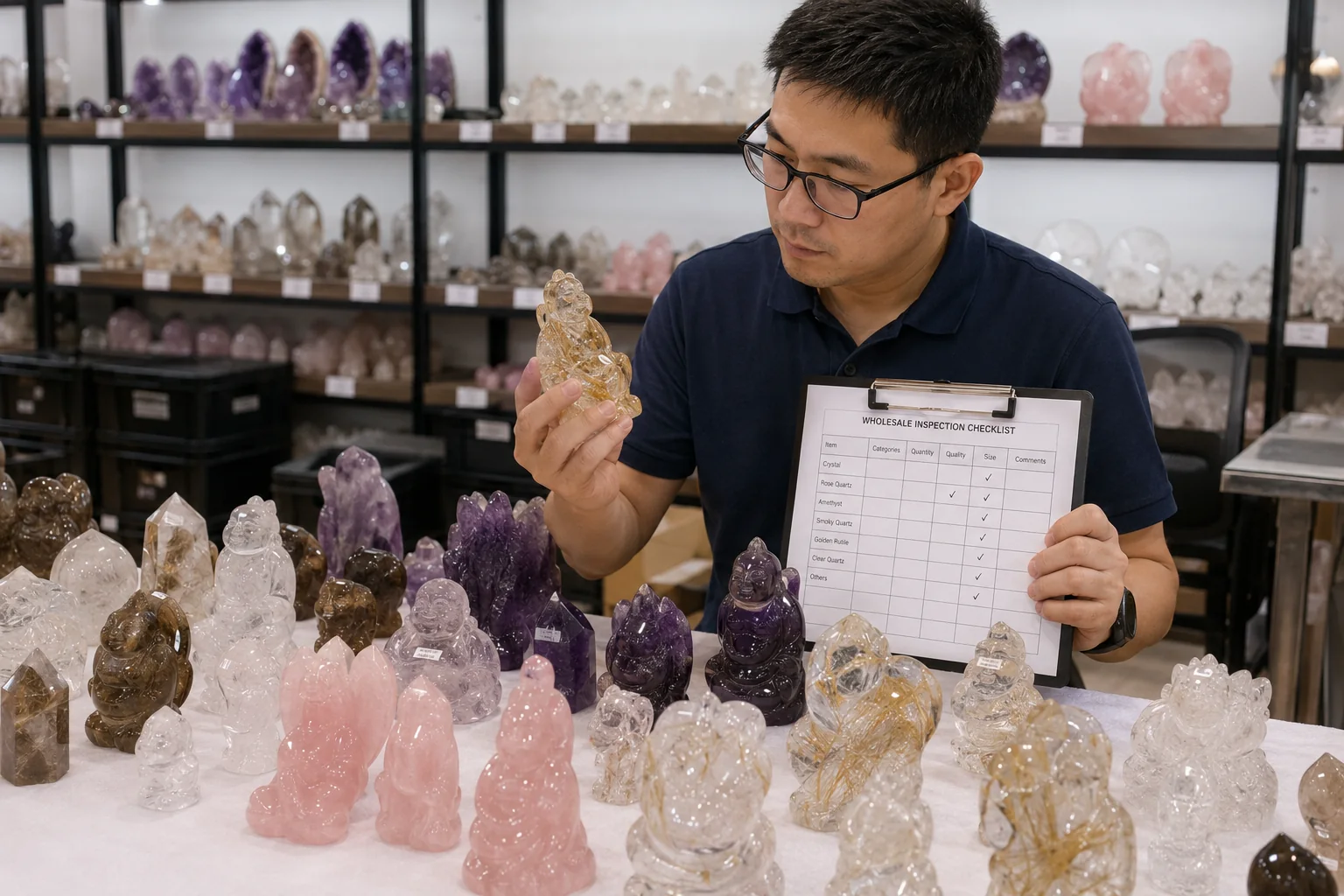
Dive Deeper: The Power of a Purchase Specification
Instead of asking for "AAA," a professional buyer provides a specification. This document precisely defines what you will and will not accept. It becomes the contract between you and your supplier, removing ambiguity and providing a clear basis for quality control inspections.
A robust specification should cover at least these eight points:
- Material Identification: E.g., "Natural Rose Quartz, from Madagascar."
- Color: E.g., "Medium pink, Pantone 13-1906 TCX, with no significant brown or grey undertones."
- Clarity & Inclusions: E.g., "Translucent. Minor internal veiling is acceptable. No surface-reaching black spots or large, dark mineral inclusions."
- Structural Integrity: E.g., "No visible, deep fractures that compromise the stability of the tower. Base must be stable and not wobble."
- Carving Accuracy: E.g., "Six-sided tower, symmetrical facets, sharp point centered over the base."
- Polish Quality: E.g., "High-gloss, mirror-like finish on all facets. No dull spots, scratches, or wheel marks."
- Dimensions & Weight: E.g., "Height: 80-100mm. Weight: 90-120g."
- Treatment Status: E.g., "Must be natural, unheated, undyed."
One mistake we often see is a buyer receiving a "hero sample" that looks perfect, only to find the bulk order is completely different. A specification sheet prevents this. When a problem arises, you don't have a subjective argument about "quality"; you have an objective checklist. The item either meets the spec, or it doesn't.
The 4 Commercial Groups for Sourcing Different Types of Quartz?
To make sourcing predictable, we group quartz by its commercial behavior—its availability, consistency, and primary risks. This helps you align your purchasing strategy with your business goals, whether you need a stable core product line or unique, high-margin showpieces.
This classification allows you to anticipate challenges. For high-volume items, the focus is managing natural variation. For color-sensitive quartz, it's verifying treatments. For included quartz, it's balancing storytelling with structural integrity.
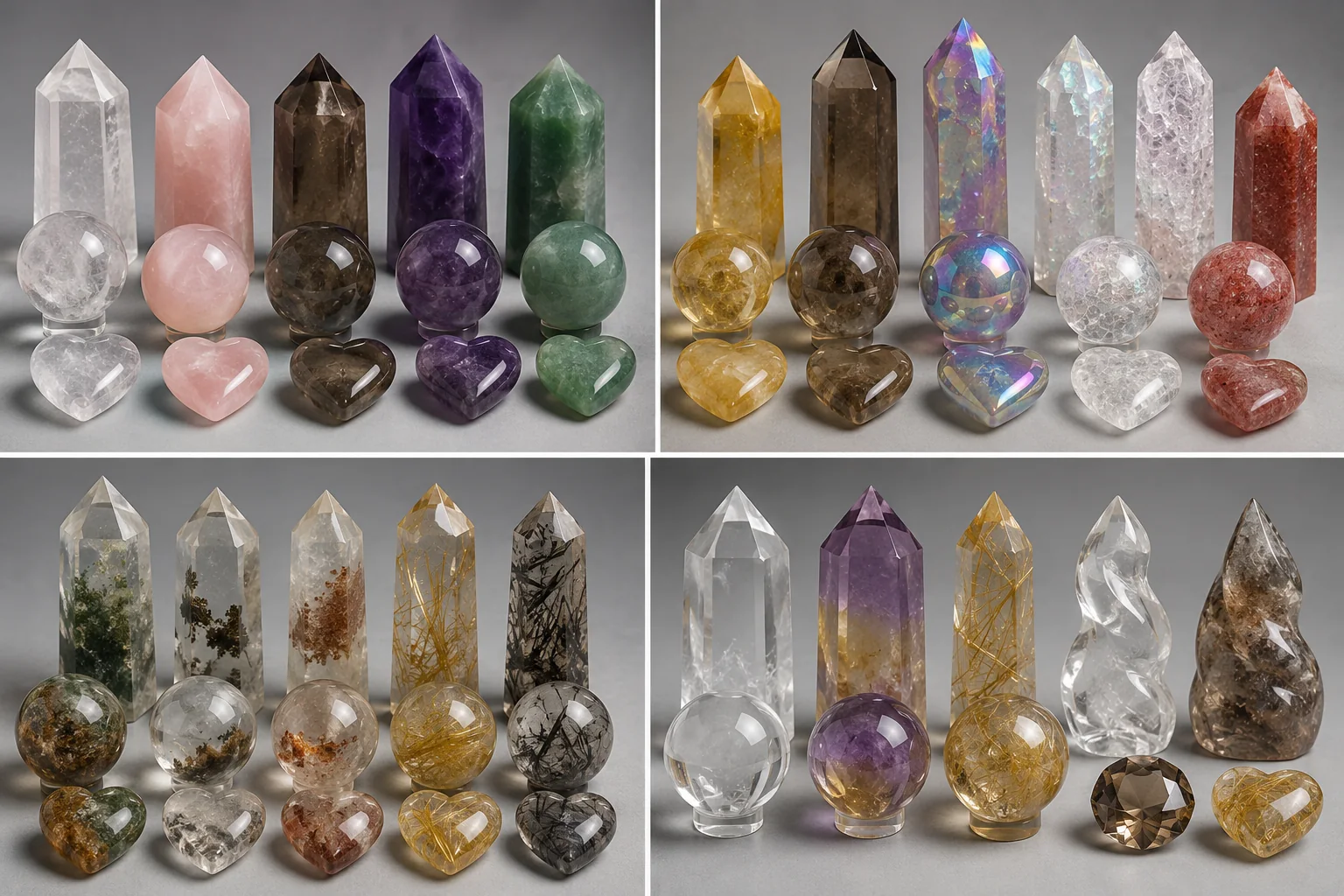
Dive Deeper: Aligning Your Business Model with Quartz Groups
Choosing the right quartz group is a strategic business decision. A new Etsy seller might focus on Group C for its unique, photographable pieces, while a large retail chain will rely on Group A for volume and consistency.
Here is a breakdown to help you decide:
| Commercial Group | Examples | Sourcing Reliability | Primary Risk | Best For Business Model |
|---|---|---|---|---|
| Group A: High-Volume | Clear Quartz, Milky Quartz, most Rose Quartz | High / Stable | Batch-to-batch color/clarity variation | Core collections, high-turnover items, starter packs |
| Group B: Color-Sensitive | Amethyst, Citrine, Smoky Quartz, Aura Quartz | Medium / Varies by treatment | Undisclosed heating, irradiation, or coating | Specific color stories, metaphysical collections |
| Group C: Inclusion-Based | Garden Quartz, Rutilated Quartz, Phantom Quartz | Low / Inconsistent | Poor batch consistency, structural weakness | Unique "one-of-a-kind" listings, storytelling pieces |
| Group D: Premium/Limited | High-clarity Rose Quartz, rare Phantoms, Ametrine | Very Low / Opportunistic | High cost, slow inventory turn, high yield loss | High-margin collector items, premium branding |
A common scenario we see is a business trying to build a core product line using Group C material. A buyer falls in love with a stunning Garden Quartz sphere and orders 100 more, expecting them to look the same. They are then shocked when the new batch has completely different "scenes" or is mostly cloudy quartz with few inclusions. The lesson is clear: use high-volume materials for repeatable products and inclusion-based materials for unique, individual listings.
A Deep Dive into the Main Types of Quartz Used for Crystal Carvings?
While the commercial groups provide a strategic framework, you still need to understand the specific characteristics of each material. Every type of quartz presents unique opportunities and challenges in sourcing, carving, and marketing.
Knowing these nuances is critical for writing accurate product descriptions and setting correct customer expectations. It's the difference between selling a product and building a brand that customers trust.
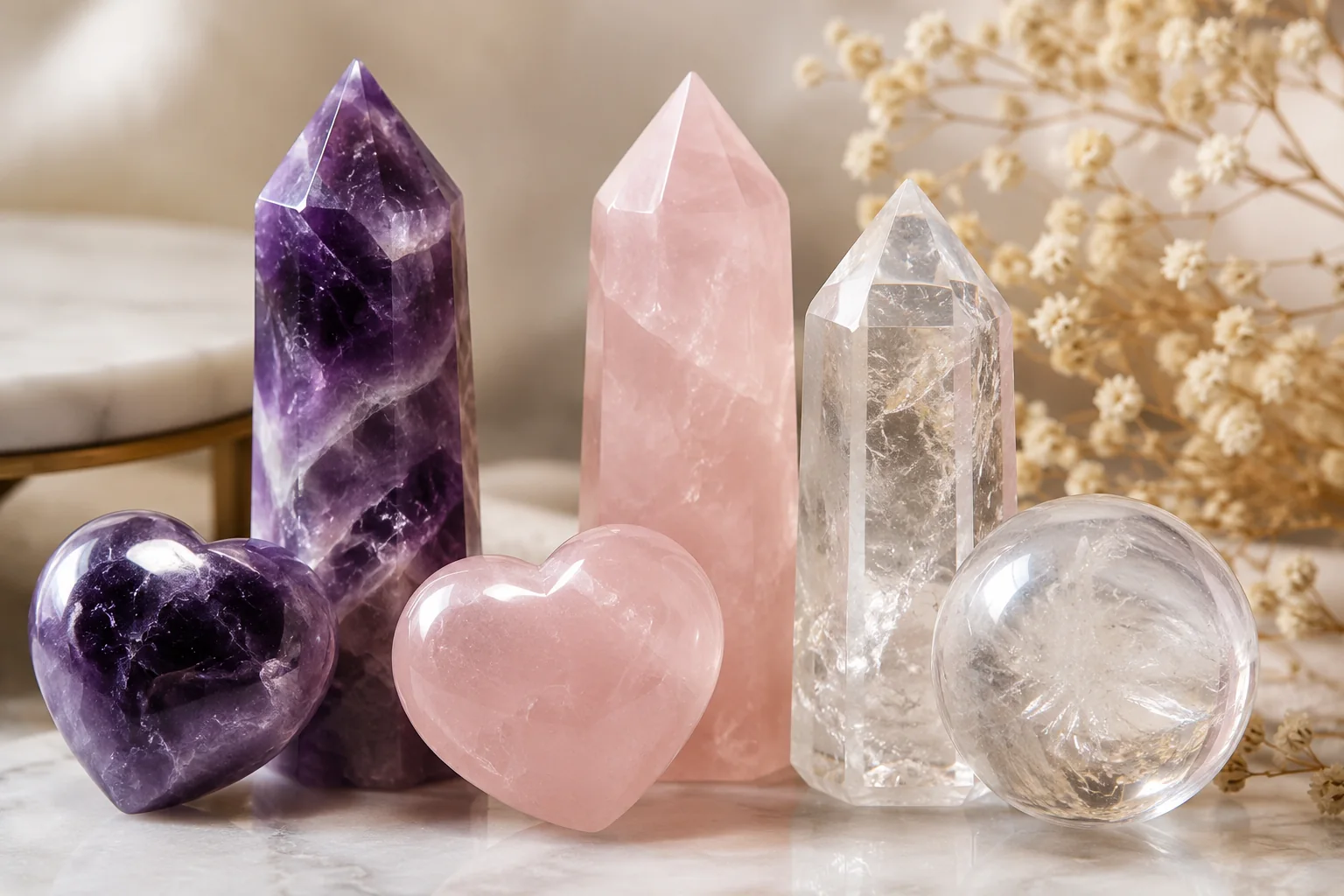
Dive Deeper: Commercial Profiles of Key Quartz Varieties
Let’s break down the most common types of quartz used for crystal carvings from a wholesale sourcing perspective. We'll focus on practical applications and risks, not just geological properties.
Clear Quartz
The workhorse of the crystal industry. Its primary value proposition is its versatility.
- Applications: Perfect for nearly any shape—towers, spheres, palm stones, animal carvings, and jewelry.
- Sourcing Risk: The main challenge is managing clarity. True "water clear" material is rare and expensive. Most commercial Clear Quartz has some degree of internal veiling, cloudiness, or minor fractures. Your specification needs to define the acceptable level of these "imperfections."
- My Advice: Be realistic. If you need 500 identical, perfectly clear towers for $5 each, it’s not going to happen with natural quartz. Specify a clarity range you can work with.
Rose Quartz
Valued for its color, which can range from pale, almost-white pink to a deep, rich rose.
- Applications: Best suited for smooth, rounded shapes like hearts, spheres, and palm stones that showcase its soft color and translucency.
- Sourcing Risk: Color consistency is the biggest battle. A common issue is suppliers using enhanced photos that make the color appear much deeper than it is. We once had a client who ordered 1,000 rose quartz hearts based on a vibrant photo, only to receive a batch that was mostly pale pink.
- My Advice: Always request a short, unedited video of the bulk material under natural light. Also, specify that you want "pink" material, not "pinkish-white."
Amethyst
Known for its purple color, which comes from iron impurities and natural irradiation.
- Applications: Geodes, clusters, points, and tumbled stones are classic. Carvings like spheres and towers are also popular.
- Sourcing Risk: Color zoning (uneven color distribution) and treatment. Lower-grade amethyst is often heated to become "Citrine." The color can also fade with prolonged exposure to direct sunlight, a fact you should share with your customers.2
- My Advice: Specify the desired color depth (e.g., "medium to deep purple") and ask for explicit confirmation that the material has not been heat-treated to alter its color.
Smoky Quartz
Its color ranges from a light, translucent grey-brown to nearly opaque black (Morion).
- Applications: Points, spheres, and faceted gems. Its grounding energy makes it popular for wands and palm stones.
- Sourcing Risk: The main risk is artificial irradiation. A great deal of the very dark, uniform Smoky Quartz on the market is clear or light quartz that has been artificially irradiated to create the color.3 Natural Smoky Quartz often has color variations and phantoms.
- My Advice: Ask your supplier directly: "Is this color natural or the result of laboratory irradiation?" A trustworthy partner will give you a straight answer.
Citrine
One of the most commercially complex stones. Natural Citrine is rare and typically a pale, smoky yellow.4 Most "Citrine" on the market is heat-treated Amethyst.
- Applications: Points, tumbled stones, and jewelry. The bright orange-yellow color is highly marketable.
- Sourcing Risk: Undisclosed treatment is rampant. Heat-treated Amethyst often has a reddish-orange tint and is more opaque at the base.
- My Advice: This is about transparency. It's perfectly fine to sell heat-treated Citrine as long as you label it correctly and price it accordingly. Frame it as "heat-treated Citrine" in your product listings. Never imply it is rare, natural Citrine unless you have proof from your supplier.
| Quartz Type | Common Appearance | Popular Applications | Primary Sourcing Risk | Treatment Concern |
|---|---|---|---|---|
| Clear Quartz | Colorless, often with veils | Towers, Spheres, Points, Any Shape | Inconsistent clarity; "water clear" is rare | Generally none |
| Rose Quartz | Pale to deep pink, translucent | Hearts, Spheres, Palm Stones | Inconsistent color; exaggerated photos | Heating (rare), Irradiation (rare) |
| Amethyst | Light lilac to deep purple | Clusters, Points, Geodes, Spheres | Color fading in sunlight; color zoning | Heating (to create "Citrine") |
| Smoky Quartz | Light brown-grey to black | Points, Wands, Spheres | Artificial irradiation to darken color | Irradiation |
| Citrine | Pale yellow to orange-brown | Points, Tumbled Stones, Jewelry | Widespread heating of Amethyst | Heating |
| Garden Quartz | Clear quartz with mineral inclusions | Spheres, Freeforms, Pendants | Huge batch inconsistency; weak structure | None |
Is Workmanship More Important Than the Quartz Itself?
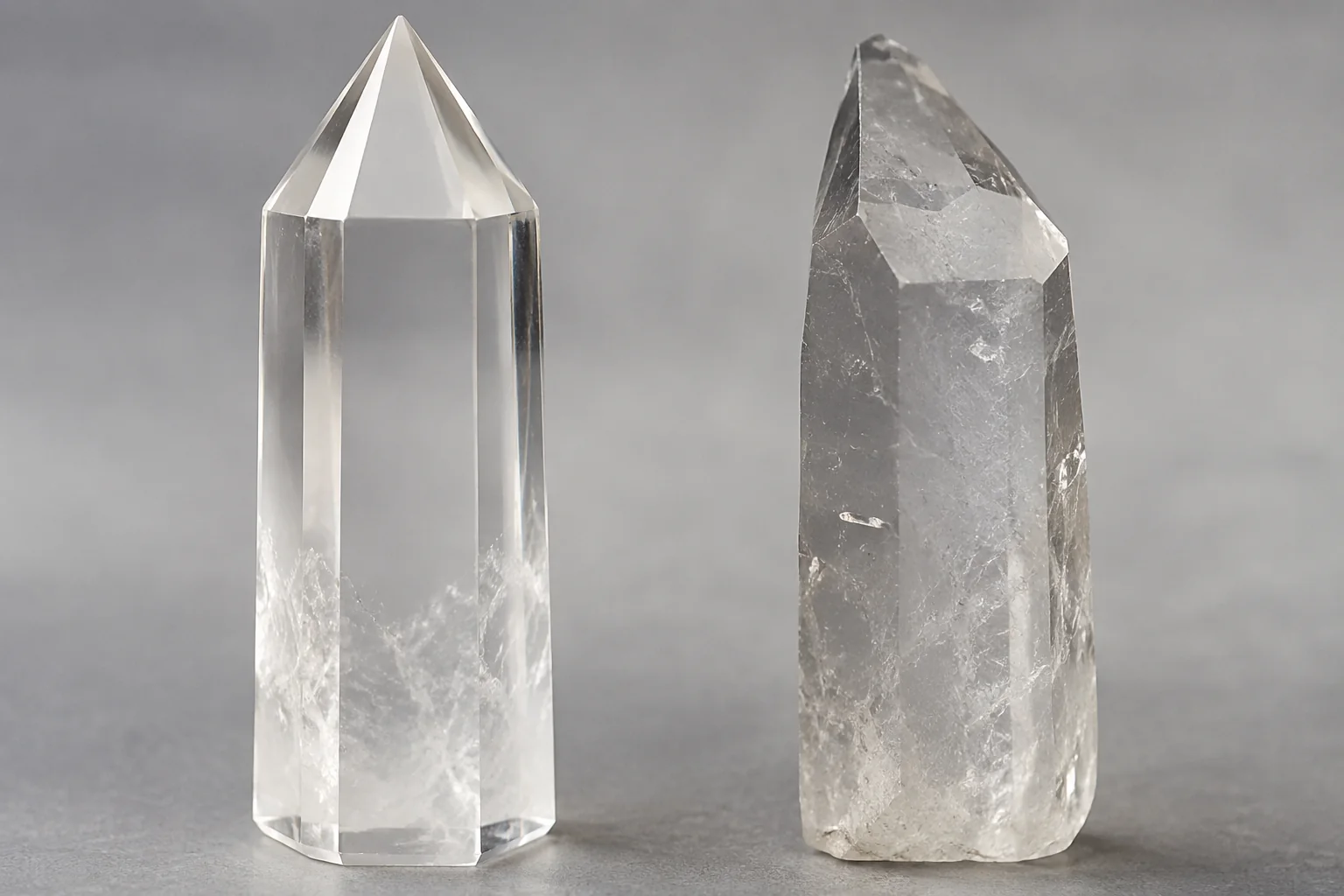
You can source the most beautiful, high-clarity quartz block in the world, but if the carving and polishing are poor, the final product is worthless. We’ve seen premium rutilated quartz ruined by lopsided carving and asymmetrical polishing.
Material and workmanship are two sides of the same coin.5 A great carving can’t save terrible material, but terrible workmanship will absolutely destroy great material. As a buyer, you must inspect for both.
Dive Deeper: A Checklist for Workmanship Defects
When your order arrives, don't just admire the material. Get critical and inspect the manufacturing quality. Here is a checklist of common workmanship defects we see:
- Symmetry and Shape:
- Are towers and points perfectly vertical, or do they lean?
- Are spheres truly round, or are they slightly egg-shaped?
- Are hearts and other symmetrical shapes balanced on both sides?
- Base Stability:
- Does the piece sit flat without wobbling? An unstable base is a sign of rushed cutting.
- Point and Edge Quality:
- Are points sharp and centered? Or are they chipped, dull, or off-center?
- Are the edges of facets crisp and well-defined?
- Polish and Finish:
- Is the surface smooth and reflective everywhere?
- Look for dull patches, scratches, or visible wheel marks from the polishing process.
- Check inside drill holes (on beads or pendants) for roughness.
- Structural Integrity Post-Carving:
- Did the carving process create new micro-fractures, especially around delicate areas?
A common situation involves animal carvings. A buyer orders 100 fluorite foxes. The material is beautiful, but the carving is crude—the ears are uneven, the snouts are blunt, and the polishing is patchy. The beautiful fluorite banding is wasted. The lesson here is that for complex shapes, workmanship often becomes the primary factor in determining the final product's value.
Frequently Asked Questions
What's the difference between natural, treated, synthetic, and imitation quartz?
Natural quartz is mined from the earth and only cut and polished.6 Treated quartz is natural quartz that has been enhanced (e.g., heated, irradiated, dyed). Synthetic quartz is lab-grown but has the same chemical and physical properties.7 Imitation is a different material, like glass, made to look like quartz.
Is treated quartz "bad" or "fake"?
No. Treatment is a standard industry practice. The issue is non-disclosure. Heat-treated Citrine is still quartz, but it should be sold as "heat-treated," not as rare natural Citrine. Honesty allows for correct pricing and builds customer trust.8
Why do my repeat orders of rose quartz look so different?
This is due to natural variation. Rose quartz color depends on the specific mine and even the specific vein within that mine.9 To manage this, provide your supplier with a physical sample or a Pantone color reference and define an acceptable range of color variation in your purchase specification.
Can I ask for only "perfect," inclusion-free quartz?
You can ask, but it will be extremely expensive and available only in small quantities. For most commercial purposes, it's better to define an acceptable level of natural characteristics. A few internal veils in a clear quartz tower are natural, not defects.
How do I vet a new wholesale supplier for quartz carvings?
Ask specific, technical questions. Instead of "Is your quality good?" ask, "Can you confirm this citrine is natural or heat-treated?" "Can you show me a video of the bulk rose quartz stock under natural light?" A good supplier welcomes detailed questions; a bad one will give vague answers.
Conclusion
Successfully sourcing the many types of quartz used for crystal carvings isn't about finding a secret "best" variety. It's about implementing a professional sourcing process. By replacing ambiguous marketing grades with a precise purchase specification, classifying quartz by its commercial behavior, and rigorously inspecting for both material and workmanship, you transform from a hopeful buyer into a savvy business owner. This structured approach minimizes risk, ensures consistency, and builds a foundation for a profitable and trusted crystal brand.
If you're ready to partner with a supplier who believes in transparency and works with you to build a successful product line, we're here to help. We can guide you in selecting the right materials, creating effective specifications, and sourcing beautiful carvings that your customers will love.
Contact us today at Crystal Carvings Wholesale via WhatsApp at +86 150 7540 9178 or email sales@crystalcarvingswholesale.com to discuss your sourcing needs.
<!--[googlesitekit-end-of-content]-->
"Standardization", https://en.wikipedia.org/wiki/Standardization. Quartz grading systems are not standardized across the industry, with terms like AAA being subjective and varying by supplier. This is supported by educational resources on gemology and mineral trade practices. Evidence role: expert_consensus; source type: education. Supports: The absence of a universal grading system for quartz in the crystal industry.. Scope note: The source may focus on broader gemstone grading rather than quartz-specific practices. ↩
"How quickly does the sun bleach amethyst? : r/Crystals", https://www.reddit.com/r/Crystals/comments/lfmodc/how_quickly_does_the_sun_bleach_amethyst/. Amethyst color can fade under prolonged exposure to sunlight, as documented in studies on UV effects on gemstones. Evidence role: mechanism; source type: research. Supports: The fading of amethyst color due to prolonged sunlight exposure.. Scope note: The degree of fading may depend on the specific mineral composition and exposure duration. ↩
"Gemstone irradiation", https://en.wikipedia.org/wiki/Gemstone_irradiation. Artificial irradiation is commonly used to darken Smoky Quartz, as noted in gemological research on gemstone treatments. Evidence role: mechanism; source type: research. Supports: The use of artificial irradiation to enhance the color of Smoky Quartz.. Scope note: The source may not address the prevalence of natural versus treated Smoky Quartz in the market. ↩
"Citrine Gemstone | Natural Citrine Stone", https://www.gia.edu/citrine/buyers-guide. Natural Citrine is considered rare and is often pale yellow to smoky yellow in color, as noted in gemological references. Evidence role: general_support; source type: encyclopedia. Supports: The rarity and typical color profile of natural Citrine.. Scope note: The source may not address commercial availability or market trends. ↩
"How Gemstone Carving and Fine Art are Intricately Linked🖌️💎 ✨Blog ...", https://www.facebook.com/Gemporia/posts/how-gemstone-carving-and-fine-art-are-intricately-linked%EF%B8%8Fblog-by-kate-mccarthy-p/605735262127383/. Material quality and workmanship are equally critical in determining the value of quartz carvings, as emphasized in gemology education resources. Evidence role: expert_consensus; source type: education. Supports: The equal importance of material quality and workmanship in quartz carvings.. Scope note: The source may focus on general gemstone practices rather than quartz-specific examples. ↩
"Quartz", https://en.wikipedia.org/wiki/Quartz. Natural quartz is defined as quartz that is mined and only subjected to cutting and polishing, according to gemological references. Evidence role: definition; source type: encyclopedia. Supports: The definition of natural quartz as mined and minimally processed material.. Scope note: The source may not address industry-specific terminology variations. ↩
"Quartz", https://en.wikipedia.org/wiki/Quartz. Synthetic quartz is lab-grown and shares identical chemical and physical properties with natural quartz, as documented in materials science research. Evidence role: definition; source type: research. Supports: The chemical and physical equivalence of synthetic quartz to natural quartz.. Scope note: The source may not address market perceptions or pricing differences. ↩
"How disclosing sponsored content affects consumer trust in bloggers", https://business.cornell.edu/news/2018/08/14/disclosing-sponsored-content-consumer-trust/. Transparent disclosure of gemstone treatments builds customer trust and supports accurate pricing, as documented in studies on consumer behavior in the gemstone market. Evidence role: general_support; source type: research. Supports: The role of transparency in building customer trust and supporting accurate pricing in gemstone sales.. Scope note: The source may not address specific practices in the quartz carving industry. ↩
"Rose Quartz Gem", https://www.gia.edu/rose-quartz. Rose quartz color variation is influenced by its geological source, including the mine and vein, as noted in mineralogical studies. Evidence role: mechanism; source type: research. Supports: The geological factors influencing the color variation of rose quartz.. Scope note: The source may not address commercial practices affecting color presentation. ↩
Keep Reading