Trading Company vs. Direct Factory: Which Crystal Supplier is Right for You?
Choosing the right crystal supplier is one of the most critical decisions for your business, yet it’s fraught with confusion and hidden risks. You spend hours searching for a reliable partner, only to face inconsistent product quality1, endless communication delays, and the sinking feeling that you’re overpaying. This frustration grows when you realize the "manufacturer" you're working with might just be a middleman, eroding your profits and control over your own products. The key to breaking this cycle is understanding the fundamental difference between sourcing from a trading company and partnering with a direct factory.
A trading company is a professional reseller that sources finished products from various workshops and sells them for a markup. A direct factory, in contrast, is the creator that manages the entire manufacturing process, from procuring raw stone to carving, polishing, and shipping the final product. Your choice between them directly impacts your quality control, customization capabilities, and profit margins.
Now that you know the core distinction, let's explore why it matters so much. The differences in their business models create ripple effects that can either accelerate your business growth or trap you in a cycle of sourcing problems. We'll dive into the critical areas where these two types of suppliers diverge completely.
What’s the Core Difference in Their Business Model?
You've likely seen it yourself: two suppliers with beautiful websites, both claiming to be "manufacturers." Yet, their communication styles, pricing, and capabilities feel worlds apart. This isn't just a coincidence; it reflects a deep, operational difference that can make or break your inventory strategy.
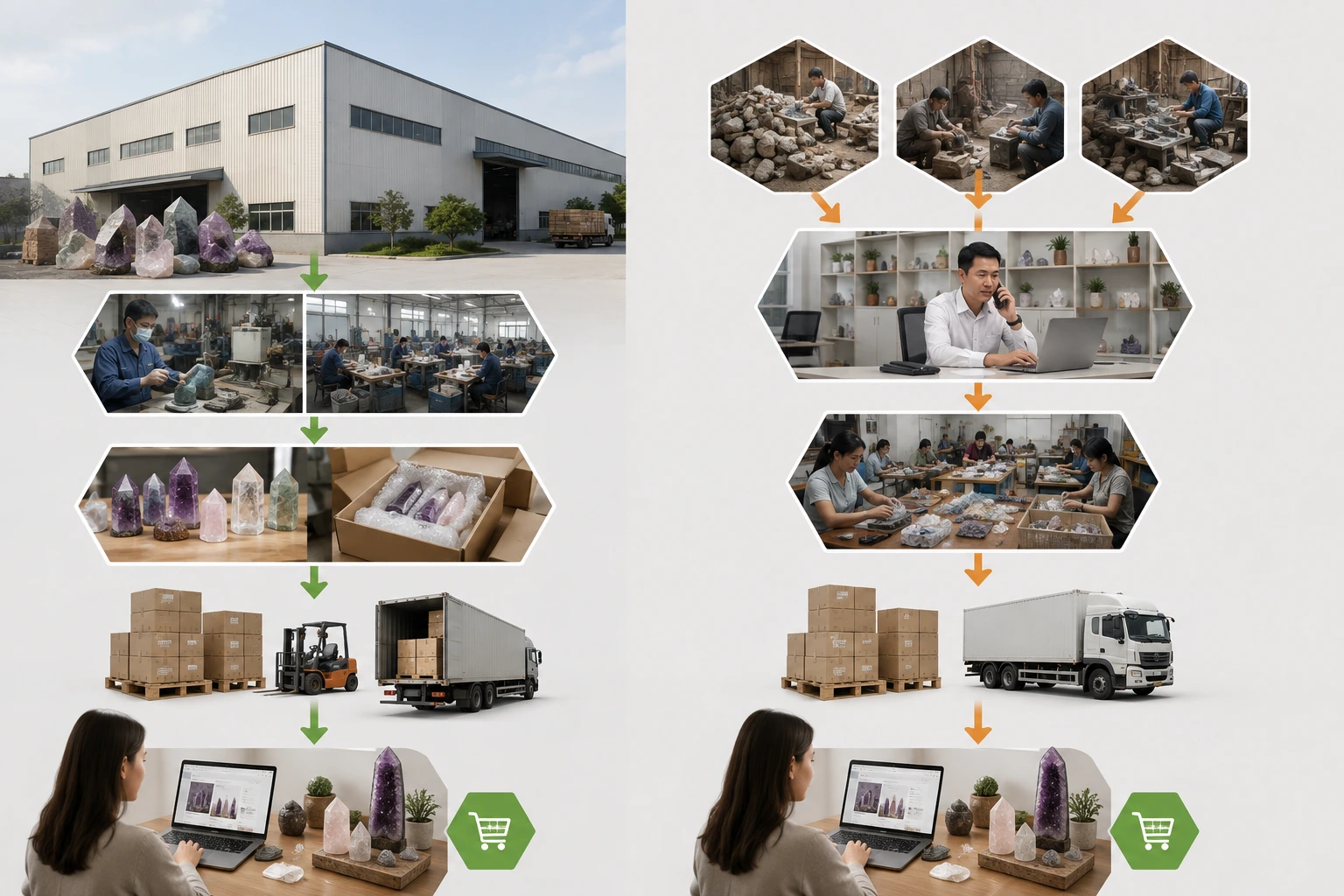
The essential difference lies in their function. A trading company operates as a professional "shopper" or sourcing agent, while a direct factory is an industrial "creator." Understanding this is the first step to identifying the right kind of crystal supplier for your specific needs.
H3: The Trading Company Model: Sourcing & Arbitrage
A trading company's business model is built on information and access, not manufacturing. Think of them as "professional buyers" for the crystal industry. When you place an order with them, their team doesn't head to a production floor—they head to the market. In China, this often means visiting the vast crystal markets in places like Donghai2 or leveraging networks of small, family-run workshops through platforms like WeChat.
Their primary activities include:
- Sourcing: Finding existing products from multiple small producers to fulfill your order.
- Consolidating: Gathering items from various sources into a single shipment.
- Arbitrage: Their profit comes from the price difference between what they pay the workshops and what they charge you. This markup is typically between 20% and 50%.
They don't purchase raw stone by the ton or operate heavy machinery. Their main asset is their network of suppliers. While this offers flexibility for buyers who want a wide variety of unrelated products, it introduces significant risks for anyone focused on a specific niche like crystals.
H3: The Direct Factory Model: Raw Material to Finished Good
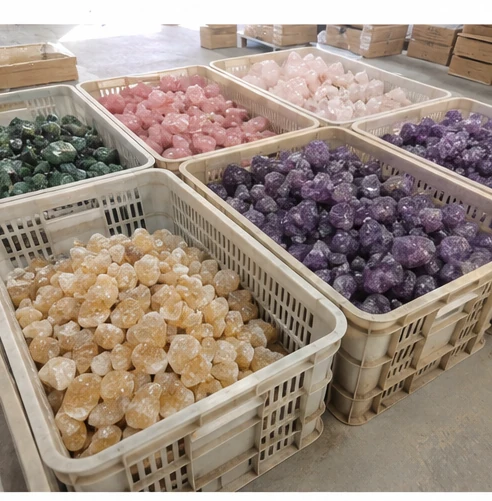
As a direct factory, our business model—and that of any true manufacturer—is fundamentally different. We are creators, not resellers. The process starts at the very beginning of the supply chain. We purchase raw, natural stones like amethyst, rose quartz, and labradorite by the ton directly from mines in Brazil, Madagascar, and other source countries3.
Our operation is an industrial process:
- Raw Material Procurement: Selecting and buying large blocks of quality raw minerals.
- Cutting & Shaping: Using industrial saws to cut the raw blocks into manageable slabs or pre-formed shapes.
- Carving & Detailing: Employing skilled artisans and machinery to carve the designs.
- Polishing: Running the items through a multi-stage polishing process4 to achieve the desired luster and smoothness.
- Quality Control: Inspecting every single piece against a strict, unified standard.
Our profit is generated from the industrial value-add—the transformation of a low-cost raw material into a high-value finished product. We control every step, which is the only way to guarantee consistency, quality, and technical expertise.
How Does Your Crystal Supplier Affect Quality Control?
Have you ever approved a beautiful sample, only to receive a bulk order where half the items look like poor imitations? This is perhaps the most common and costly complaint from buyers, and it almost always points back to the supplier's operating model. The "bait and switch" phenomenon isn't always intentional malice; it's often the inevitable result of a fragmented supply chain.
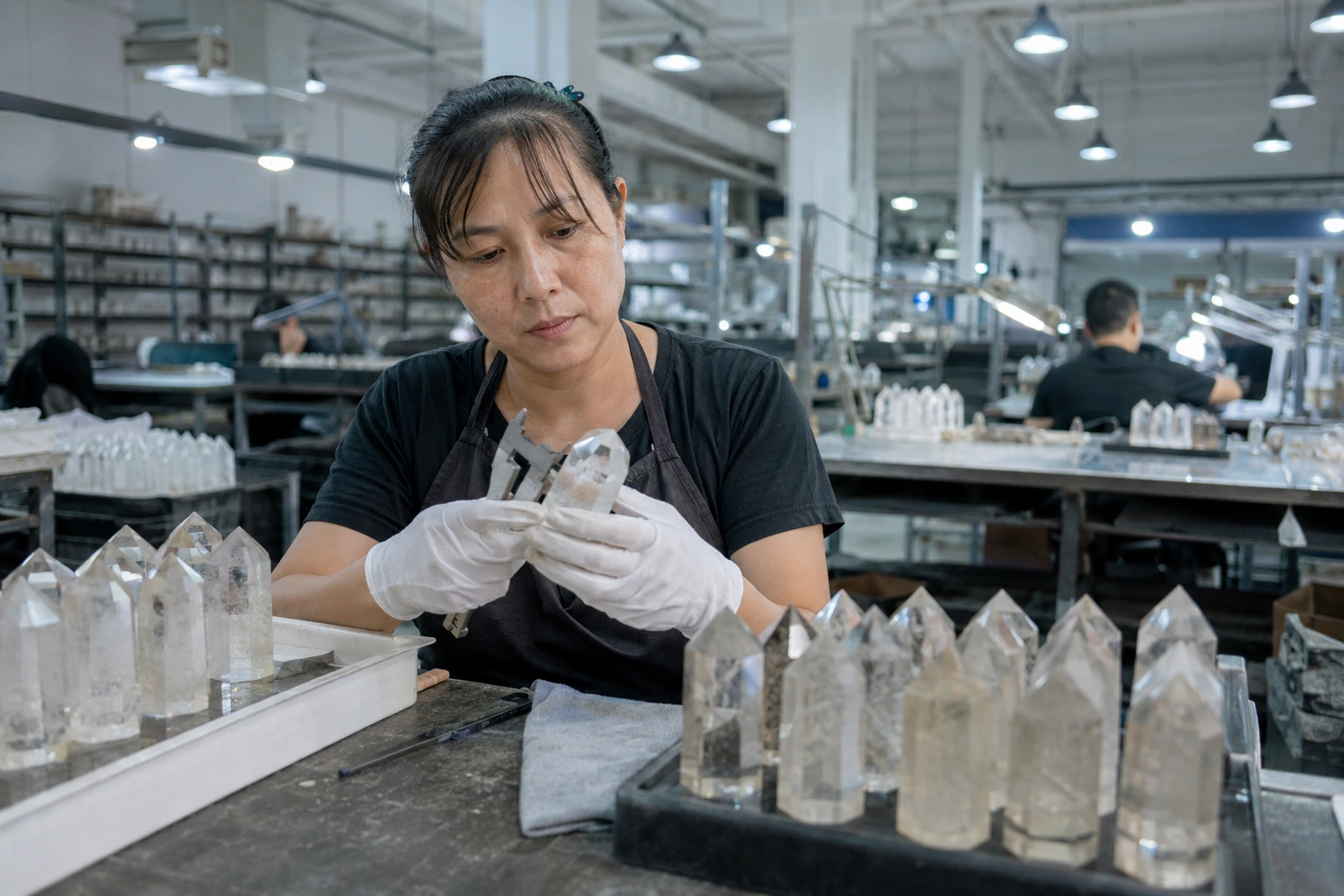
A direct factory provides "single-source" quality control, as your entire order is made from the same raw material batch and processed on one production line. In contrast, a trading company's reliance on multiple workshops often leads to a "batching disaster," resulting in wildly inconsistent quality.
H3: The "Batching Disaster" with Trading Companies
Let's imagine you order 500 labradorite hearts from a trading company. To fill this order quickly and cheaply, the trader might source them from three different workshops:
- Workshop A provides 200 pieces made from high-quality material with a brilliant blue flash.
- Workshop B provides 200 pieces made from a lower-grade stone with a dull, muddy appearance.
- Workshop C delivers the final 100 pieces, but the carving proportions are slightly off, making them look thicker than the sample.
The trading company's job is to consolidate, not to re-manufacture. They will likely pack all 500 pieces into one box and ship it to you. When you open it, you're faced with a chaotic mix of quality. This inconsistency makes it impossible to build a reputable brand, as your customers will never know what to expect.
H3: "Same-Source" Quality Control at the Factory
Now, consider ordering those same 500 labradorite hearts from a direct factory like us. The process is completely different. The entire order begins as a single, large batch of raw labradorite stone selected for its quality. Every piece follows the exact same journey:
- It's cut by the same machines.
- It's shaped and carved by the same team of artisans.
- It's polished on the same production line using the same compounds.
- It's inspected by one QC manager against one set of standards.
At our factory, quality control begins when the material is still a giant rock. Any piece with a significant flaw, poor coloration, or structural crack is identified and culled during the production process. It never even makes it to the packaging area. This "same-source" methodology is the only way to ensure that the 500th piece is virtually identical in quality to the first.
Can Your Crystal Supplier Handle True Customization (OEM/ODM)?
As your business grows, you'll inevitably want to create your own unique designs—a custom-shaped worry stone, a private-label crystal tower, or an exclusive carving for your subscription box. This is the ultimate test that separates a true factory from a trading company. When you venture into OEM/ODM, the cracks in the trading company model become impossible to ignore.
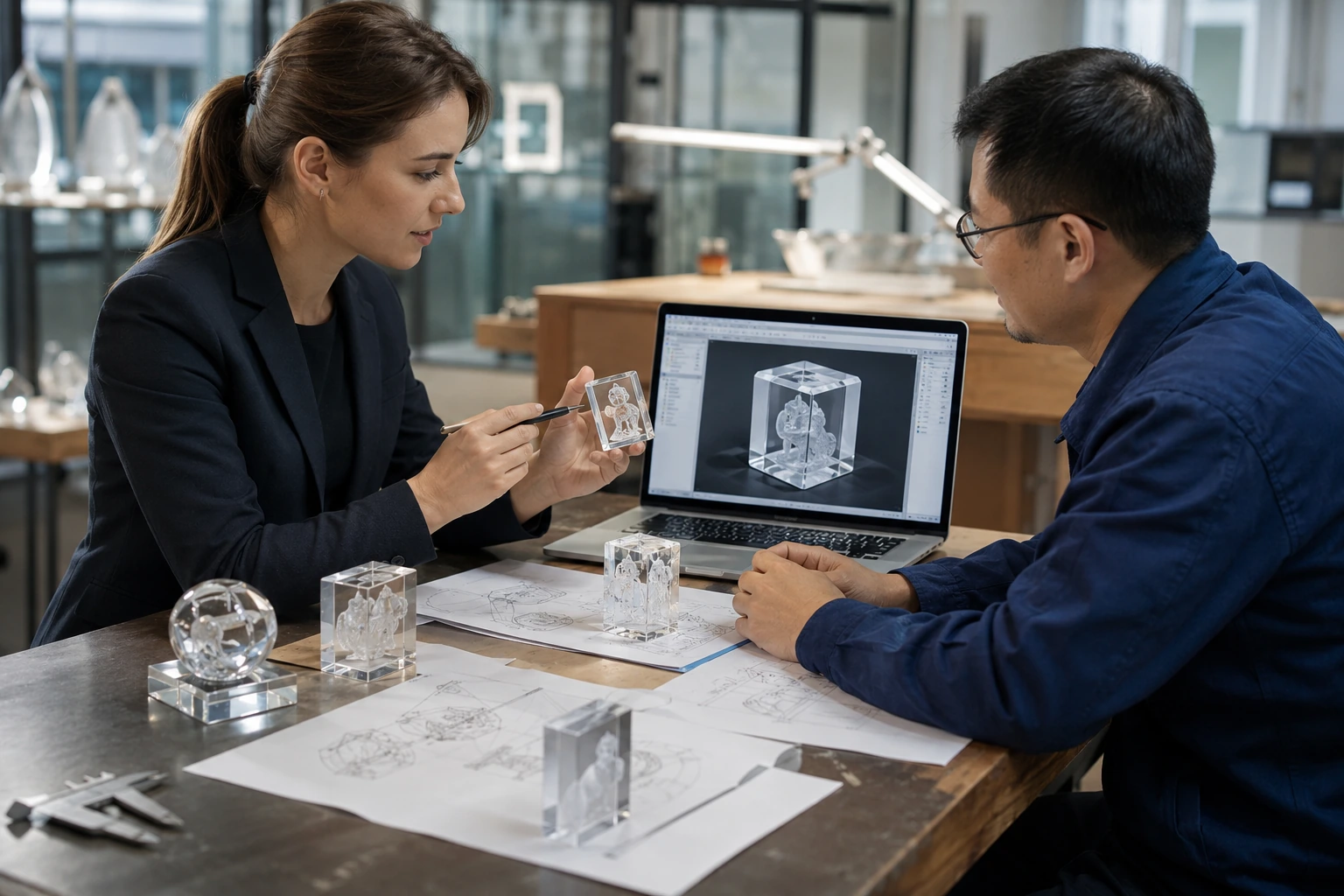
A direct factory offers "engineer-to-engineer" communication for customization, providing expert technical feedback on materials and design. Attempting the same with a trading company often devolves into a frustrating "telephone game," where critical details are lost in translation between you, the trader, and the actual maker.
H3: The "Telephone Game" of Customizing with a Trader
When you send your unique design to a trading company, they become a simple messenger. The process looks like this:
- You send your design file and instructions in English.
- The trader translates (or misinterprets) your request for the workshop owner.
- The workshop owner gives verbal instructions to the carving artisan.
- The artisan produces a sample based on this third-hand information.
- You receive the sample and notice the nose on your carving isn't quite right. You send feedback.
- The feedback travels back through the same broken chain of communication.
This back-and-forth is not only slow and inefficient, but it also fails at a technical level. The trader likely has no practical knowledge of gemology or carving. They can't tell you that a sharp, 90-degree angle is prone to chipping5 in brittle amethyst but works perfectly for obsidian. They just push the workshop to "make it work," often resulting in a compromised final product and immense frustration on your end.
H3: "Engineer-to-Engineer" Customization with a Factory
When you work with a direct factory, you are communicating directly with the people who have the machines and the technical knowledge. You speak with our product managers and technicians—the "engineers" of the crystal world.
If you send us a design, our first response will be a technical evaluation. We might say, "This is a beautiful design. For it to work with rose quartz, we recommend increasing this curve by 5 degrees to prevent fracturing along the stone's natural cleavage plane. If you want to keep the sharper angle, we suggest using black obsidian, which is much more stable for this type of cut."
Because we have our own mold-making equipment, 3D printers for prototyping, and a full range of carving and polishing machines, we can:
- Provide expert feedback to improve your design for manufacturing.
- Create accurate pre-production samples quickly.
- Maintain absolute consistency across your entire custom order.
This level of partnership is impossible for a crystal supplier who doesn't own a single piece of equipment.
Where Do Your Profits Go with Each Type of Crystal Supplier?
Ultimately, your success as a retailer depends on your profitability. If your supply chain is eating up too much of your margin, you won't have the resources to invest in marketing, customer service, or growth. The price you pay for your products is directly tied to the number of middlemen between you and the production floor.
Sourcing directly from a factory eliminates the 20-50% markup charged by trading companies6. This recovered margin isn't just extra profit; it's the financial fuel you need to scale your business, run ad campaigns, and out-compete others in a crowded market.
Let's do some simple math on a hypothetical amethyst cluster that retails for $100.
| Cost & Profit Breakdown | Sourcing via Trading Company | Sourcing Direct from Factory |
|---|---|---|
| Factory Production Cost | $20 | $20 |
| Your Purchase Price | $30 - $35 | $20 |
| Trader's Markup | $10 - $15 | $0 |
| Your Potential Profit | $65 - $70 | $80 |
That extra $10-$15 you save on every single piece by going direct is your lifeline. That's the money that pays for:
- Your Google or Facebook Ads campaigns.
- Collaborations with influencers.
- Upgraded, branded packaging.
- Offering competitive retail prices or running sales.
- Your ability to place larger orders and scale up.
If you plan to build a serious, long-term business, protecting that 20-30% margin7 by removing the middleman is not just an option—it's a strategic necessity.
Frequently Asked Questions
How can I tell if a crystal supplier is a factory or a trading company?
Ask for a factory tour via video call. A true factory will proudly show you their raw material warehouse, cutting machines, polishing lines, and workers. Also, ask technical questions about material properties or customization limitations. A factory can answer immediately; a trader will have to "check and get back to you."
Are trading companies always a bad choice?
Not at all. If you run a general gift shop and want to buy 10 crystal spheres, 20 yoga mats, and 50 incense burners in one order, a trading company acting as a sourcing agent is perfect. They excel at cross-category consolidation. They are the wrong choice for specialization, branding, and scale.
What is the MOQ for a direct factory vs. a trading company?
This is a common misconception. Many believe factories always have sky-high MOQs. At Crystal Carvings Wholesale, we offer flexible, low-MOQ trial orders8 and mixed-style orders because we cater to businesses of all sizes. A trading company's MOQ is often based on the collective MOQs of its many small suppliers.
Why do so many "manufacturers" on Alibaba turn out to be traders?
It's easy to create a polished website or Alibaba profile and label yourself a "manufacturer." Many trading companies do this to appear more authoritative and justify higher prices. Over 80% of listings you find are likely traders. Due diligence, like asking for a video tour, is essential to verify their claims.
Conclusion
Choosing the right crystal supplier comes down to aligning your business goals with your partner's capabilities. There is a place for both trading companies and direct factories in the global supply chain, but they serve very different needs. A trading company offers convenience for broad, non-specialized sourcing. However, for any business focused on building a reputable brand in the crystal, gemstone, or metaphysical space, the choice is clear.
To ensure consistent quality, unlock true customization, and protect your profit margins for growth, you must bypass the middlemen. Partnering directly with a factory like Crystal Carvings Wholesale gives you control over your products from the ground up, transforming your supply chain from a liability into a competitive advantage. This direct relationship is the only sustainable path to scaling your crystal business.
If you are ready to improve your product quality, develop your own branded line, and increase your profitability, the next step is to connect with a true factory partner. Contact us at Crystal Carvings Wholesale to discuss how our direct manufacturing process can help you build a stronger, more successful crystal collection.
<!--[googlesitekit-end-of-content]-->
"How to Choose a Reliable Crystal Carvings Wholesale Supplier in ...", https://crystalcarvingswholesale.com/how-to-choose-a-reliable-crystal-carvings-wholesale-supplier-in-china/. Research indicates that trading companies frequently source products from multiple suppliers, which can lead to inconsistencies in quality due to variations in production standards and materials used. Evidence role: general_support; source type: research. Supports: Trading companies often face challenges in maintaining consistent product quality due to reliance on multiple suppliers.. Scope note: The support may vary depending on the specific industry or region being discussed. ↩
"How to Choose a Reliable Crystal Carvings Wholesale Supplier in ...", https://crystalcarvingswholesale.com/how-to-choose-a-reliable-crystal-carvings-wholesale-supplier-in-china/. Donghai is widely regarded as one of the largest centers for crystal production and trade in China, hosting numerous workshops and markets dedicated to the industry. Evidence role: historical_context; source type: encyclopedia. Supports: Donghai is recognized as a significant hub for crystal markets in China.. Scope note: The prominence of Donghai may be specific to certain types of crystals or time periods. ↩
"Amethyst", https://en.wikipedia.org/wiki/Amethyst. Geological studies and trade reports identify Brazil and Madagascar as leading global sources of high-quality amethyst and rose quartz. Evidence role: general_support; source type: education. Supports: Brazil and Madagascar are key exporters of raw natural stones such as amethyst and rose quartz.. Scope note: The prominence of these countries may vary depending on the specific type and quality of the stones. ↩
"How Are Crystal Carvings Made? A Complete Production Process ...", https://crystalcarvingswholesale.com/how-are-crystal-carvings-made-a-complete-production-process-guide/. Educational resources on gemstone processing describe multi-stage polishing as a standard method for achieving high-quality finishes in crystals. Evidence role: mechanism; source type: education. Supports: A multi-stage polishing process is used in factories to enhance the luster and smoothness of crystals.. Scope note: The specific stages and techniques may vary depending on the factory and type of crystal. ↩
"Amethyst Gemstone | Amethyst Stone", https://www.gia.edu/amethyst. Gemological studies confirm that brittle stones like amethyst are susceptible to chipping at sharp angles due to their cleavage planes and structural weaknesses. Evidence role: mechanism; source type: education. Supports: Sharp angles in brittle materials like amethyst are prone to chipping due to their structural properties.. Scope note: The susceptibility to chipping may vary depending on the specific quality and treatment of the stone. ↩
"Profit Margin vs. Markup: Key Differences Explained - Investopedia", https://www.investopedia.com/ask/answers/102714/whats-difference-between-profit-margin-and-markup.asp. Studies on supply chain economics show that trading companies often add a markup of 20% to 50% to cover their operational costs and profit margins. Evidence role: statistic; source type: research. Supports: Direct sourcing from factories avoids the typical 20-50% markup applied by trading companies.. Scope note: The markup range may vary depending on the product type and market dynamics. ↩
"[PDF] Benefits of sourcing alternative inputs of manufacturers for suppliers", https://www.ceibs.edu/sites/portal.prod1.dpmgr.ceibs.edu/files/2023%20Benefits%20Sourcing.pdf. Financial studies emphasize that preserving a healthy profit margin, typically around 20-30%, is essential for funding marketing, operations, and scaling efforts. Evidence role: statistic; source type: research. Supports: Maintaining a 20-30% margin through direct sourcing is critical for reinvestment and business growth.. Scope note: The optimal margin may vary depending on the specific business model and industry. ↩
"How to Choose a Reliable Crystal Carvings Wholesale Supplier in ...", https://crystalcarvingswholesale.com/how-to-choose-a-reliable-crystal-carvings-wholesale-supplier-in-china/. Industry reports highlight that certain manufacturers provide low-MOQ options to attract small and medium-sized enterprises. Evidence role: general_support; source type: institution. Supports: Some direct factories offer flexible, low-MOQ trial orders to accommodate smaller businesses.. Scope note: The availability of low-MOQ options may depend on the specific factory and product type. ↩
Keep Reading