

Are you a new crystal buyer who focuses on getting the lowest product price, only to be shocked by the final shipping and customs bill? Many importers fall into this trap, realizing too late that logistics for heavy, fragile items can quickly erase their profits1. Understanding the nuances of importing crystals from China is the key to building a sustainable and profitable business.
To successfully import crystals from China, you must master four key areas: 1) Choose the right shipping method (air vs. sea) based on your product's value and weight. 2) Use DDP (Delivered Duty Paid)2 trade terms to avoid hidden costs. 3) Work with a supplier who understands correct HS codes to minimize import duties. 4) Insist on export-grade packaging to prevent damage.
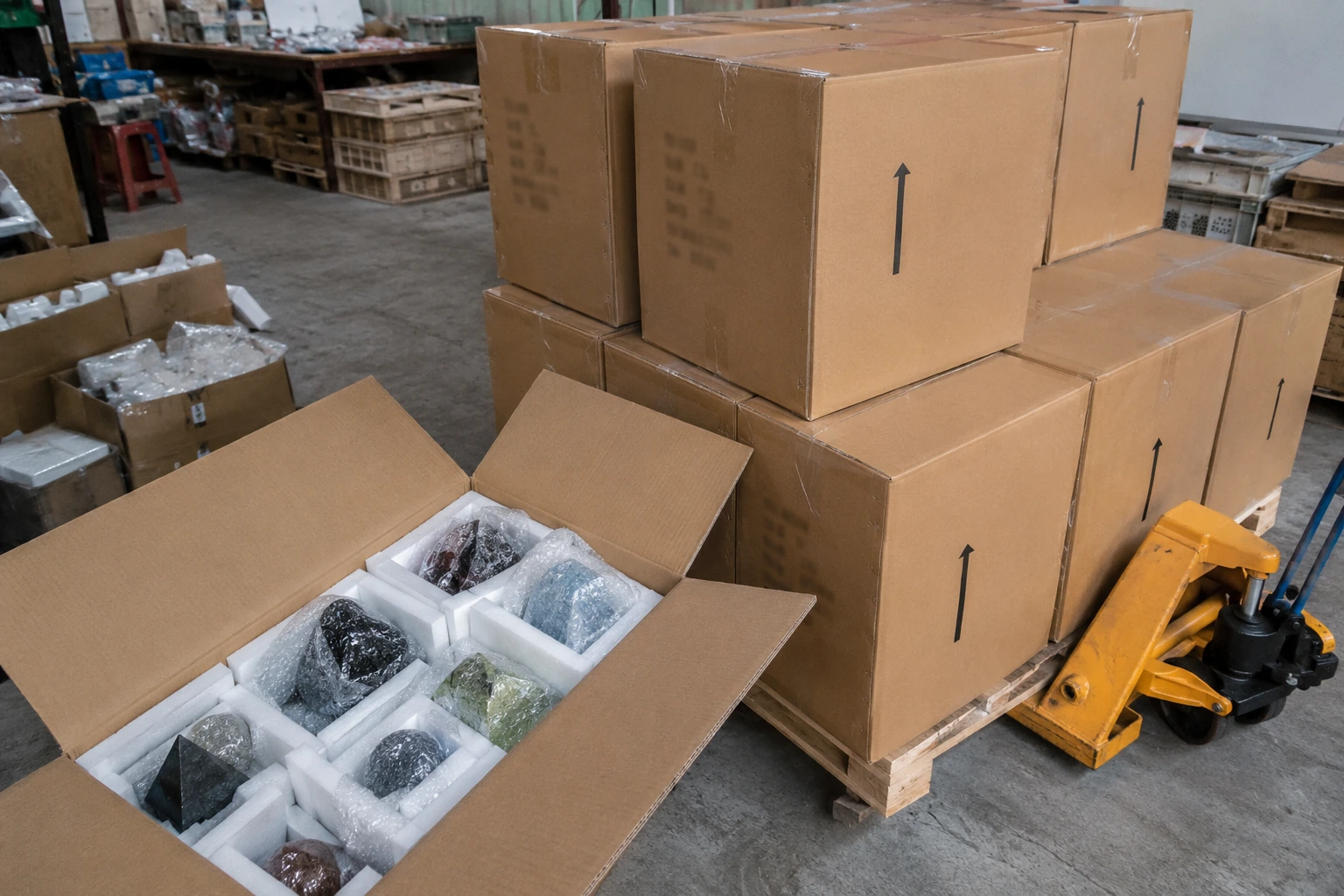
Mastering these four pillars—shipping strategy, trade terms, customs codes, and protective packaging—is the professional secret to protecting your profit margins. Let's dive into each one so you can import with confidence.
What’s the Best Shipping Method for Importing Crystals from China?
You’ve found the perfect crystal carvings, but the shipping quote is staggeringly high. Choosing the wrong logistics plan can not only eat your entire profit margin but also lead to major stock delays, hurting your sales. The solution lies in understanding your product's "weight-to-value ratio3" to create a smart shipping strategy.
For high-value, low-volume items like rare specimens or urgent samples, air freight is the best choice. For bulkier, standard inventory like crystal points and spheres, sea freight is essential to reduce your cost per kilogram and protect your profitability.
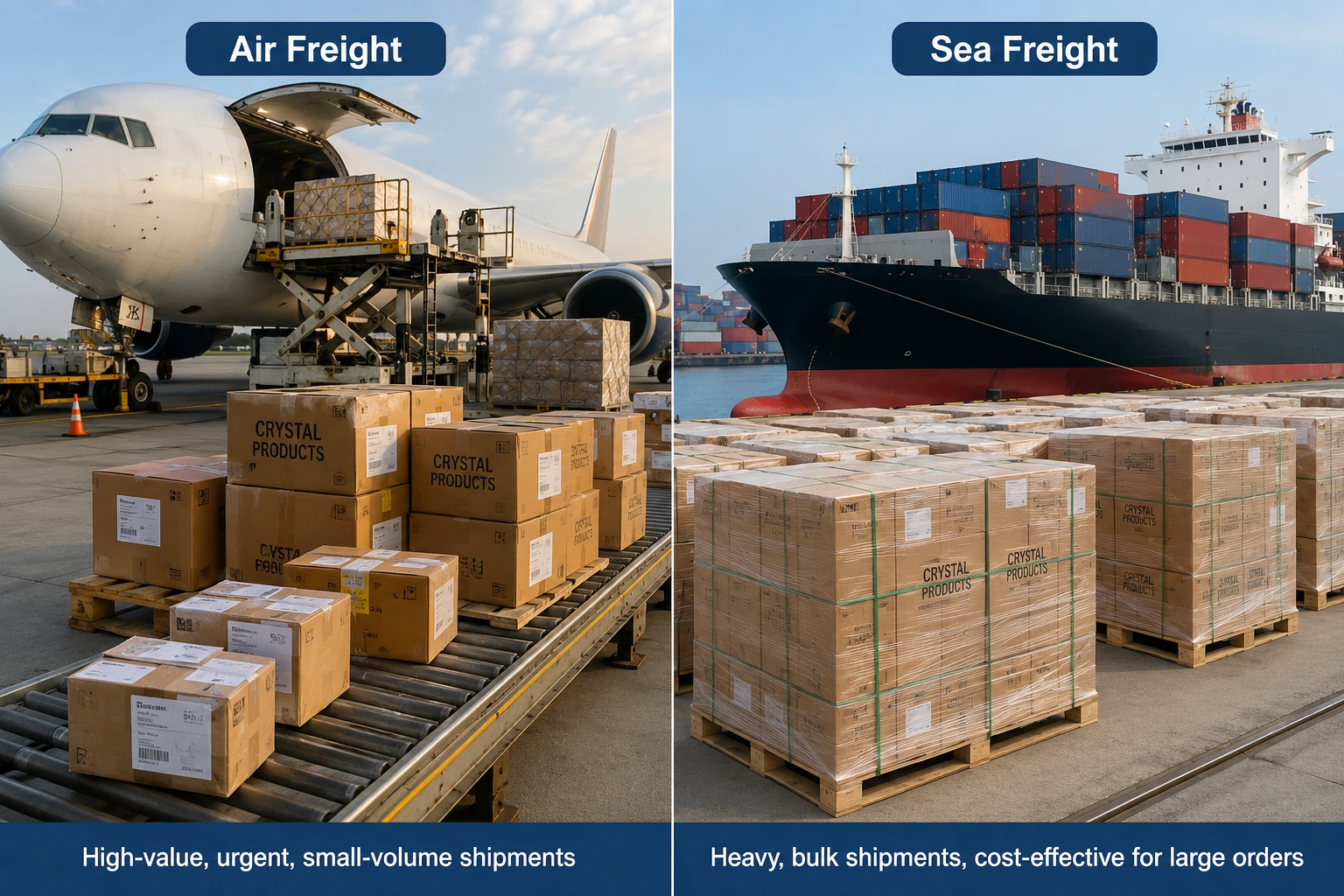
Dive Deeper: Matching the Method to Your Margin
The single most important concept to grasp when importing crystals from China is the weight-to-value ratio. A $1,000 order of apparel and a $1,000 order of crystals are two completely different logistical challenges. Crystals are dense, heavy, and fragile, making shipping a significant component of your final landed cost. I’ve seen new buyers try to ship 50kg of common clear quartz points via DHL, only to abandon the order when they see a shipping bill that costs more than the goods.
H3: When to Use Air Freight (Air Express & Air Cargo)
Air freight is your go-to option for speed and precision. It's ideal for products where the value justifies the higher shipping cost.
- Best Use Cases:
- High-Value Items: Think top-grade amethyst geodes, rare Moldavite, or intricate labradorite carvings. The cost of shipping is a small fraction of the product's retail value.
- Urgent Samples: If you need to test a new product for your market quickly, air shipping a small batch is a smart investment.
- Hot-Sellers: Running low on a best-selling item? Air freight can replenish your stock in days, not months, preventing lost sales.
The primary methods are Air Express (e.g., DHL, FedEx, UPS), which offers door-to-door service in 3-10 days, and Air Cargo, which ships to a nearby airport and is slightly cheaper but requires you to handle final clearance and pickup.
H3: When to Use Sea Freight (LCL & FCL)
Sea freight is the workhorse of global trade and the key to profitability for most crystal businesses. While slow, it is dramatically cheaper for heavy goods.
- Best Use Cases:
- Bulk Inventory: This is for your bread-and-butter products—crystal towers, spheres, palm stones, and large decor pieces ordered by the hundreds of kilograms.
- Non-Urgent Stocking: If you can plan your inventory 2-3 months in advance, sea freight is the undeniable choice.
You have two main options: LCL (Less than Container Load), where your shipment shares space in a container with other importers' goods, and FCL (Full Container Load), where you book an entire container for yourself. For most small to medium-sized crystal shops, LCL is the most common and cost-effective sea freight option.
H3: My "80/20" Rule for Crystal Inventory Shipping
I always advise my clients to adopt an "80/20" approach to inventory management.
- 20% by Air: Use air freight for 20% of your order volume—your most urgent, high-margin, or test products. This gets cash flowing back into your business quickly.
- 80% by Sea: Plan ahead and ship the other 80%—your standard, bulk replenishment stock—via sea freight. The cost savings are immense and are the foundation of a healthy margin.
Why is DDP the Safest Choice When Importing Crystals from China?
You found a supplier offering a rock-bottom FOB or EXW price and feel like you've struck gold. The excitement fades when your goods land at the port, and you're suddenly hit with a barrage of unexpected bills for customs clearance, port fees, duties, and broker charges. This is a common nightmare that turns a "great deal" into a financial loss.
DDP (Delivered Duty Paid) is the safest and most transparent shipping term for most crystal importers. The quoted price is all-inclusive, covering shipping, insurance, customs clearance, and import duties, delivered directly to your door. This eliminates surprise costs and logistical headaches.
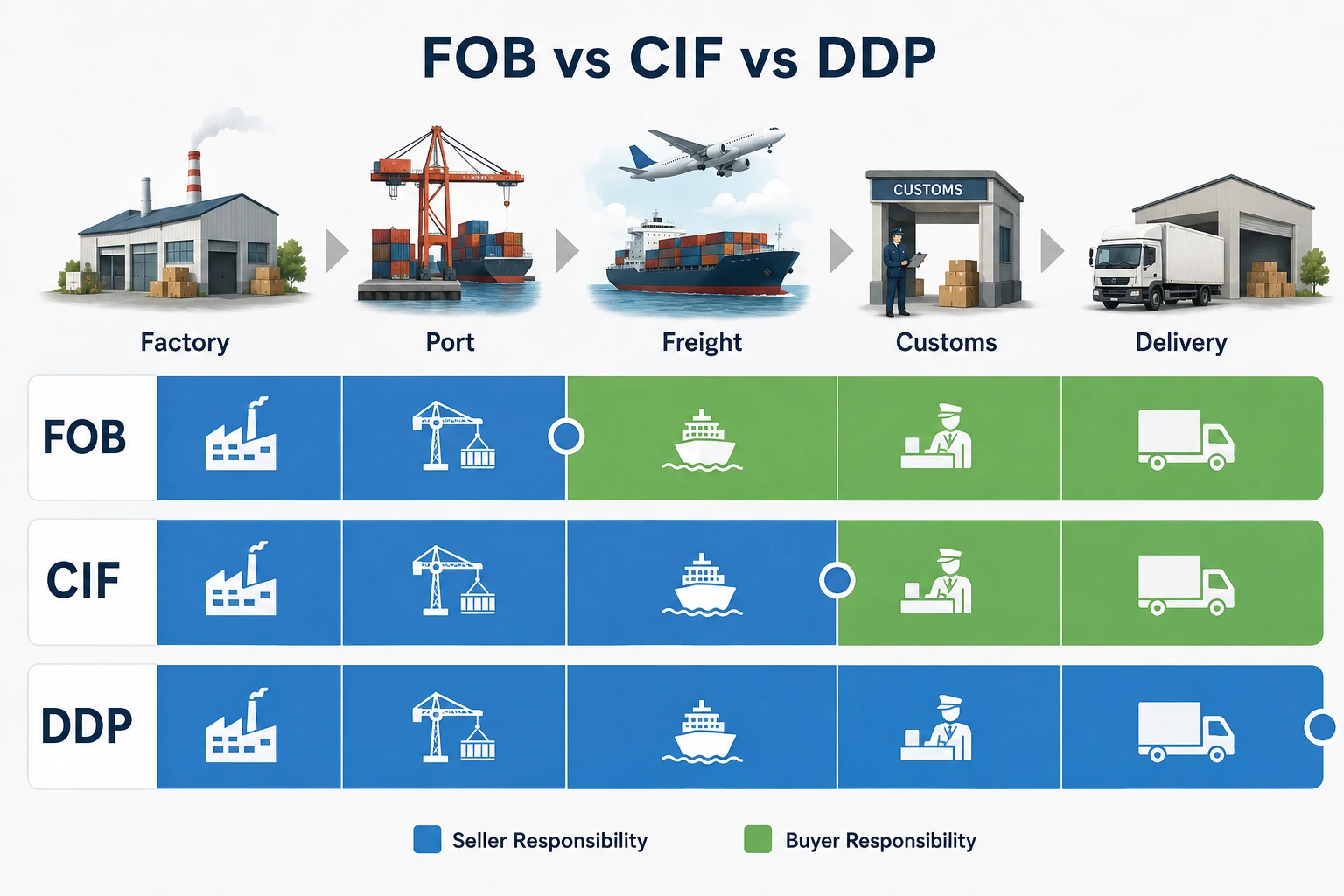
Dive Deeper: Escaping the Trap of Hidden Costs
Incoterms (International Commercial Terms) define the responsibilities of the seller and buyer in an international transaction. Choosing the wrong one is a painful and expensive lesson.
H3: The Hidden Dangers of EXW and FOB
Many suppliers in China will quote EXW or FOB to appear cheaper, but these prices hide significant downstream costs and responsibilities for you, the buyer.
- EXW (Ex Works)4: This is the price of the goods sitting at our factory door. The buyer is responsible for everything: arranging pickup in China, Chinese export customs, international freight, insurance, destination customs clearance, duties, and final delivery. This is only suitable for massive corporations with their own logistics departments. For a small business, it's a minefield.
- FOB (Free On Board): The supplier's responsibility ends once your goods are loaded onto the ship at the Chinese port. You are then responsible for paying for the ocean freight, insurance, and the entire import process in your home country. This is where many buyers get stuck. They have to scramble to find a freight forwarder and a customs broker, deal with paperwork like Customs Bonds (in the U.S.), and pay a dozen separate fees they never budgeted for.
H3: The Peace of Mind with DDP (Delivered Duty Paid)
When you partner with us and choose DDP, you transfer all the logistical risk and complexity to us. The price we quote you is the final, landed cost to get the crystals onto your shelf. There are zero hidden fees5 and zero paperwork hassles for you.
Here’s what we handle behind the scenes for a DDP shipment:
- Pickup & Export: We pack your order and transport it from our workshop to the port or airport.
- China Customs: We handle all the necessary export declaration paperwork in China.
- International Freight: We book and pay for the air or sea freight to your country.
- Import Clearance: Our logistics partners in your country manage the entire customs clearance process6.
- Duties & Taxes: We pay the import duties on your behalf.
- Final Delivery: The shipment is delivered from the port to your final address (store, warehouse, or even your garage) via a local courier like UPS or FedEx.
For small to medium-sized retailers, online sellers, and private label brands, DDP is the only way to guarantee budget certainty and focus on what you do best: selling crystals.
How Can the Right HS Code Reduce Your Costs When Importing Crystals?
You’ve carefully calculated all your costs, but when the final tax invoice arrives from customs, it's 20% higher than you planned for. This frustrating scenario is often caused by a simple clerical error: an inexperienced supplier using the wrong customs code for your products. Working with a supplier who understands the nuances of Harmonized System (HS) codes7 is a powerful, hidden strategy for saving money when importing crystals from China.
The HS Code used on the customs declaration determines the import duty rate. Many suppliers incorrectly classify decorative crystal carvings under Chapter 71 (Jewelry), which carries high tariffs. A professional supplier knows many of these items can be legally and correctly classified under Chapter 688 (Articles of Stone), which often has a much lower or even zero duty rate.
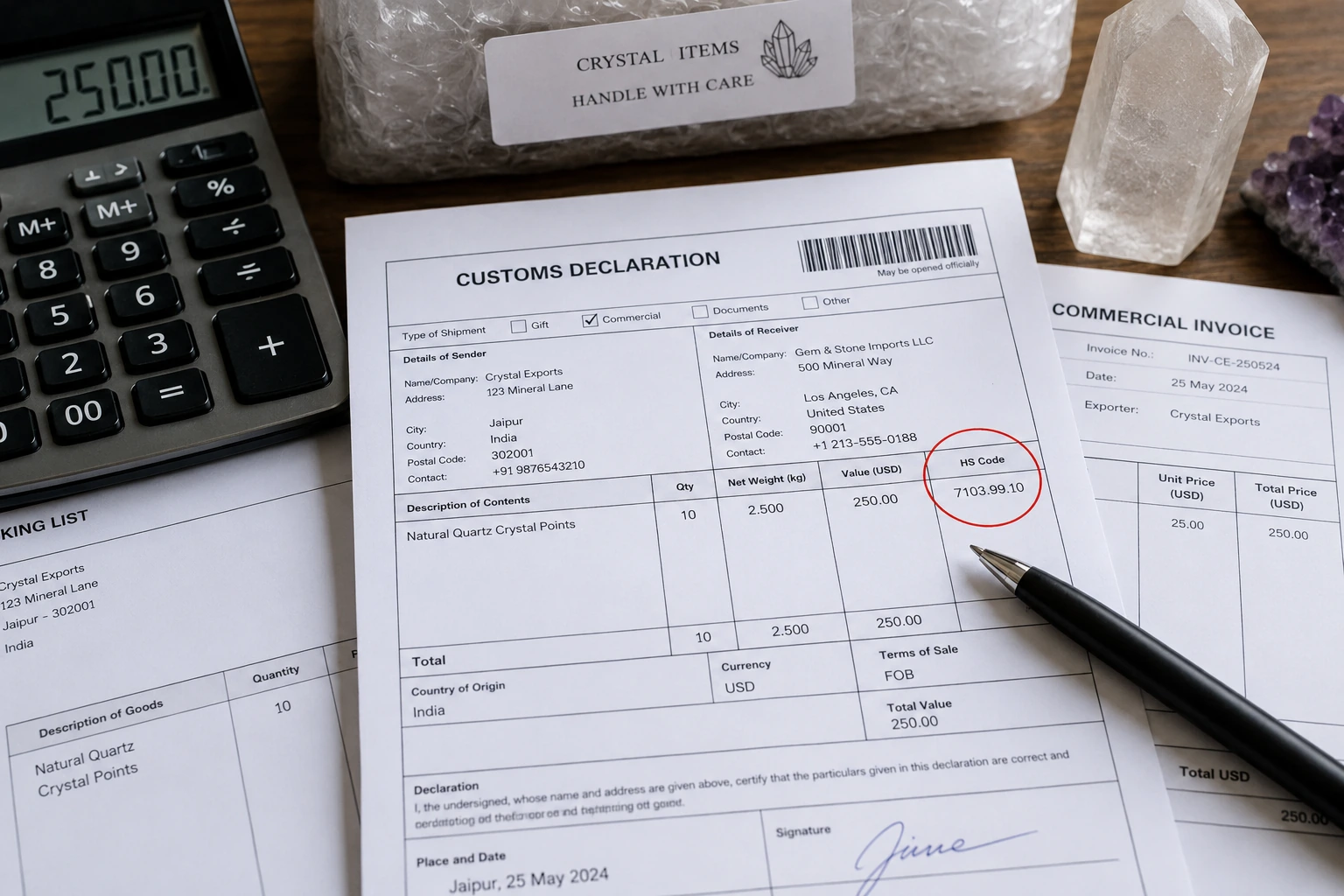
Dive Deeper: A Secret Known by Factory-Level Experts
The HS code system is a global standard for classifying traded products. Customs officials use this code to determine if an item is allowed into the country and what percentage of duty to apply. For crystals, the classification is nuanced, and getting it wrong is costly.
H3: The Common, Costly Mistake: Misclassification in Chapter 71
Chapter 71 of the Harmonized System covers "Natural or cultured pearls, precious or semi-precious stones, precious metals..." and articles of jewelry. For simplicity, many amateur brokers or suppliers will lump all crystal products into this category.
However, this chapter is primarily intended for stones that have been worked for use in jewelry (e.g., faceted, drilled for stringing). If your product is a decorative rose quartz sphere, an amethyst display piece, or an obsidian carving, classifying it under Chapter 71 can attract unnecessarily high duty rates, sometimes over 20% in certain countries. You end up overpaying taxes simply because the wrong code was typed on a form.
H3: The Professional, Cost-Saving Solution: Correct Classification in Chapter 68
A more appropriate classification for many of our products is found in Chapter 68: "Articles of stone, plaster, cement, asbestos, mica or similar materials."
For example, codes like HS Code 6815.999 ("Other articles of stone or of other mineral substances") can often be applied to decorative carvings, spheres, towers, and freeforms that are not part of a jewelry article. The import duty rate for this category is often significantly lower—sometimes even 0%—depending on your country's trade agreements.
As a dedicated B2B supplier, we are deeply familiar with these compliant declaration strategies. We work to ensure your shipment is classified under the most appropriate and financially advantageous HS code allowed by law. While the final decision always rests with the importing country's customs authority, a correct and defensible declaration from the supplier is the most critical first step. We always advise clients to confirm potential classifications with a qualified customs broker in their country for absolute certainty.
How Should a Supplier Package Your Order for Importing Crystals from China?
Your long-awaited shipment has finally arrived after weeks at sea. You eagerly open the box, only to hear the sickening sound of loose, broken pieces. Instead of beautiful inventory, you have a box of chipped points and cracked spheres—a complete financial loss. This is why vetting your supplier's packaging standards is just as critical as checking the quality of the crystals themselves.
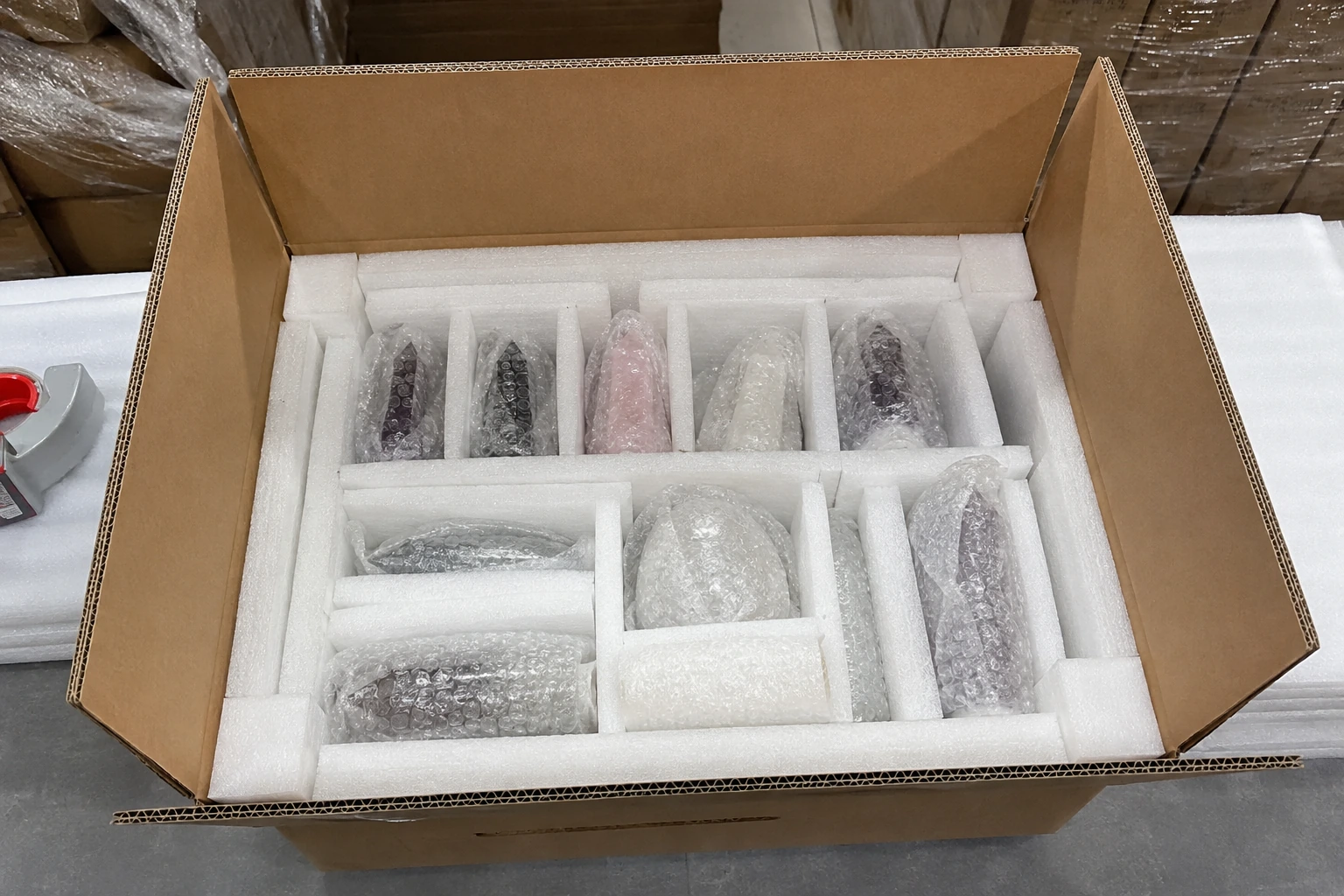
Export-grade packaging is non-negotiable. Every crystal should be individually wrapped in thick bubble wrap or EPE foam. These pieces must then be placed in a strong, 5- or 7-ply reinforced export carton with no room to shift. For heavy sea shipments, palletizing is essential10 to protect against damage during port handling.
Dive Deeper: Protecting Your Investment from Breakage
Remember, as I often tell my team, "You're shipping rocks, not t-shirts!" Your crystal shipment will face two primary threats: violent handling during customs inspections11 and the relentless vibration and impact of a trans-oceanic journey.
Many workshops try to cut corners on packaging to save on dimensional weight, which lowers their shipping cost. They'll cram unwrapped stones into a flimsy, single-layer cardboard box, using a bit of old newspaper as "filler." This is a guaranteed recipe for disaster and is a major red flag. If a supplier won't show you their packaging, walk away.
H3: Our Export-Grade Packaging Protocol
At Crystal Carvings Wholesale, we treat packaging as part of the product. A broken crystal is worthless to our clients, so we refuse to compromise on protection. Our standard operating procedure includes:
- Individual Item Protection: Every single carving, sphere, point, or specimen is individually wrapped in multiple layers of thick bubble wrap or dense, shock-absorbing EPE pearl cotton. No two crystals ever touch directly.
- Internal Box Integrity: We use cardboard dividers and fill every inch of empty space within the box. This prevents the heavy items from shifting during transit, which is a primary cause of breakage.
- Reinforced Outer Cartons: We only use 5-ply or 7-ply hardened corrugated export cartons. These are specifically designed to be stacked and to withstand the pressure and impacts common in international shipping containers.
- Mandatory Palletizing for Sea Freight: For any LCL sea shipment over a certain weight, we insist on palletizing. The cartons are stacked securely on a fumigation-free pallet, then tightly shrink-wrapped into a single, stable unit. This is the ultimate protection against damage from forklifts and rough handling at the port.
Our packaging may add a small amount to the overall cost, but it is an insurance policy on your investment. The cost of replacing one shattered high-value carving far outweighs the minimal expense of proper packing.
Frequently Asked Questions
What is a Customs Bond and do I need one?
A Customs Bond is a type of insurance policy required by U.S. Customs and Border Protection for commercial imports valued over $2,500. It guarantees that all duties and taxes will be paid. If you use a DDP shipping service from us, our logistics partner handles this requirement, so you do not need to purchase one yourself.
Can I mix different shipping methods for one order?
Absolutely. This is a smart strategy that we facilitate for many of our clients. You can request a small, urgent portion of your order to be sent by air to get products on your shelves quickly, while the larger, bulk portion follows by sea freight to maximize cost savings. Just be sure to coordinate this with us when placing your order.
How are import duties calculated for crystals?
Import duties are calculated as a percentage of the customs value of your goods. This percentage, known as the tariff rate, is determined by the product's 10-digit Harmonized System (HS) Code and the specific trade agreements between China and your country. A professional supplier helps ensure the correct code is used to prevent overpayment.
What happens if my shipment is damaged upon arrival?
In the rare event that you receive a damaged shipment, you should document everything immediately. Take clear photos of the unopened box (showing any external damage), the packaging materials inside, and the broken items themselves. Contact us right away with the photos. As a reputable supplier that stands by our robust packaging, we will work with you on a swift resolution.
Conclusion
Successfully importing crystals from China is about much more than just the product's factory price. True profitability comes from a holistic understanding of the entire supply chain. By mastering your logistics—choosing the optimal mix of air and sea freight, insisting on DDP trade terms to eliminate surprise fees, ensuring the correct HS codes are used to minimize taxes, and demanding robust, export-grade packaging—you protect your investment and secure your profit margins. This comprehensive approach transforms a potentially risky process into a reliable and scalable part of your crystal business.
Ready to source your next crystal collection without the logistical headaches? Contact Crystal Carvings Wholesale today. We provide clear, all-inclusive DDP quotes and the expert guidance needed to make importing crystals from China a simple and secure process for your brand. Reach out on WhatsApp at +86 150 7540 9178 or email us at sales@crystalcarvingswholesale.com for a fast, no-obligation quotation.
<!--[googlesitekit-end-of-content]-->
"The Impact of the COVID-19 Pandemic on Freight Transportation ...", https://www.usitc.gov/research_and_analysis/tradeshifts/2020/special_topic.html. Studies on international trade logistics indicate that shipping costs for heavy and fragile goods can account for a substantial portion of total expenses, often exceeding 20% of the product's value. Evidence role: statistic; source type: research. Supports: Shipping and handling costs for heavy, fragile items can significantly affect profit margins.. Scope note: The data may vary depending on the specific product category and shipping route. ↩
"Incoterms Explained: A Deep Dive into Delivery Duty Paid (DDP)", https://www.texasconstructionlawblog.com/2025/05/incoterms-explained-a-deep-dive-into-delivery-duty-paid-ddp/. DDP terms are widely recommended for small and medium-sized importers as they include all costs and reduce logistical complexities. Evidence role: expert_consensus; source type: education. Supports: DDP is often considered the safest and most transparent shipping term for importers.. Scope note: The effectiveness of DDP terms may depend on the reliability of the supplier and logistics provider. ↩
"What is a loan-to-value ratio and how does it relate to my costs?", https://www.consumerfinance.gov/ask-cfpb/what-is-a-loan-to-value-ratio-and-how-does-it-relate-to-my-costs-en-121/. The weight-to-value ratio is a widely recognized metric in logistics, influencing the choice between air and sea freight based on cost efficiency. Evidence role: mechanism; source type: education. Supports: The weight-to-value ratio is a key determinant in choosing cost-effective shipping methods.. Scope note: The concept may be less applicable to non-commercial or non-international shipping scenarios. ↩
"Incoterms EXW - Ex Works", https://www.aitworldwide.com/resources/incoterms/incoterms-exw-ex-works/. EXW (Ex Works) terms require the buyer to handle all logistics from the seller's premises, which can be complex and costly for small businesses. Evidence role: definition; source type: encyclopedia. Supports: EXW terms place all logistical responsibilities and costs on the buyer, making them more suitable for large corporations.. Scope note: The suitability of EXW terms may vary depending on the buyer's logistical capabilities. ↩
"What is DDP Shipping and Why Do eCommerce Businesses Need It?", https://www.shipmonk.com/resources/content-hub/what-is-ddp-shipping-international-shipping-information. Educational resources on international trade confirm that DDP terms include all costs, reducing the risk of unexpected fees for importers. Evidence role: expert_consensus; source type: education. Supports: DDP shipping is designed to eliminate hidden fees and simplify logistics for importers.. Scope note: The effectiveness of DDP terms depends on the reliability of the logistics provider. ↩
"What Is DDP Shipping? A Guide to Delivered Duty Paid", https://www.dhl.com/us-en/home/ship/ddp-shipping.html. Educational materials on DDP shipping explain that logistics providers handle customs clearance as part of the all-inclusive service. Evidence role: mechanism; source type: education. Supports: Logistics partners manage the customs clearance process under DDP shipping terms.. Scope note: The level of service may vary depending on the specific logistics provider. ↩
"Import Tariffs & Fees Overview and Resources", https://www.trade.gov/import-tariffs-fees-overview-and-resources. Government customs guidelines indicate that accurate HS code classification is essential for determining applicable import duties. Evidence role: mechanism; source type: government. Supports: Correct HS code classification can reduce import duties for crystal products.. Scope note: The final duty rate depends on the importing country's specific trade agreements and customs policies. ↩
"[PDF] Harmonized Tariff Schedule of the United States Revision 15 (2026)", https://hts.usitc.gov/reststop/file?release=currentRelease&filename=Chapter%2068. Customs documentation indicates that Chapter 68 covers 'Articles of stone, plaster, cement, asbestos, mica or similar materials,' which may include certain crystal carvings. Evidence role: definition; source type: government. Supports: Crystal carvings can be classified under Chapter 68 of the HS code system, which often has lower duty rates.. Scope note: The final classification depends on the specific characteristics of the product and the importing country's regulations. ↩
"6815.99.41.70 - Harmonized Tariff Schedule", https://hts.usitc.gov/search?query=6815994170. Government customs guidelines indicate that HS Code 6815.99 covers 'Other articles of stone or of other mineral substances,' which may include decorative crystal carvings. Evidence role: definition; source type: government. Supports: HS Code 6815.99 is applicable to certain decorative crystal carvings and may have lower duty rates.. Scope note: The final classification and duty rate depend on the importing country's customs authority. ↩
"Palletizing & Crating Guide: Sea Freight from USA", https://oceanfreightusa.com/Palletizing-in-Sea-freight.aspx. Research on shipping logistics highlights that palletizing reduces the risk of damage during handling and transit for heavy goods. Evidence role: mechanism; source type: research. Supports: Palletizing is crucial for protecting heavy shipments during sea freight.. Scope note: The effectiveness of palletizing depends on proper stacking and securing techniques. ↩
"What should be inspected before a wholesale crystal shipment ...", https://crystalcarvingswholesale.com/what-should-be-inspected-before-a-wholesale-crystal-shipment-leaves-the-factory/. Studies on international shipping highlight that customs inspections can involve handling practices that increase the risk of damage to fragile items. Evidence role: general_support; source type: research. Supports: Customs inspections can pose a risk of damage to fragile goods like crystals.. Scope note: The extent of risk may vary depending on the specific customs procedures of the importing country. ↩