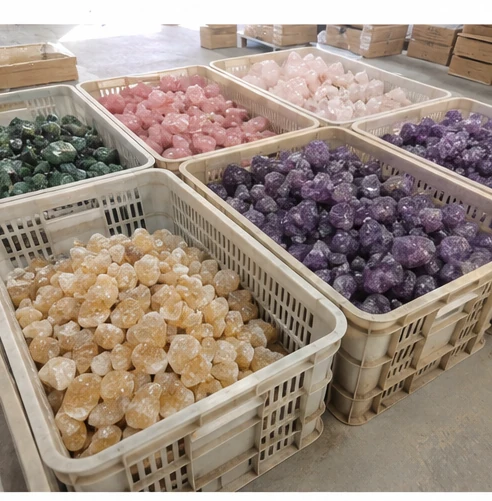

Finding a reliable B2B partner can feel like searching for a flawless crystal in a mine—it’s difficult and time-consuming. You worry that the beautiful samples you approved won't match the bulk order you receive, leaving you with unsellable inventory and a damaged reputation. To build a thriving crystal business, you need a dependable wholesale crystal supplier who provides consistent quality, transparent communication, and reliable service.
To evaluate the quality of a wholesale crystal supplier, you must assess five key areas beyond the product itself: the consistency between samples and bulk orders1, the fine details of craftsmanship and polishing, their transparency about natural flaws and treatments, their internal defect rejection rate, and their production lead time and communication efficiency.
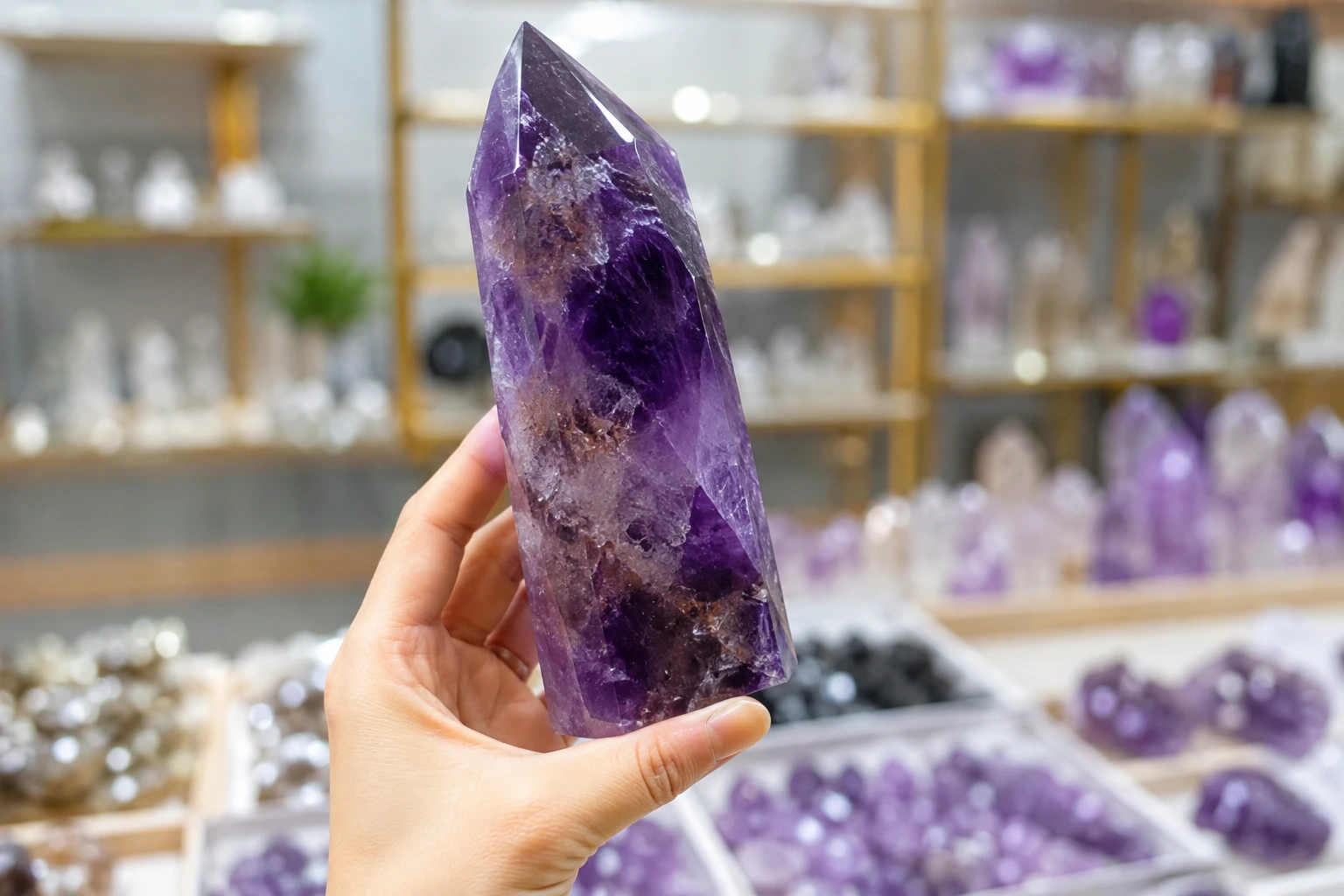
These five pillars separate the professional, long-term partners from the transactional traders who can disappear after one bad order. Diving into each of these areas will give you the confidence to place larger orders and build a stable, profitable supply chain. Let's explore how to conduct this evaluation.
How Do You Verify a Wholesale Crystal Supplier's Product Consistency?
You’ve found a potential supplier and they’ve sent you a stunning sample. The color is vibrant, the clarity is perfect. But a nagging fear remains: will the 500-kilogram bulk order look anything like this? This uncertainty can paralyze your purchasing decisions.
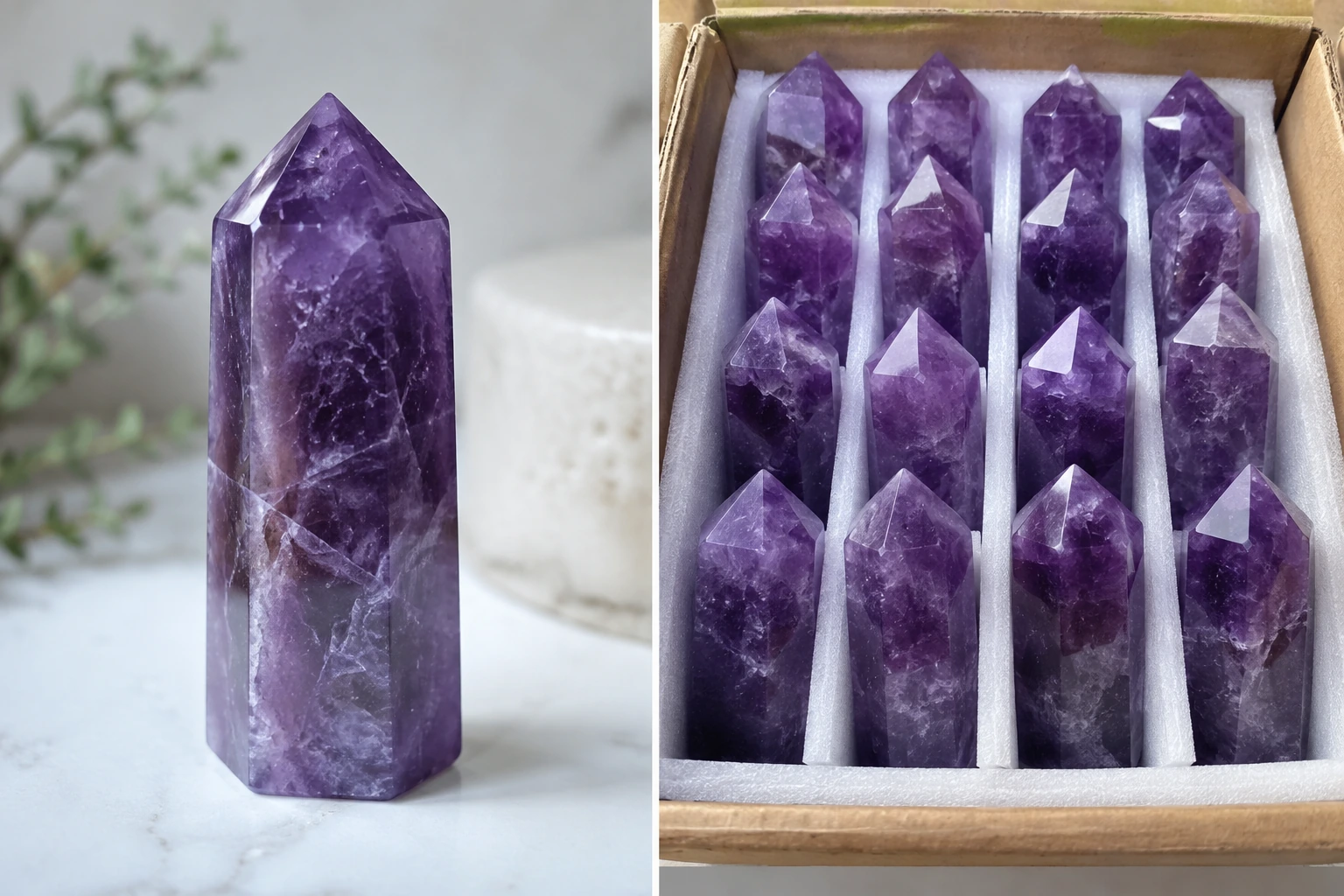
A supplier's true quality is revealed in their ability to maintain consistency from a single sample to a full container load. The most reliable suppliers have rigorous internal systems to ensure the products you receive match the quality you approved.
The "Sample vs. Bulk" Consistency Test
In the crystal industry, one of the most notorious tactics is the "Bait and Switch." A supplier sends you a flawless, AAA-grade sample to win your business. Impressed, you place a large order. What arrives, however, is a mix of B-grade and C-grade stones, full of internal fractures, cloudy inclusions, and dull color. When you complain, they hide behind the excuse that "natural products vary."
This isn't just a variation; it's a deliberate strategy. Here’s the factory insider secret: natural crystals are mined in large, multi-ton blocks. Within a single raw stone, there are premium zones and waste zones. A trading company, who simply buys from various small workshops, has no control over which grade of material is used for your bulk order. They are at the mercy of the workshop's available stock.
In contrast, a true source factory like ours controls the process from the very beginning.
- Material Grading: At the initial cutting stage, we strictly grade all raw materials2 into different levels (e.g., A-grade, B-grade, C-grade) based on clarity, color, and integrity.
- Order Allocation: When you place an order for A-grade crystal towers, we use only A-grade material blocks to produce them. B-grade material is allocated for different products or price points.
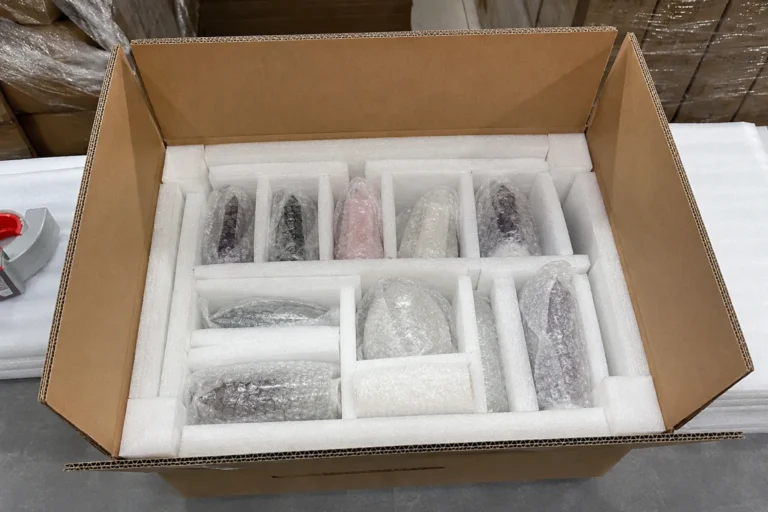
How to Evaluate Consistency: Never make a large purchasing decision based on a sample alone. Before committing to a bulk order, insist that the wholesale crystal supplier provide a "Random Bulk QC Video3." This is a video taken in natural light, showing them randomly grabbing finished products from your actual production run and packing them into boxes. A supplier who confidently shoots this video for you is one who has nothing to hide and has full control over their production consistency. They have the confidence that any piece they pick up will meet the standard you agreed upon.
What Craftsmanship Details Should You Check in a Wholesale Crystal Supplier's Products?
You're looking at two crystal skulls carved from the same block of obsidian. One feels substantial, smooth, and detailed, while the other feels light and crude. Why can one retail for $50 while the other struggles to sell for $20? The difference isn't the stone; it's the craftsmanship.
Poor craftsmanship devalues your products and your brand. Customers can feel the difference, even if they can't articulate it. The subtle details of polishing and symmetry are what elevate a simple stone into a cherished piece of decor or jewelry.
A top-tier wholesale crystal supplier invests in skilled artisans and proper finishing processes because they know it directly impacts your retail success. They understand that excellent craftsmanship is a non-negotiable aspect of quality.
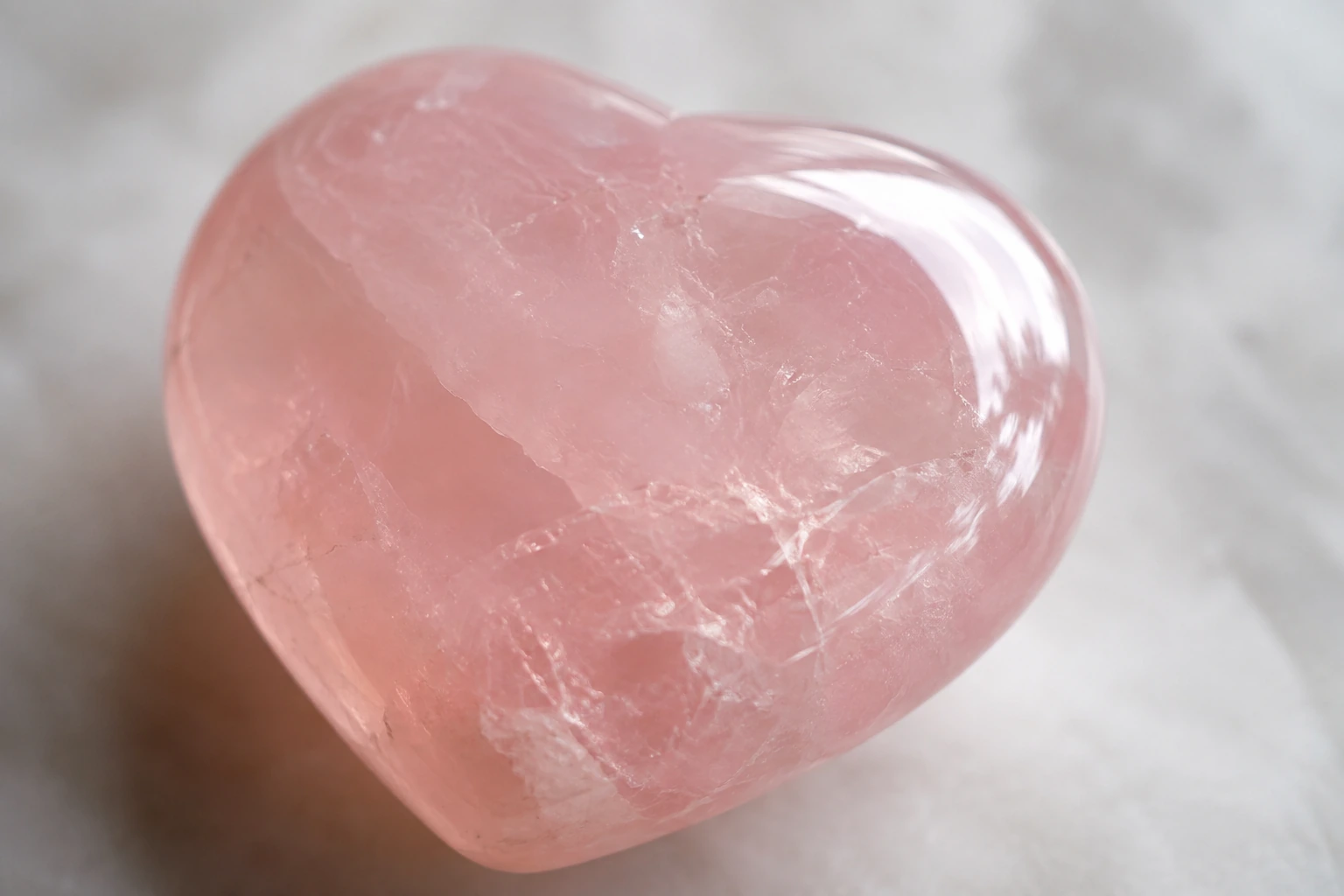
Diving Deeper into Polishing and Symmetry
For an untrained eye, all polished stones look shiny. But for a professional buyer, the difference is in the micro-details. Here are two common traps set by low-quality workshops:
- The Polishing Trap: Proper polishing is a multi-stage, labor-intensive process4 that uses progressively finer grits to achieve a glass-like surface. To save time and money, some workshops shorten this process significantly. To hide the rough, matte surface, they apply a chemical finishing wax5. The product looks shiny when you receive it, but after a few months, the wax wears off, revealing a dull, lifeless stone that looks old and used.
- The Symmetry Trap: This is a critical flaw that many buyers overlook until their customers complain. For popular items like crystal towers, an unskilled artisan may cut a point that is visibly off-center or create facets that are uneven in size and shape. When placed on a shelf, the tower looks tilted and cheap. The same applies to intricate carvings like animals or skulls, where asymmetrical features or poorly defined details (like teeth or eyes) make the piece look amateurish.
How to Evaluate Craftsmanship: When you receive a test order, use your hands and eyes.
- Touch the Surface: A top-quality polish feels "wet" and almost warm to the touch, with a liquid-smooth glide. There should be absolutely no gritty or resistant feeling as you run your fingers over it.
- Inspect the Symmetry: Place a crystal tower on a flat table. Look down at it directly from above. Is the tip in the perfect geometric center of the base? For carvings like a貔貅 (Pixiu) or a skull, inspect the fine details. Are the eyes, teeth, and claws sharp and well-defined, or are they blurry and crude?
- Check for Light Play: A well-polished stone will have a deep luster and play with the light beautifully. A poorly polished or waxed stone will have a more superficial, greasy-looking shine.
These small details separate premium products that command higher prices from discount-bin items. A good wholesale crystal supplier is obsessed with these details.
How Does a Wholesale Crystal Supplier's Transparency About Flaws Affect Quality?
"A 100% flawless natural crystal does not exist. If you find one, it's probably man-made glass." This is something I often tell new clients to set realistic expectations. The key isn't finding a "perfect" stone, but finding a supplier who is perfectly honest about the stone's imperfections.
Many sourcing relationships sour because of mismatched expectations around natural flaws. A buyer expects perfection, while a dishonest supplier uses the "natural" label as an excuse for poor quality control, causing frustration and disputes.
A trustworthy wholesale crystal supplier acts as your industry guide. They educate you on the characteristics of different minerals and are transparent about any treatments, ensuring you know exactly what you are buying.
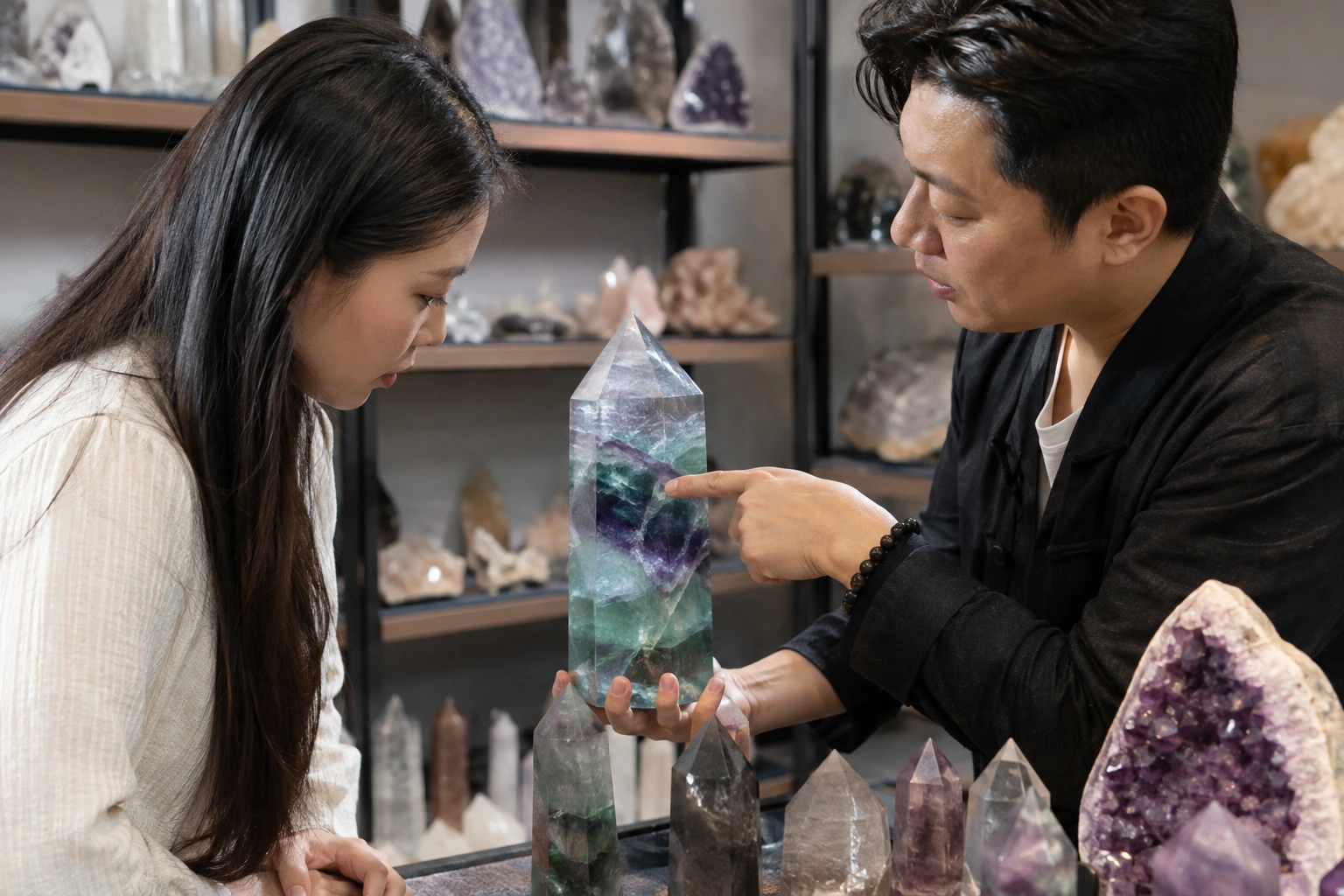
Diving Deeper into Treatments and Honesty
The crystal market is unfortunately filled with ambiguity. When a buyer asks, "Does this material have cracks?" an unreliable supplier might give a vague answer or, even worse, sell them a treated stone as a natural, flawless specimen.
For example, some stones with many internal fractures are acid-washed and polymer-filled to improve their clarity. This treated stone is then presented as a high-grade natural piece. When the filling eventually discolors or degrades, and the customer complains, the supplier shrugs and says, "Crystals are natural; flaws are normal."
This is not transparency; it is deception. A quality-focused partner operates differently. Their role is to empower you with knowledge.
| Common Stone | Potential Treatment / Natural Feature | What a Transparent Supplier Will Tell You |
|---|---|---|
| Fluorite | Natural Ice Cracks | "This batch of fluorite has beautiful color, but please note it naturally contains internal ice crack patterns." |
| Agate/Carnelian | Heat-Treated / Dyed | "This Red Agate has been heat-treated to enhance and stabilize its color, which is a standard industry practice." |
| Citrine | Heat-Treated Amethyst | "This is heat-treated citrine6, which is how most citrine on the market is produced. Natural citrine is very rare and priced much higher." |
| Turquoise | Stabilized / Reconstituted | "This is stabilized turquoise7, which makes the soft stone durable enough for jewelry. We do not sell reconstituted (powdered) turquoise." |
How to Evaluate Transparency: Test your potential supplier. Ask them a direct question about treatments: "Do you sell any heat-treated or dyed stones? How do you distinguish them from your natural products?"
A high-quality wholesale crystal supplier will welcome this question.
- They will have clear policies and will not hesitate to explain them.
- They will mark products as "Natural" or "Treated" (e.g., Heated, Dyed, Stabilized) on quotations, product descriptions, and invoices.
- They will never cross the line of passing off a treated stone as a top-grade natural one.
This honesty builds the foundation for a long-term partnership, protecting both your investment and your brand's integrity.
Why Is a Wholesale Crystal Supplier's Defect Rejection Rate Important?
When evaluating a supplier, what they sell you is only half the story. The other, more important half is what they throw away. A supplier's internal quality control and their strictness in rejecting imperfect items speak volumes about their commitment to quality.
You might receive a shipment that is 95% perfect8, but the 5% of chipped, cracked, and broken items can cause a disproportionate amount of trouble, from customer complaints to time-consuming claims processes.
A serious wholesale crystal supplier understands that their reputation is on the line with every single piece they ship. They have a robust internal system for culling defective products before they ever make it into your box.
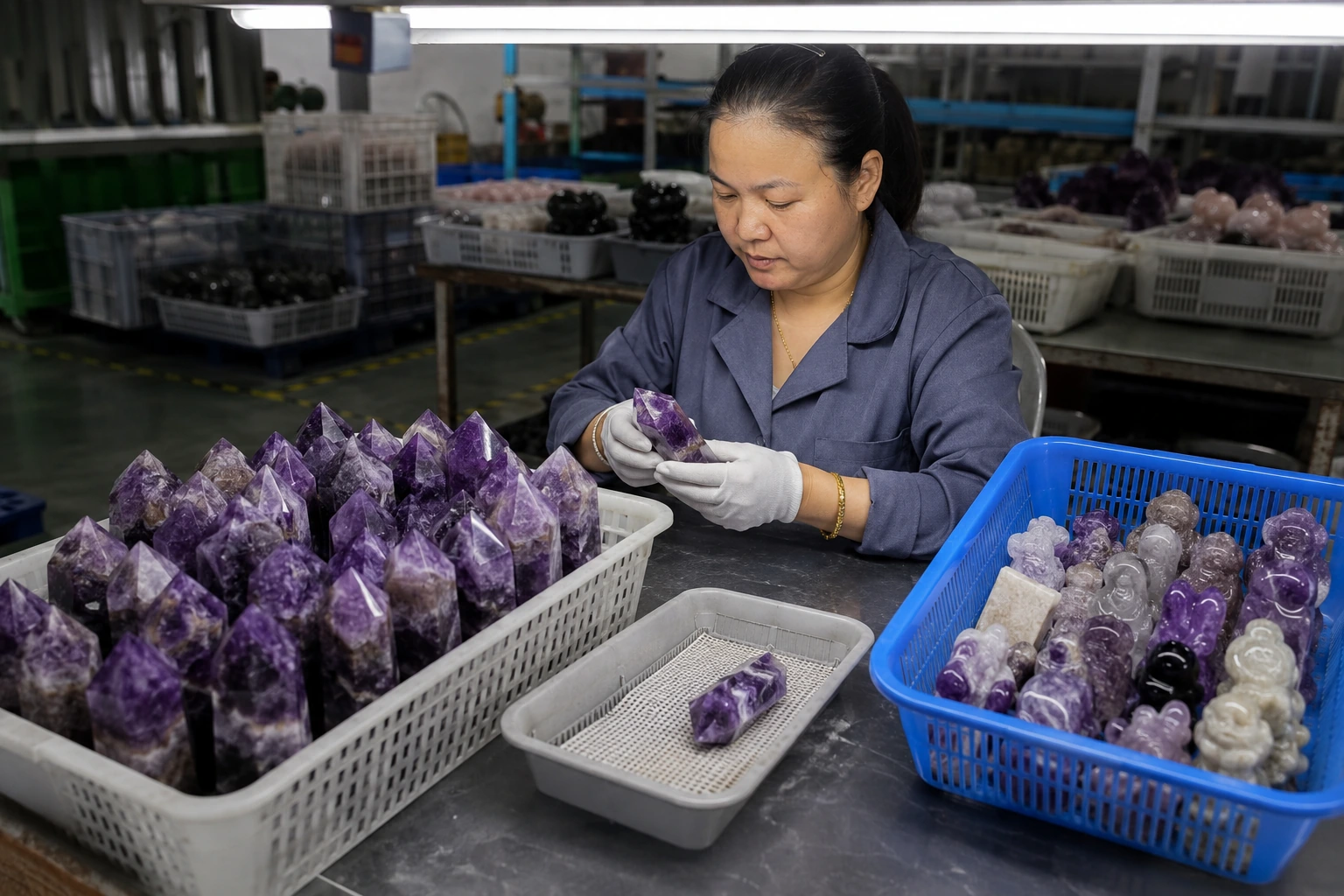
Diving Deeper into the QC Logic
At a source factory, the production process is a battle against breakage. From the initial sawing of raw stone blocks, through shaping, carving, and polishing, there is a significant and unavoidable rate of damage. This is especially true for brittle minerals like amethyst clusters, fluorite, and selenite.
Here is the quality control logic of a top-tier factory:
- Multi-Stage Inspection: QC isn't a single step at the end. It happens after every major stage. A piece that cracks during carving is removed immediately. A piece that chips during polishing never moves on to packaging.
- Strict Rejection Rule: At our factory, we have an unbreakable rule: any product found with a chipped corner, a deep structural crack, or a significant surface flaw is immediately classified as a "defect."
- Segregation of Defects: These rejected items are either discarded, recycled, or sold separately in a low-grade domestic "clearance" market. They are never, under any circumstances, allowed to be mixed into a standard export order.
This disciplined approach is what separates a professional factory from a small workshop that might try to slip a few defective pieces into a large order, hoping you won't notice.
How to Evaluate Their Policy: Don't wait until you have a problem to find out their policy. Test them during the negotiation phase. Ask a direct, hypothetical question:
"What is your after-sales policy if I receive my order and find that 5% of the products have significant chips or are broken from issues that are not related to shipping?"
The response will tell you everything you need to know:
- A Reliable Supplier: Will have a clear, pre-defined policy. They will confidently offer to refund or reship9 the defective items, no questions asked (though they will ask for photos for their own internal QC improvement). They take responsibility.
- An Unreliable Supplier: Will become evasive. They might say, "that won't happen," or worse, immediately tell you that it's your problem and you need to file a claim with the shipping company. They shift blame.
A supplier who stands behind their product with a clear and fair after-sales policy is a supplier who is confident in their internal rejection rate.
How Do Lead Time and Communication Reflect a Wholesale Crystal Supplier's Quality?
You've found a supplier with great products, but getting an answer to a simple question takes three days, and your promised two-week lead time has stretched into its sixth week. Excellent product quality is the foundation, but in the fast-paced world of e-commerce and retail, service quality is what holds the entire structure together.
Your business depends on a predictable supply chain. You're running marketing campaigns, managing inventory for seasonal peaks, and promising products to your customers. A wholesale crystal supplier who constantly misses deadlines and communicates poorly is not a partner; they are a liability.
Efficient communication and reliable lead times are not just "nice to have"—they are direct indicators of a supplier's operational maturity, internal organization, and respect for your business.

Diving Deeper into Production and Responsiveness
Why is there such a huge variation in lead times between suppliers? It often comes down to their business model.
- Trading Companies: These businesses don't own factories. They act as middlemen, sourcing your order from a network of different workshops. This means they are juggling multiple production schedules they don't control. If one workshop is delayed, your entire order is delayed. Their lead times are often guesses, not guarantees.
- Source Factories: A vertically integrated factory10 controls the entire production process under one roof. They manage their own raw material inventory, cutting schedules, carving teams, and polishing lines. This gives them direct control over the production timeline and the ability to provide much more accurate lead time estimates.
A supplier's responsiveness is another key indicator. A professional team will have dedicated sales staff11 who can answer questions quickly and coordinate with the production floor to get you the information you need.
How to Evaluate Their Efficiency: The best way to test a supplier's operational capability is with a small, custom order. It doesn't have to be complex. Try placing a trial order for something like:
- A standard product with your logo engraved on the base.
- A custom-sized carving (e.g., a 4-inch tower instead of their standard 3-inch).
Observe their response:
- An Integrated Factory: Can typically provide a CAD drawing or 3D model for approval within 1-3 days. They can often produce a physical sample within 5-7 days because they have an in-house design and sampling team.
- A Trading Company or Disorganized Workshop: May take over a week just to confirm if the customization is possible. The entire process of getting a drawing and sample could drag on for half a month or longer as they try to coordinate with third-party workshops.
Finding a good supplier is about finding a long-term strategic partner who is on the same frequency as you. Their efficiency and reliability are just as important as the quality of the stones they sell.
Frequently Asked Questions
What is a reasonable MOQ for a new wholesale crystal buyer?
A reasonable Minimum Order Quantity (MOQ) depends on the supplier. A good B2B-focused wholesale crystal supplier will offer flexibility. For example, we often support new buyers with low-MOQ trial orders, allowing them to test various products with a mixed value of just a few hundred dollars to start.
How can I verify if a crystal is natural or man-made?
Verifying a crystal requires experience. Look for natural imperfections like inclusions, color zoning, and internal fractures. Man-made materials like glass or resin often appear "too perfect." For definitive identification, consult a certified gemologist. A transparent supplier will always disclose if a product is natural, treated, or man-made.
What's the difference between a crystal factory and a trading company?
A factory is the source manufacturer; they cut, carve, and polish the raw stones themselves. This gives them control over quality, cost, and lead times. A trading company is a middleman that buys from various factories. While they may offer a wider variety, they have less control over consistency and production schedules.
Conclusion
Choosing the right wholesale crystal supplier is one of the most critical decisions you will make for your business. It's about more than just price; it's about finding a strategic partner who is invested in your success. By moving beyond surface-level evaluation and assessing the five key areas—consistency, craftsmanship, transparency, internal QC, and communication—you can filter out unreliable vendors and identify a truly professional partner. Remember to test their processes with random QC videos, small custom orders, and direct questions about their policies.
This diligent approach will help you build a resilient supply chain, offer consistently high-quality products to your customers, and grow your crystal business with confidence.
If you are looking for a reliable, factory-direct wholesale crystal supplier that values transparency and long-term partnership, we are here to help. Contact us to discuss your sourcing needs and learn how we can support your product collection.
Website: https://crystalcarvingswholesale.com/
WhatsApp: +86 150 7540 9178
Email: sales@crystalcarvingswholesale.com
<!--[googlesitekit-end-of-content]-->
"Smoky Quartz Carvings: Color Grades, Quality and Wholesale ...", https://crystalcarvingswholesale.com/smoky-quartz-carvings-color-grades-quality-and-wholesale-guide/. Research on supply chain management highlights that consistency between product samples and bulk orders is a critical factor in evaluating supplier reliability and quality control processes. Evidence role: general_support; source type: research. Supports: Consistency between samples and bulk orders is a key indicator of supplier quality.. Scope note: The source may not specifically address the crystal industry but provides general insights into manufacturing and supply chain practices. ↩
"An Introduction to Gem Treatments", https://www.gia.edu/gem-treatment. Studies on gemstone manufacturing processes highlight the importance of grading raw materials based on clarity, color, and structural integrity during the initial cutting stage. Evidence role: mechanism; source type: research. Supports: Grading raw materials by clarity, color, and integrity is a standard practice in gemstone production.. ↩
"Achieving Supply Chain Transparency - MIT Sloan Management Review", https://sloanreview.mit.edu/video/achieving-supply-chain-transparency/. Studies on supplier transparency suggest that visual quality control methods, such as video documentation, can enhance trust and verify product consistency in bulk orders. Evidence role: general_support; source type: research. Supports: Requesting a random bulk QC video can help verify supplier transparency and product consistency.. Scope note: The source may not specifically mention 'Random Bulk QC Videos' but supports the general principle of visual quality verification. ↩
"Effects of different polishing techniques on the surface ... - PMC", https://pmc.ncbi.nlm.nih.gov/articles/PMC5349026/. Educational resources on lapidary techniques describe the multi-stage polishing process required to achieve a glass-like finish on gemstones. Evidence role: mechanism; source type: education. Supports: Proper gemstone polishing involves a multi-stage process using progressively finer grits.. ↩
"Andrew J. Gellman Group SOP", https://uhv.cheme.cmu.edu/procedures/polish.html. Industry reports on gemstone finishing techniques confirm that chemical waxes are sometimes used to enhance surface appearance temporarily. Evidence role: mechanism; source type: research. Supports: Some workshops use chemical finishing wax to mask inadequate polishing in gemstones and crystals.. Scope note: The source may not focus exclusively on the crystal industry but discusses similar practices in gemstone finishing. ↩
"Can Crystal Carvings Be Left in Sunlight? A Material-by-Material ...", https://crystalcarvingswholesale.com/can-crystal-carvings-be-left-in-sunlight-a-material-by-material-guide/. Gemological studies confirm that the majority of citrine sold commercially is heat-treated amethyst, with natural citrine being significantly rarer and more valuable. Evidence role: general_support; source type: encyclopedia. Supports: Most citrine on the market is heat-treated amethyst, and natural citrine is rare and more expensive.. ↩
"Turquoise Carvings: Natural vs Stabilized Material and Buying ...", https://crystalcarvingswholesale.com/turquoise-carvings-natural-vs-stabilized-material-and-buying-guide/. Research on gemstone treatments explains that stabilization is a process used to improve the durability of soft stones like turquoise for jewelry applications. Evidence role: mechanism; source type: research. Supports: Stabilization is a common treatment for turquoise to enhance its durability for use in jewelry.. ↩
"Evaluating the impacts of COVID-19 outbreak on supply chain ...", https://pmc.ncbi.nlm.nih.gov/articles/PMC8968776/. Research on supply chain quality control shows that small defect rates can lead to significant operational challenges and customer dissatisfaction. Evidence role: statistic; source type: research. Supports: Even a small defect rate, such as 5%, can significantly impact business operations and customer satisfaction.. ↩
"How To Return Goods", https://supplychain.ucsf.edu/purchasing/procurement-policies-and-guidelines/how-return-goods. Industry guidelines recommend that suppliers establish clear refund or reshipment policies to handle defective products and maintain customer trust. Evidence role: expert_consensus; source type: institution. Supports: Reliable suppliers often have clear refund or reshipment policies for defective items.. ↩
"Vertical integration", https://en.wikipedia.org/wiki/Vertical_integration. Studies on vertical integration in manufacturing show that controlling the entire production process improves lead time accuracy and operational efficiency. Evidence role: general_support; source type: research. Supports: Vertically integrated factories can provide more accurate lead time estimates due to their control over the production process.. ↩
"Top Traits of Supply Chain Professionals", https://gradadmissions.scranton.edu/blog/articles/business/supply-chain-management-key-qualities.shtml. Business management literature emphasizes the role of dedicated sales teams in improving supplier communication and operational efficiency. Evidence role: expert_consensus; source type: education. Supports: Dedicated sales staff are a key feature of professional suppliers, ensuring efficient communication and coordination.. ↩
Keep Reading