Many new crystal retailers struggle to figure out how to properly price crystal carvings for their shops. The most common mistake I see is defaulting to a simple "keystone" strategy—doubling the wholesale cost. If you do this for every item, you are almost certainly leaving at least 30% of your potential net profit on the table1. A more nuanced approach that considers material, artistry, and market trends is essential for maximizing your profit margins.
To price crystal carvings for maximum profit, move beyond a simple cost-plus model. Instead, implement a tiered strategy: use a lower markup (2x-2.5x) for common, material-driven pieces to drive traffic, and a much higher markup (4x-5x or more) for intricate, craft-driven carvings that are unique works of art. This blended approach balances accessibility with high-margin sales.
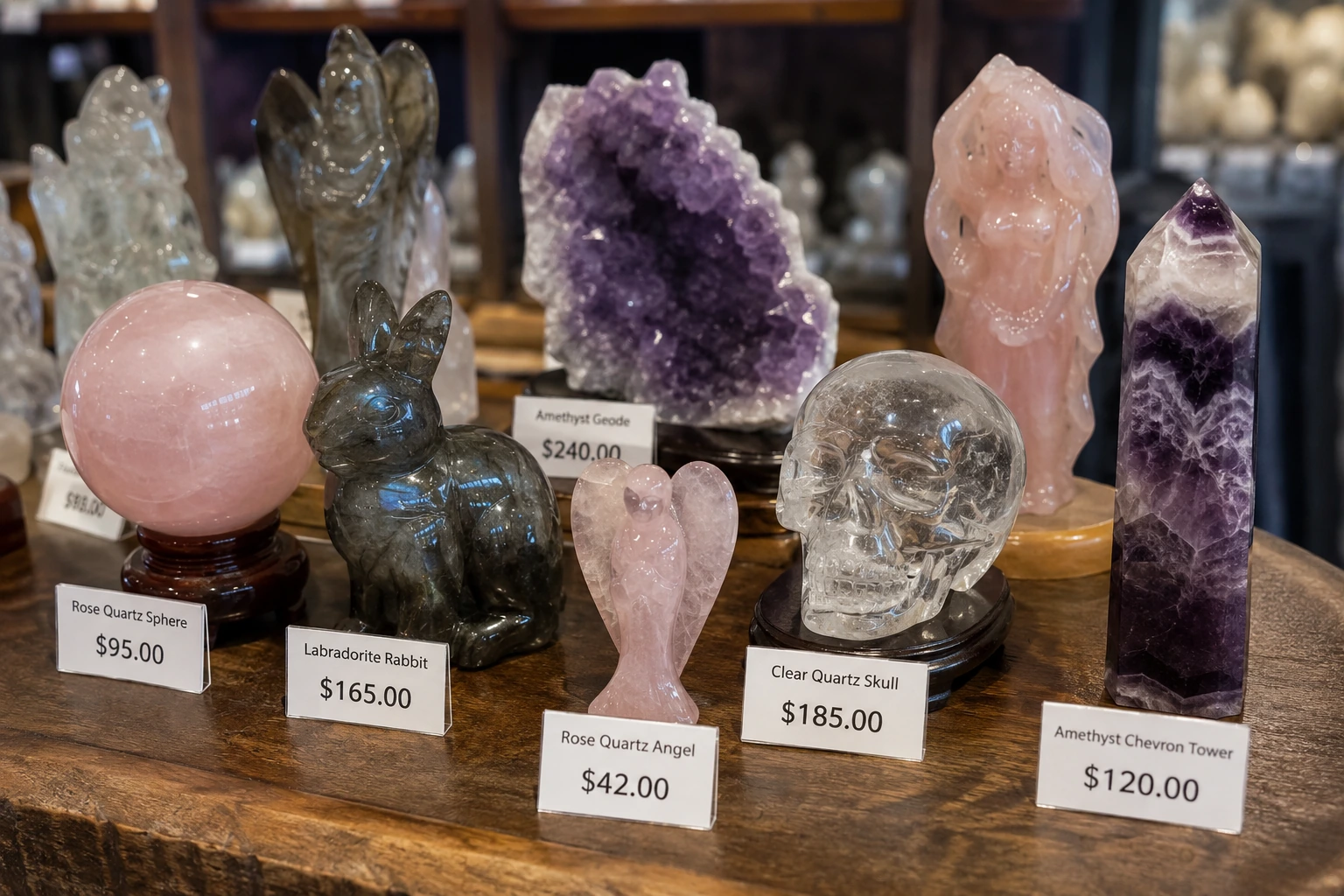
This strategy sounds simple on the surface, but mastering it requires a deeper understanding of your products, your market, and your customers' psychology. Let's break down the specific tactics you can use to unlock the true revenue potential of your crystal inventory.
Should You Price Crystal Carvings by Weight or by Artistry?
Do you find yourself pricing valuable carvings by putting them on a scale, just as you would with raw stones? This is a critical error I see many buyers make, and it can dramatically undervalue your most profitable items while commoditizing your unique collection.
For retail success, you must distinguish between two product categories. Price common items like amethyst points based on their material value and market competition. However, you must price intricate crystal carvings based on their artistic value, complexity, and uniqueness—not their weight in grams.
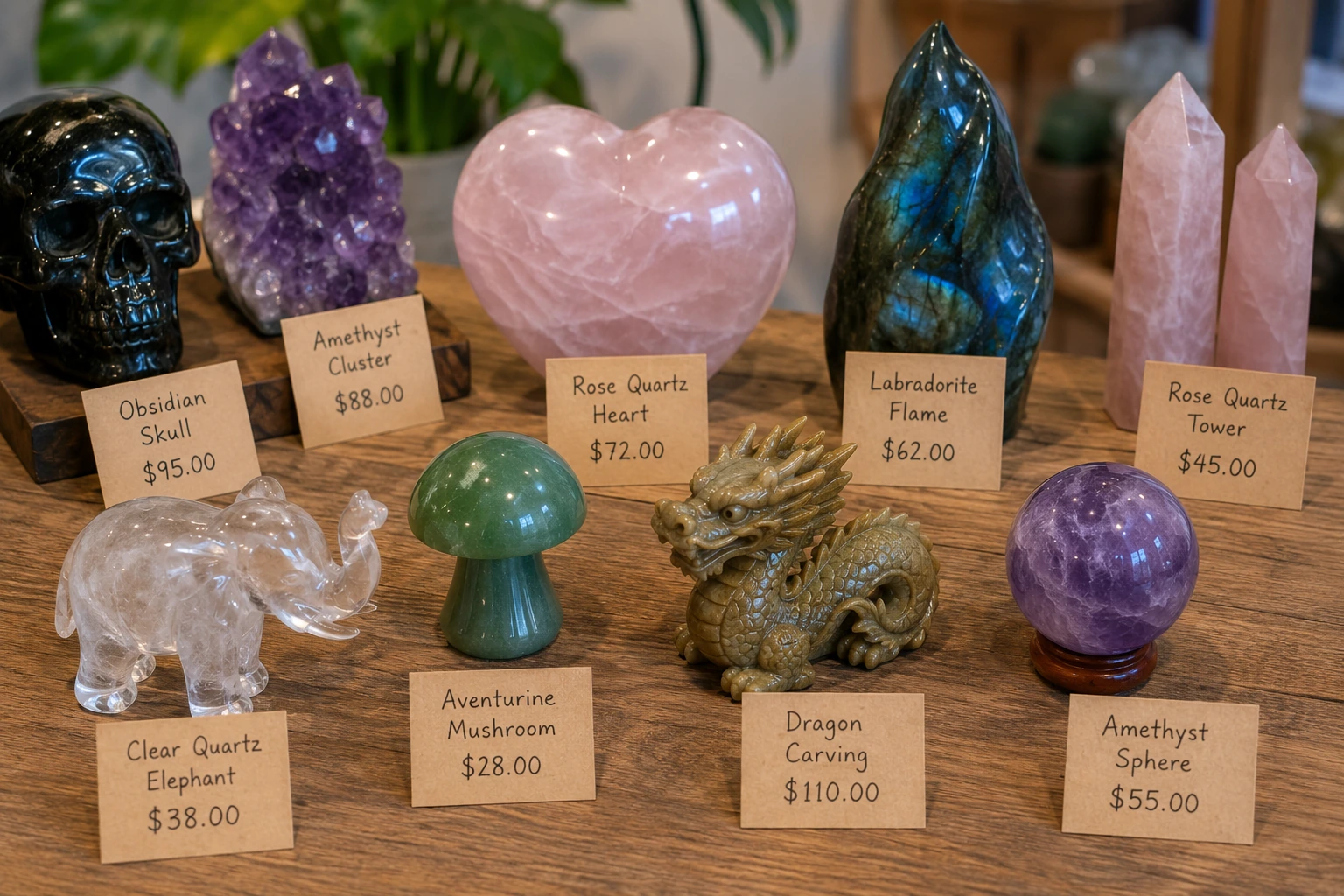
Dive Deeper: Traffic Drivers vs. Profit Generators
As a factory CEO, I see tens of thousands of pieces shipped globally. The most successful retailers I work with understand how to segment their inventory. They don't treat every crystal the same. Think of your collection in two distinct categories:
1. Traffic Drivers (Material-Oriented Products)
These are your foundational, high-recognition items. Think of products like:
- Standard Rose Quartz Spheres
- Amethyst Towers and Points
- Common Agate Slices
- Basic Tumbled Stones
The prices for these items are quite transparent in the market. A savvy customer can easily search online and compare your price for a 10cm amethyst tower to ten other shops. For this category, your goal isn't to make a massive profit on each piece. Instead, their job is to attract steady foot traffic to your physical store or clicks to your website. They build trust and drive conversions.
For these traffic drivers, a retail markup of 2 to 2.5 times your wholesale cost is a smart benchmark. It keeps you competitive while ensuring a healthy, stable cash flow.
2. Profit Generators (Craft-Oriented Products)
This is where you make your real money. These are the pieces where the value lies not in the stone itself, but in the skill and time invested by the artist.
Consider this: a raw chunk of clear quartz might have a very low material cost. But when one of our master carvers spends hours transforming it into a lifelike nine-tailed fox or an anatomically complex skull, it ceases to be a simple mineral. It becomes an art object.
For these intricate carvings, you should be aiming for a 4x, 5x, or even higher markup. Why? Because the customer has lost their point of comparison. They cannot find that exact same carving, with the same expression and detail, in another shop. They are buying a one-of-a-kind piece. Pricing it by weight would be like pricing a painting by the cost of the canvas and paint—you'd be giving away the artistry for free.
How Can Social Media Trends Influence How You Price Crystal Carvings?
Is your pricing strategy static and purely mathematical? In the fast-moving digital world, you could be missing out on periodic demand spikes for specific crystal shapes and meanings that explode in popularity on social media.
Pricing isn't just a math problem; it's about timing and market sentiment. By monitoring trends on platforms like TikTok, Instagram, and Facebook groups2, you can identify carvings with high "emotional premium" and adjust your prices upward to capture the value of this temporary, high-intent demand.
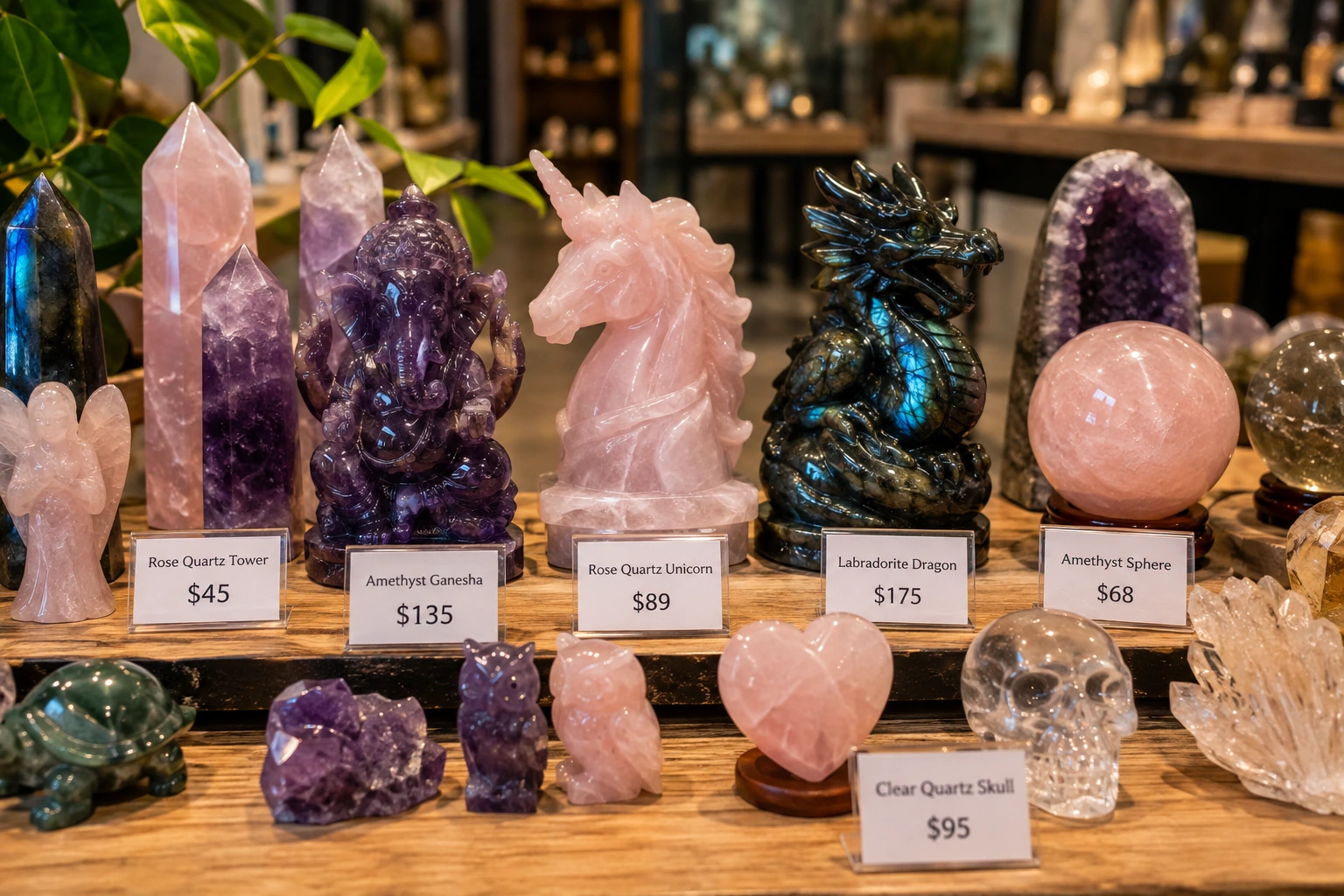
Dive Deeper: Earning the "Emotional Premium"
At our manufacturing facility, part of our service is conducting market research for our clients. We actively track conversations in wholesale and retail crystal communities across North America and Europe. This gives us a unique, ground-floor view of what's about to become popular.
We regularly see certain shapes or symbolic carvings experience a sudden, explosive surge in demand.
- A few seasons ago, crystal mushrooms became a massive trend in home decor.
- More recently, certain goddess statues or dragon turtles went viral in spiritual and manifestation communities on TikTok.
When you purchase these items that have a strong "trend tag" attached to them, you must abandon traditional pricing constraints. A customer looking for a viral mushroom carving isn't just buying a piece of fluorite; they are buying into a feeling, a community trend, and an aesthetic they saw online. This is the emotional premium.
An astute retailer who stocks these trending items can often achieve a 300% or higher profit margin3 on a single piece. The demand is so high and so specific that customers are far less price-sensitive. My advice is to always ask us what's currently gaining traction online. By stocking these viral pieces, you can capitalize on cultural moments and significantly boost your profitability.
Can a 'Statement Piece' Help You Price Crystal Carvings More Effectively?
Does your shop or website feel like a collection of small, low-priced items? Without a high-value centerpiece, customers may perceive your entire collection as "cheap," which inadvertently puts a ceiling on your average order value.
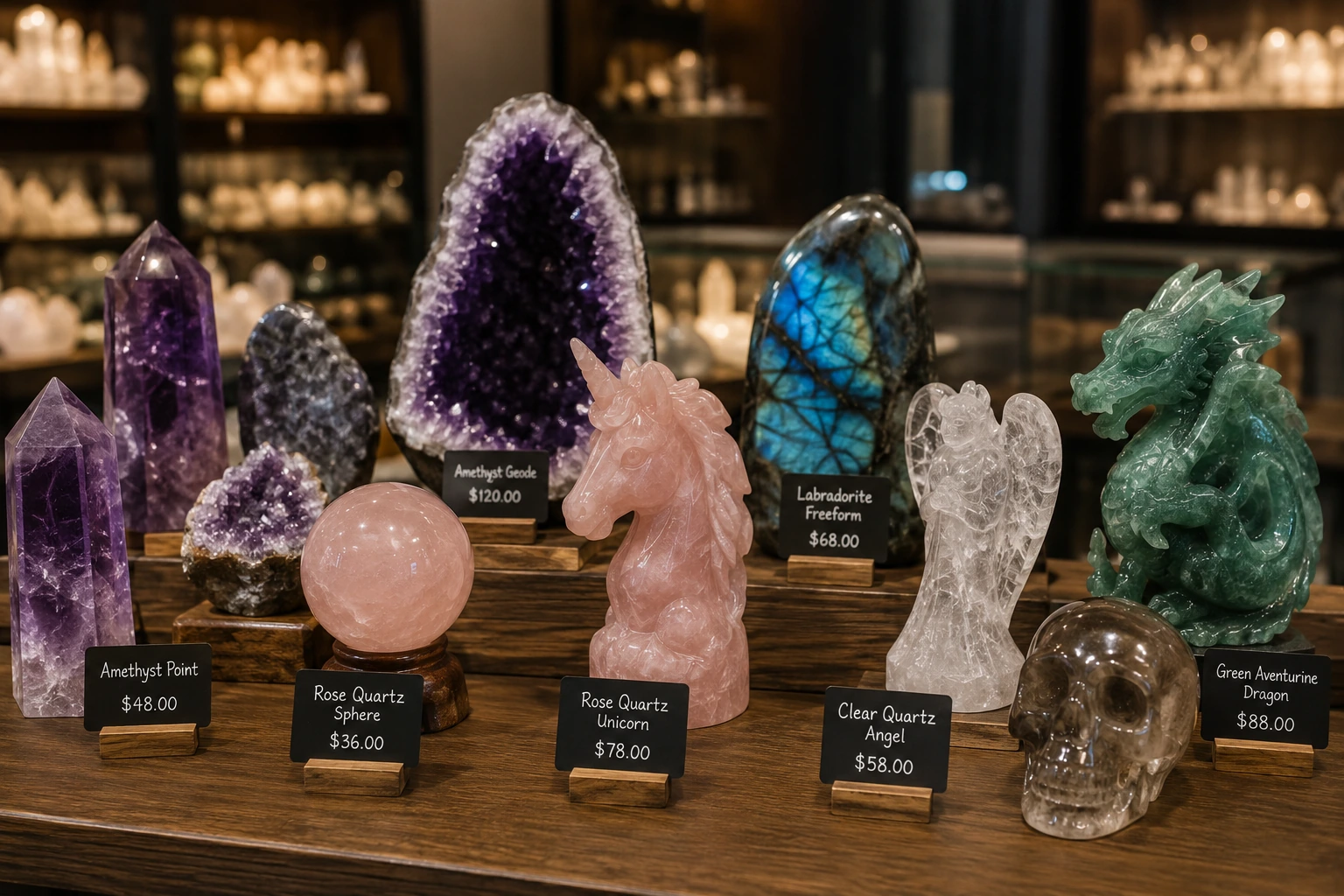
Absolutely. Placing a large, high-ticket "statement piece" in your store or on your homepage acts as a powerful "price anchor4." This high price point psychologically reframes the value of your other items5, making your mid-range, high-margin carvings seem significantly more affordable and appealing by comparison.
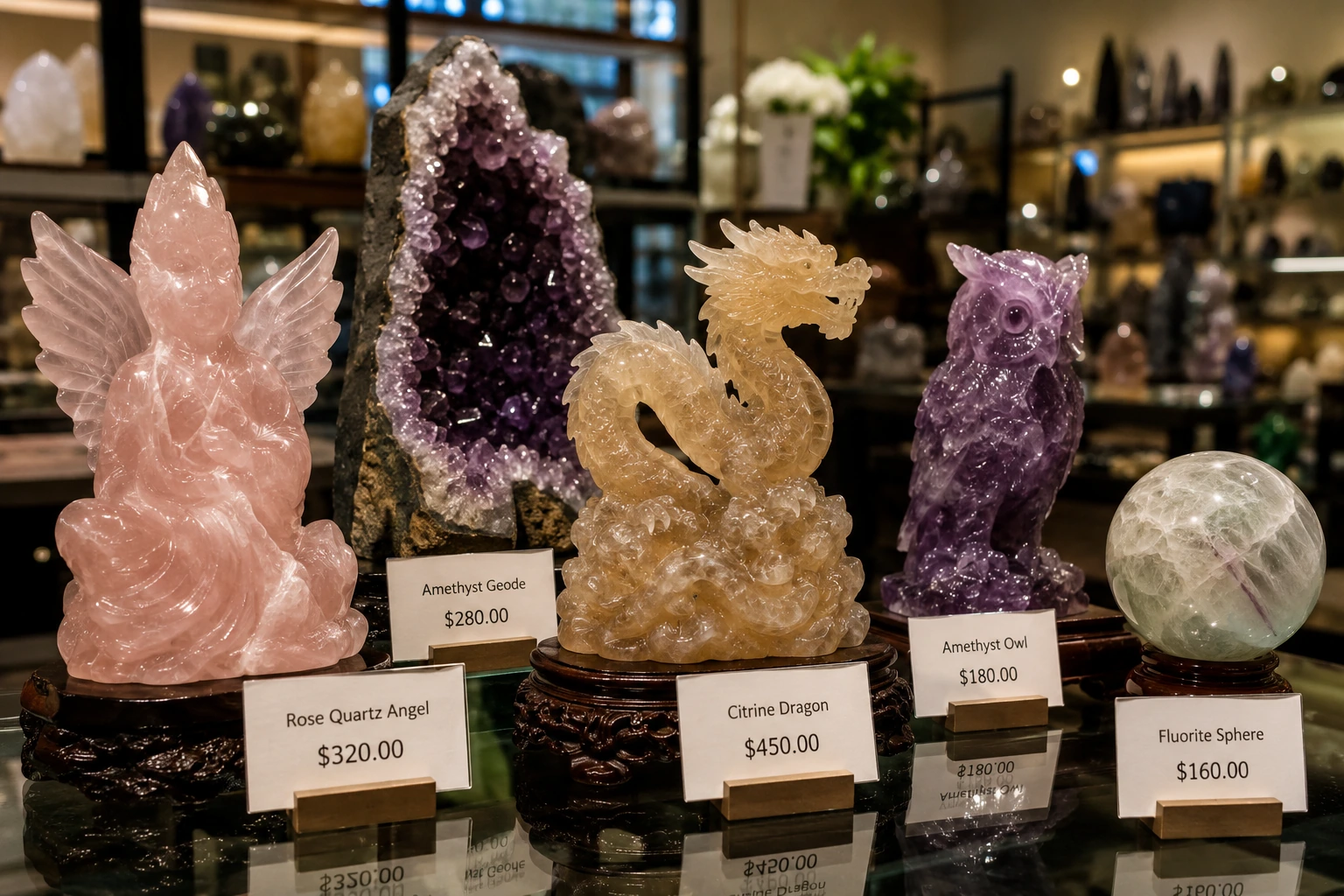
Dive Deeper: Using the Anchor Pricing Effect
This is a strategy I emphasize constantly when consulting with new shop owners on their first orders. Many are hesitant and want to play it safe, ordering only items in the $10-$30 wholesale cost range. The result is a shop that looks like a discount bin, and it becomes very difficult to sell anything for over $100.
To avoid this, your procurement strategy must include one or two "showstoppers." These are your statement pieces.
- A massive, 50kg Uruguayan amethyst cathedral geode.
- An exceptionally large and flashy labradorite freeform sculpture.
- A museum-quality, master-carved dragon from a single piece of jasper.
You might price this piece at $2,000, $5,000, or even higher. Its primary job is not to sell quickly. Its job is to be a psychological anchor.
Here’s how it works:
- A customer enters your store or lands on your website and their eyes are immediately drawn to the magnificent $2,000 geode. They are impressed by the quality and scale of what you offer.
- Then, as they browse further, they see a beautiful, hand-carved fluorite unicorn priced at $120.
- Their brain doesn't think, "$120 is a lot for a crystal." Instead, it thinks, "Wow, I can get a piece of this amazing collection for only $120? That's a great deal compared to that $2,000 anchor piece!"
This effect dramatically increases the perceived value of your entire inventory and boosts sales of your core profit-generating items in the $80 - $250 retail range.
Is Bundling an Effective Way to Price Crystal Carvings and Hide Costs?
Are you constantly fighting price wars with competitors over common items like a single rose quartz heart? Competing on price for an individual, easily compared product is a race to the bottom that erodes your profit margin6.
Bundling is a highly effective "black box" pricing strategy that savvy retailers use to escape this trap. By combining several different items into a curated kit, you create an entirely new, unique product with no direct price comparison7, allowing you to set a much higher price and margin.
Dive Deeper: The "Black Box" Method of Pricing
Instead of lowering your price on a single rose quartz heart, change the product's form. This is where you can truly get creative and add value. As a supplier that supports mixed material and mixed style orders, we make it easy for our clients to source the exact components they need for this strategy.
Here’s how you can build a high-margin bundle:
-
Source the Components: Purchase a variety of complementary items in a mixed lot.
- One Clear Quartz Point (Wholesale Cost: $3)
- One Rose Quartz Carved Heart (Wholesale Cost: $6)
- One Selenite Cleansing Wand (Wholesale Cost: $2)
- Total Component Cost: $11
-
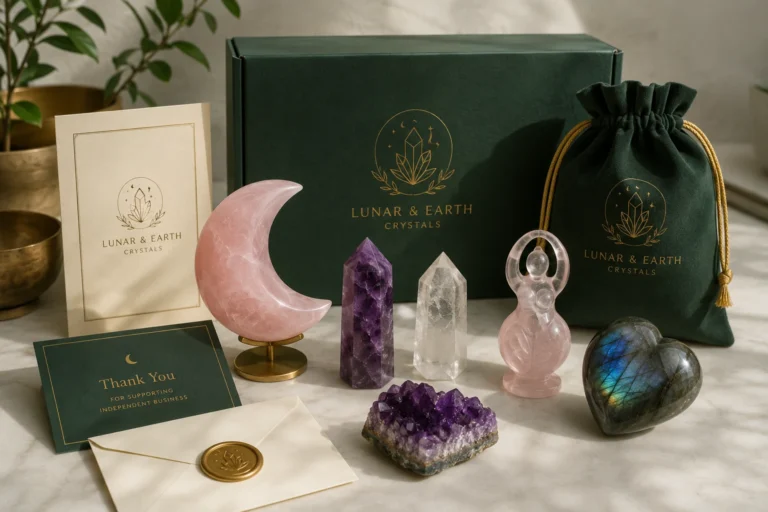
Create a New Product: Package these items together in a nice gift box. Add a small, professionally printed card that explains the purpose of the kit. Name it something evocative, like the "Self-Love & Clarity Starter Kit."
-
Price for Value: This kit, which cost you only $11 in physical goods, is now a unique, value-added product. You are no longer selling three simple stones; you are selling a solution, an experience, and a perfect gift. You can confidently price this kit at $49, $59, or even more.
By creating this "black box," you have completely broken the price transparency of the individual components. Your customer cannot compare your "Self-Love & Clarity Kit" to another store's single rose quartz heart. You've created a new SKU that is unique to your brand, giving you full control over its price and profit margin.
Frequently Asked Questions
What is a good starting markup for most crystal carvings?
A simple keystone (2x cost) is the bare minimum and often not enough. A better strategy is a tiered approach: use a 2x-2.5x markup for common, high-volume items and a 3x-5x (or more) markup for unique, intricate, or trend-driven carvings where the value is in the artistry and story.
How do I price B-grade or imperfect crystal carvings?
Be transparent about any imperfections, often marketing them as "perfectly imperfect" or noting their unique natural characteristics. Price them lower than A-grade pieces to create an affordable entry-level option for budget-conscious buyers. They also make great items for flash sales or as free gifts with larger purchases.
Should I offer discounts on my crystal carvings?
Use discounts strategically for specific events like holiday sales or to clear old stock. Avoid constant, store-wide discounting, as it can devalue your brand and train customers to wait for a sale. Instead, consider bundling or offering a "gift with purchase" to maintain the perceived value of your core products.
How do I communicate the value of a high-priced, intricate carving?
Use high-quality photography and video to showcase the fine details from every angle. Write compelling product descriptions that tell a story about the craftsmanship, the carver's skill, the hours involved, and the symbolism of the piece. You are not just selling a stone; you are selling a piece of art.
Conclusion
To truly succeed in the retail crystal market, you must learn how to strategically price crystal carvings beyond a simple, one-size-fits-all formula. This means segmenting your inventory into traffic drivers and profit generators, capitalizing on social media trends with an emotional premium, using anchor pricing with impressive statement pieces, and creating unique, high-margin bundles. By implementing these advanced strategies, you can stop leaving money on the table and build a more resilient, profitable crystal business. Learning how to price crystal carvings effectively based on their perceived value, not just their wholesale cost8, is the skill that separates the most successful retailers from the rest.
If you are ready to build a curated collection designed for maximum profitability9, contact us today. My team and I can help you select the right mix of products for these strategies and provide a fast, no-obligation quote for your business.
Email: sales@crystalcarvingswholesale.com WhatsApp: +86 150 7540 9178
"How to Use Crystal Ornaments in Christmas Displays and Retail ...", https://crystalcarvingswholesale.com/how-to-use-crystal-ornaments-in-christmas-displays-and-retail-collections/. Research on retail pricing strategies indicates that relying solely on keystone pricing can lead to missed profit opportunities, as it does not account for product-specific factors like demand elasticity or perceived value. Evidence role: statistic; source type: research. Supports: The claim that a simple keystone pricing strategy can result in leaving a significant percentage of potential profit unearned.. Scope note: The exact percentage of profit loss may vary depending on the specific market and product category. ↩
"The Power of Social Media Marketing - STU Online", https://online.stu.edu/degrees/business/mba/marketing/the-power-of-social-media/. Studies have shown that social media trends can significantly influence consumer demand and allow retailers to adjust pricing to capture higher margins during periods of heightened interest. Evidence role: general_support; source type: research. Supports: The role of social media in influencing consumer demand and pricing strategies for niche products.. Scope note: The source may not focus specifically on crystal carvings but provides insights into general retail practices. ↩
"Popular Crystal Carvings for Intention Setting and Decor - Crystal ...", https://crystalcarvingswholesale.com/popular-crystal-carvings-for-intention-setting-and-decor/. Research on consumer behavior and pricing strategies suggests that products with high emotional appeal can command significantly higher profit margins, sometimes exceeding 300%. Evidence role: statistic; source type: research. Supports: The potential for high profit margins on trending items with emotional premium.. Scope note: The source may not specifically address crystal carvings but discusses general retail trends. ↩
"Anchoring effect", https://en.wikipedia.org/wiki/Anchoring_effect. Educational materials on consumer psychology explain that price anchoring can influence customer perception of value, making mid-range items appear more affordable. Evidence role: mechanism; source type: education. Supports: The psychological effect of price anchoring in retail environments.. Scope note: The source may not specifically address crystal retail but provides general insights into price anchoring. ↩
"Anchoring effect", https://en.wikipedia.org/wiki/Anchoring_effect. Research in consumer psychology has shown that high-priced items can serve as anchors, altering customer perception of value for other products. Evidence role: mechanism; source type: research. Supports: The psychological reframing effect caused by high-priced items in retail settings.. Scope note: The source may not focus specifically on crystal carvings but discusses general retail pricing strategies. ↩
"Price war", https://en.wikipedia.org/wiki/Price_war. Studies on retail competition indicate that price wars often lead to reduced profit margins and can harm long-term business sustainability. Evidence role: general_support; source type: research. Supports: The negative impact of price wars on retail profit margins.. Scope note: The source may not specifically address crystal retail but provides general insights into pricing competition. ↩
"[PDF] Seller Beware: How Bundling Affects Valuation", https://www.anderson.ucla.edu/documents/areas/fac/marketing/Seminars/Fall%202017/Shaddy%20%20Fishbach%20-%20How%20Bundling%20Affects%20Valuation%20(job%20market%20paper).pdf. Research on retail strategies shows that bundling can reduce price transparency and allow retailers to set higher margins by creating unique product offerings. Evidence role: mechanism; source type: research. Supports: The ability of bundling to create unique products and reduce price transparency.. Scope note: The source may not focus specifically on crystal carvings but discusses general retail bundling practices. ↩
"Understanding the Influence of Consumers' Perceived Value ... - PMC", https://pmc.ncbi.nlm.nih.gov/articles/PMC8844988/. Educational resources on pricing strategies emphasize that perceived value plays a critical role in consumer purchasing decisions and retail success. Evidence role: expert_consensus; source type: education. Supports: The importance of perceived value in determining retail pricing strategies.. Scope note: The source may not specifically address crystal carvings but provides general insights into retail pricing. ↩
"The Retail Profitability Paradox - MIT Sloan Management Review", https://sloanreview.mit.edu/article/the-retail-profitability-paradox/. Research on retail strategies highlights that curated collections can improve customer experience and increase profitability by aligning products with consumer preferences. Evidence role: general_support; source type: research. Supports: The role of curated collections in enhancing retail profitability.. Scope note: The source may not specifically address the crystal retail market but discusses general retail practices. ↩
Keep Reading