Struggling to justify the cost of high-quality crystal carvings to your customers or procurement team? Many buyers assume these beautiful objects are mass-produced from a mold, making it hard to explain price differences. This guide demystifies the entire manufacturing process, showing you how raw stone becomes a work of art and empowering you to source with confidence.
The process of making crystal carvings begins with selecting and slicing high-quality raw stone to remove imperfections. The stone is then cut and roughly shaped using saws and sometimes CNC machines. After that, skilled artisans use a variety of hand-held tools for detailed carving1. The final step involves a multi-stage sanding and polishing process to achieve a smooth, lustrous finish2.
This summary provides a high-level overview, but the real value for a wholesale buyer lies in the details of each stage. Let's break down the journey from a rugged stone to a polished masterpiece, revealing where quality is won, lost, and how it impacts your bottom line.
How Are Crystals Carved from Raw Stone to Finished Products?
Does the journey from a giant rock to a delicate carving seem like a complete mystery? This "black box" manufacturing process can make it impossible to evaluate a supplier's quality or pricing. Let's open the box and walk through the complete production line.
The creation of gemstone carvings follows a meticulous, multi-stage path. It starts with sourcing and grading large blocks of raw mineral, followed by primary cutting to create manageable pieces. These are then shaped into rough forms, detailed by hand, and finally polished to a brilliant shine before undergoing a final quality inspection.
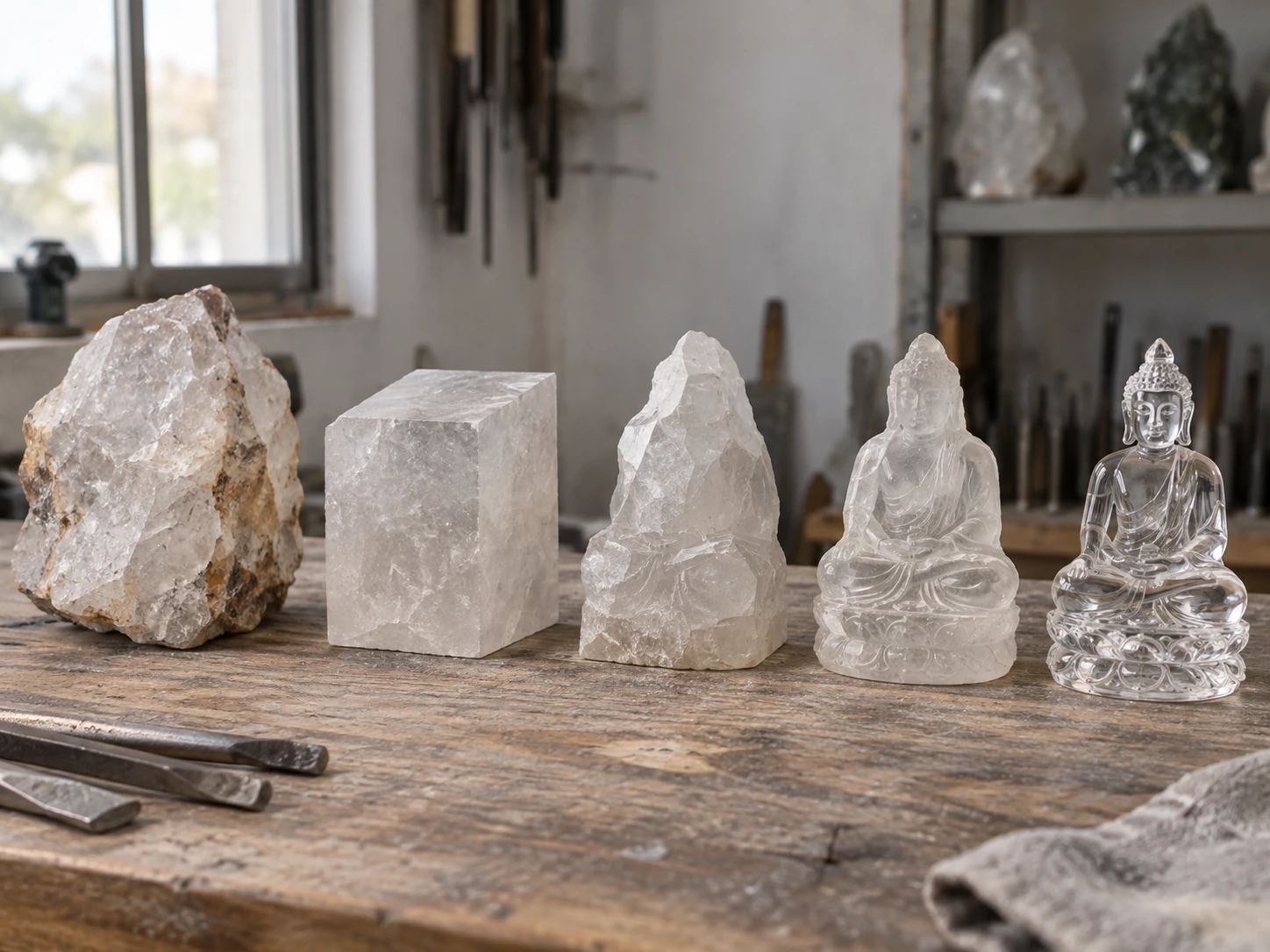
The Five Core Stages of Production
At our factory, I see this transformation every day. It's a process that combines heavy machinery with delicate artistry. Every single carving, whether it's a simple tower or a complex dragon, goes through these fundamental steps. Understanding them is the first step toward becoming an expert buyer.
Here is a high-level breakdown of the journey:
- Sourcing and Selection: It all begins at the mine. We acquire large, often multi-ton blocks of raw crystal. The first critical task is to assess the block and decide how to cut it to get the best "heart" material, avoiding natural cracks and inclusions.
- Cutting and Rough Shaping: Giant, water-cooled saws slice the block into more manageable slabs or cubes. For geometric items like towers and spheres, CNC (Computer Numerical Control) machines may be used to create uniform rough shapes, or "blanks."
- Fine Detailing and Carving: This is where artistry takes over. For intricate designs like animals, skulls, or deities, skilled artisans use a series of handheld, water-cooled rotary tools with various diamond-coated burrs to carve the fine details.
- Sanding and Polishing: The carved piece, which is still matte and rough, goes through a lengthy finishing process. This involves tumbling with progressively finer abrasive grits or hand-polishing with flexible wheels to bring out the stone's natural luster.
- Final Quality Control and Packing: Every finished piece is inspected for flaws in the carving, polishing imperfections, or material defects that were missed. Approved items are then cleaned and securely packed for international shipping.
Selecting Raw Material and Planning the Carving?
Have you ever wondered why two seemingly identical carvings have vastly different prices? The answer often lies in the very first step: the quality of the raw stone. Choosing the wrong block or cutting it inefficiently can lead to immense waste, driving up the cost of the final product.
The selection of raw material is a high-stakes gamble on yield. The process involves inspecting massive, uncut stones for internal fractures and impurities. An experienced master must then plan the cuts to maximize the amount of usable, high-quality material while minimizing costly waste.

The Brutal Economics of Yield Rate
The true cost of a carving is determined the moment the first cut is made. This is a part of the process most buyers never see, but it has the single biggest impact on price.
When we receive a shipment from a mine, we aren't getting clean, beautiful crystals. We get multi-ton boulders covered in dirt and host rock.
- Slicing the Stone: The first step is to use enormous, water-jet saws to slice the boulder open. This is the moment of truth. Only now can we see the inside of the stone and assess its quality.
- Finding the "Heart": Natural minerals are full of internal fractures (fissures), cloudy spots (inclusions), and dead zones with poor color. Our most experienced artisans must "read" these slices and identify the sections of "gem-grade" material worth carving. This is where their decades of experience become invaluable.
- The Cost of Waste: To give you a real-world example, creating a single, flawless 15cm Rose Quartz fox carving might require us to cut through several kilograms of A-grade raw material3. The final piece may only weigh 500 grams, but its cost includes the much larger amount of stone that was cut away due to imperfections. When you buy a premium carving, you are not just paying for its final weight; you are paying for all the raw material that was sacrificed to achieve its perfection.
Cutting and Rough Shaping: Handwork and Machine Assistance?
Does the term "machine-made" automatically mean lower quality in the world of crystals? This common misconception can prevent buyers from appreciating the efficiency and precision that modern tools bring to the craft. The key is understanding where machines excel and where the human touch is irreplaceable.
Rough shaping uses a combination of machinery and handwork to efficiently form the basic outline of the final product. Large saws make initial cuts, while CNC machines can create geometric blanks for items like spheres and towers. This machine assistance is about creating a canvas for the artist, not replacing them.
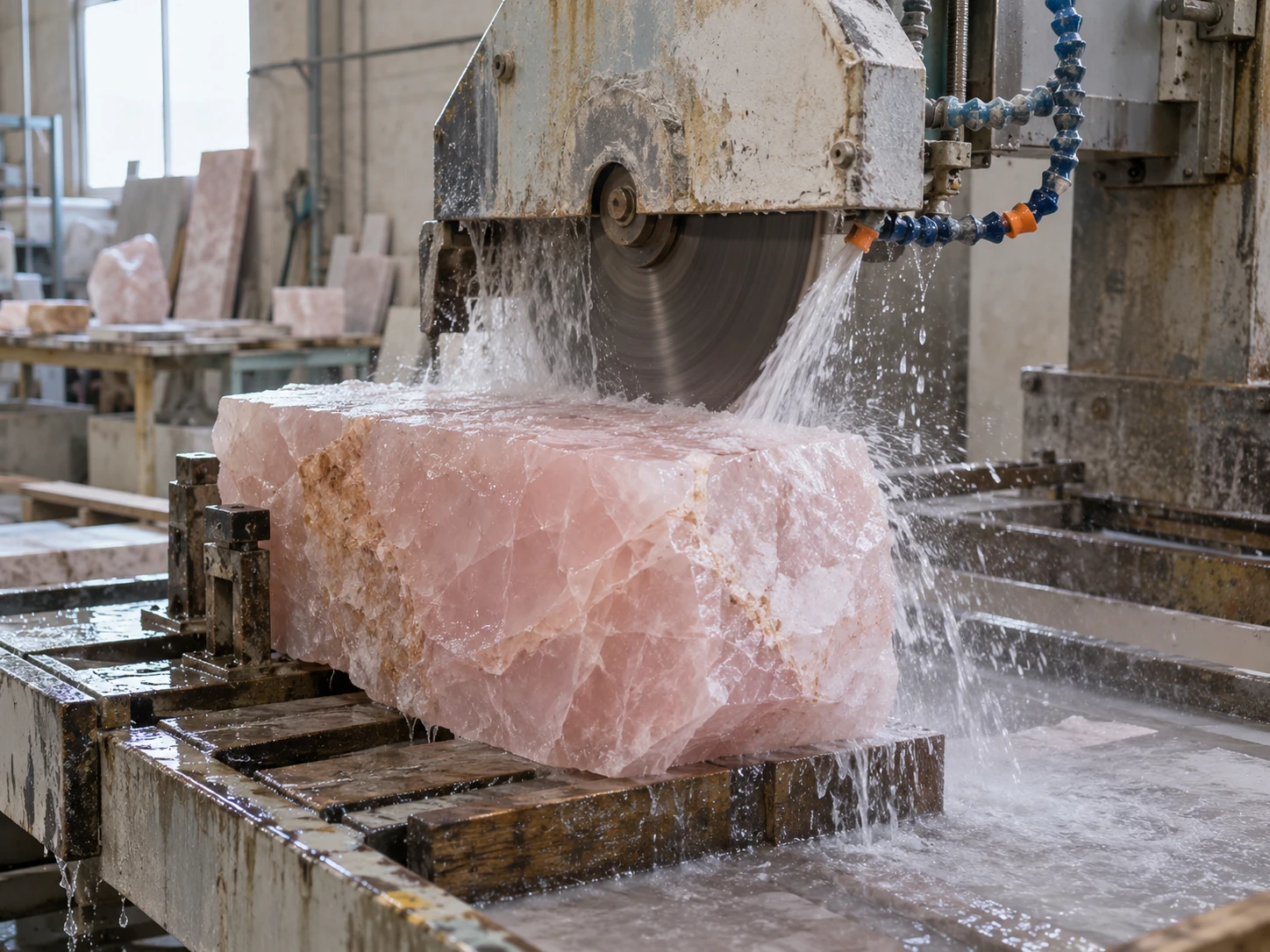
The Battle Against Material Physics
Once a clean piece of raw material is selected, the goal is to give it a basic form. This stage is a constant negotiation between the desired shape and the stone's natural properties.
CNC for Consistency and Speed
For standardized products with geometric shapes, we leverage technology.
- Crystal Towers & Points: We use CNC machines to cut hexagonal or square blanks from slabs of stone. This ensures consistency in size and angle across a large batch.
- Crystal Spheres: Making a perfect sphere starts with cutting a cube, then using a specialized machine to grind it into a rough ball shape. This is far more precise and efficient than doing it by hand.
This machine-assisted stage is not about "mass production" in the way one might think of plastic molding. It's about intelligently preparing the stone for detailed work.
The Limits of a Machine
However, machines are only as good as their operator and the material they are cutting. Natural crystals have unique properties that must be respected.
- Hardness and Brittleness: Every stone has a different Mohs hardness and level of fragility. If a machine's rotational speed is too high or the cutting angle is wrong for a brittle stone like Fluorite or Amethyst, the entire piece can shatter instantly.
- Cleavage Planes: Many crystals have natural planes of weakness, called cleavage4. An experienced factory understands how to cut with the stone's grain to prevent it from splitting. A less experienced workshop will fight against the grain, leading to a very high breakage rate. That cost of breakage is inevitably passed on to the buyer.
Detail Carving, Sanding and Polishing?
What separates a mediocre carving that sits on the shelf from a premium masterpiece that flies out the door? The difference is almost always found in the final stages of detailing and polishing. These steps transform a rough shape into an object with life, soul, and a high perceived value.
Detail carving is performed almost exclusively by hand, where skilled artisans use specialized tools to create texture, depth, and personality. This is followed by a multi-day, multi-stage polishing process that physically grinds the surface to a glass-like luster, a hallmark of superior quality.
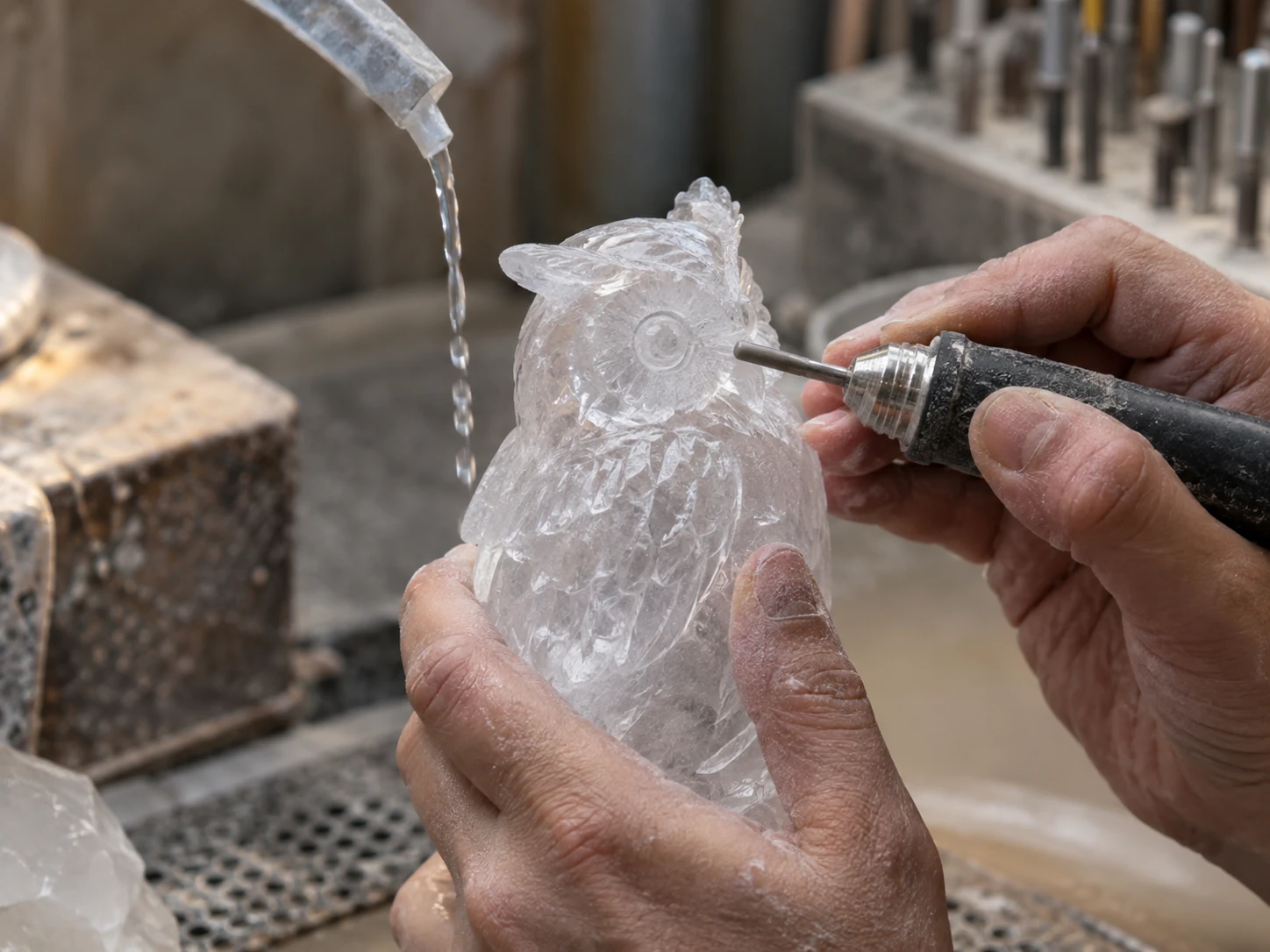
Where Artistry Creates Value
A machine can give a crystal its basic shape, but only a human hand can give it a soul. This is why complex crystal carvings can command such high retail prices and become the hero products of a brand.
Fine Hand Carving: After rough shaping, the blanks for complex pieces like skulls, goddesses, animals, or intricate patterns are handed over to our master carvers5.
- The Artisan's Toolkit: A carver will use a flexible-shaft rotary tool with a constant flow of water to prevent dust and cool the stone. They will switch between dozens of different diamond-coated burrs, from large grinders to tiny, needle-like tips.
- Creating Depth and Texture: With these tools, they painstakingly bring the piece to life. They carve the deep eye sockets of a skull, the individual feathers on a wing, or the soft fur texture on an animal. This process is incredibly time-consuming. A single master artisan might only be able to complete one or two highly complex pieces in a full day's work. This step is the source of your most powerful brand stories.
The Polishing Secrets That Define Quality
Have you ever received a batch of carvings that looked foggy or felt strangely oily to the touch? This is a tell-tale sign of a supplier cutting corners in the polishing stage.
- The Right Way: High-quality polishing is a physical, not chemical, process. Carvings are placed in a vibratory tumbler, a large basin filled with water and abrasive media6. They are tumbled for days, starting with a coarse grit and moving through several stages to progressively finer grits. For complex shapes, this is followed by manual polishing with felt wheels to reach every nook and cranny. The result is a true, brilliant, glass-like shine that comes from the stone itself.
- The Low-Quality Shortcut: To save time and electricity, some suppliers will drastically shorten the tumbling process and then coat the piece in a thick layer of mineral oil or wax. It looks shiny at first, but this coating quickly wears off, revealing the dull, poorly polished surface underneath. A properly polished crystal should feel smooth and cool, not greasy, and its shine will last a lifetime.
What Should Buyers Check When Sourcing Crystal Carvings?
You've received a sample, and it looks great. But how can you be sure the bulk order will match this quality? Approving a sample without asking the right questions or knowing what to look for is a common and costly mistake for wholesale buyers.
Before approving any sample, a buyer must critically evaluate four areas: the quality of the raw material, the precision of the carving details, the perfection of the polish, and the supplier's stated tolerances for variation in a bulk production run.
Your Pre-Approval Checklist
A sample is not just a product; it's a promise from your supplier. Your job is to verify that promise and understand its terms. As a manufacturer, these are the points I discuss with discerning clients to ensure we are aligned.
1. Scrutinize the Material Itself
Look past the shape and inspect the stone.
- Cracks and Fissures: Are there internal fractures that compromise the piece's integrity? A few natural internal lines are normal, but deep cracks that reach the surface are defects.
- Color and Clarity: Is the color vibrant and consistent? For stones like Clear Quartz, how clear is it? Note the grade of the material.
- Inclusions: Are there excessive cloudy spots or mineral deposits that detract from the beauty?
2. Analyze the Carving and Shaping
This is where you evaluate the skill of the carvers.
- Symmetry and Proportions: Is the piece symmetrical? Are the proportions correct for the object it represents (e.g., a skull, an animal)?
- Detail Clarity: Are the lines sharp and intentional? On a goddess carving, are the facial features distinct? On an animal, is the fur texture clear, or is it a muddy mess?
- Undercuts and Depth: Have the carvers created a sense of depth, or is the design flat and superficial? High-quality carvings have complex angles and "undercuts" that are difficult to execute.
3. Evaluate the Polish and Finish
Feel the surface and look at it under a bright light.
- Surface Luster: Does it have a deep, glassy shine, or does it look dull and foggy?
- Feel: Does it feel smooth and cool, or is there a waxy, oily residue? The latter is a red flag for poor polishing disguised by a chemical coating.
- Scratches: Are there any leftover scratches from the carving or sanding process7? A perfect polish is uniform across the entire piece, even in tight corners.
4. Ask These Critical Questions About Bulk Production
- "This sample represents your best work. What is the acceptable range of variation for color, clarity, and internal fissures in a bulk order?"
- "What are your quality control checkpoints for carving details? How do you ensure consistency from the first piece to the last?"
- "Can you confirm your polishing process is multi-stage physical grinding and not reliant on a final wax coating?"
- "What is your defect rate, and how do you handle pieces that don't meet the standard agreed upon from this sample?"
Frequently Asked Questions
Why are natural stones processed or carved at all?
Natural stones are carved to unlock their beauty and create forms with specific purposes. In their raw state, many crystals are simply rough, unappealing chunks. Carving transforms them into beautiful decorative objects, tools for metaphysical practices (like spheres and points), or intricate works of art that are far more valuable.
How can I distinguish between handmade and machine-assisted carvings?
Examine the shape's complexity. Perfectly geometric and symmetrical forms like towers, spheres, and palm stones are almost always machine-assisted for the initial rough shaping to ensure consistency and efficiency. Highly intricate, organic, or asymmetrical designs like detailed animals, deities, or floral patterns require significant hand-detailing work that machines cannot replicate.
Can I assume a single sample represents the entire batch?
No, you should treat a sample as the "target quality standard," not an exact replica of every piece. Because crystal carvings are made from natural materials, there will always be slight variations in color, pattern, and internal characteristics. It is essential to discuss and agree upon an acceptable range of these variations with your supplier before confirming a bulk order.
Conclusion
Understanding how crystal carvings are made transforms you from a simple buyer into an informed sourcing partner. The journey from a raw, unpredictable boulder to a polished work of art is a delicate balance of geology, technology, and irreplaceable human skill. The price of a carving reflects not just its own weight, but the cost of the wasted material, the precision of machine work, the hours of an artisan's labor, and the quality of the final polish. By appreciating these steps, you can better evaluate suppliers, justify premium pricing to your customers, and build a collection of truly exceptional products.
As a wholesale buyer, partnering with a manufacturer who is transparent about these steps is crucial for your success. If you're looking for a reliable supplier for custom or wholesale crystal carvings, our team is ready to discuss your specific needs and provide samples that reflect our deep commitment to this craft.
<!--[googlesitekit-end-of-content]-->
"Stone Carving Tools – Nasher Virtue", https://sites.duke.edu/nashervirtue/stone-carving-tools/. Artisans typically use rotary tools with diamond-coated burrs for detailed carving of crystals, as described in educational resources on gemstone carving techniques. Evidence role: mechanism; source type: education. Supports: Skilled artisans use hand-held tools for detailed carving in the production of crystal carvings.. Scope note: The source may focus on general gemstone carving rather than specific practices for crystal carvings. ↩
"Multi-step polishing process by ESOTERIC!",
. Research on gemstone finishing techniques highlights the use of progressively finer abrasives and tumbling methods to achieve a polished surface. Evidence role: mechanism; source type: research. Supports: Crystal carvings undergo a multi-stage sanding and polishing process to achieve a smooth, lustrous finish.. Scope note: The source may not specifically address crystal carvings but provides general insights into polishing methods. ↩"An Introduction to Synthetic Gem Materials", https://www.gia.edu/gem-synthetic. Studies on gemstone production report high material waste rates due to internal fractures and inclusions in raw stones. Evidence role: statistic; source type: research. Supports: Creating a single, flawless carving requires cutting through several kilograms of A-grade raw material.. Scope note: The source may provide general statistics rather than specific examples for Rose Quartz carvings. ↩
"Geometrical prediction of cleavage planes in crystal structures", https://pmc.ncbi.nlm.nih.gov/articles/PMC8420770/. Research on mineralogy explains how cleavage planes influence the stability and carving methods for natural crystals. Evidence role: mechanism; source type: research. Supports: Many crystals have natural planes of weakness, called cleavage, which affect carving techniques.. Scope note: The source may focus on general mineral properties rather than specific applications in crystal carving. ↩
"Making the Cut: The Art and Science of Fantasy Carving", https://www.gia.edu/gia-news-research/making-cut-art-science-fantasy-carving. Studies on gemstone artistry emphasize the skill and precision required for carving intricate designs, often involving years of experience. Evidence role: expert_consensus; source type: research. Supports: Master carvers handle intricate designs such as skulls, goddesses, animals, or patterns.. Scope note: The source may focus on general gemstone artistry rather than specific examples of crystal carvings. ↩
"Vibratory Rock Tumblers", https://kingsleynorth.com/collections/vibratory-tumblers?srsltid=AU7gw4WH2dsgXSqlJDT_-or1c_-QP7TLDV5hyWLMUbYLy0hJWPO5SSX6. Educational guides on gemstone polishing describe the use of vibratory tumblers with abrasive media to achieve a smooth finish. Evidence role: mechanism; source type: education. Supports: High-quality polishing involves the use of a vibratory tumbler filled with water and abrasive media.. Scope note: The source may not specifically address crystal carvings but provides general insights into polishing methods. ↩
"What is causing lines and scratches on gemstone surface ...", https://www.facebook.com/groups/577367348259195/posts/590005110328752/. Research on gemstone finishing highlights the importance of eliminating scratches to achieve a uniform, polished surface. Evidence role: mechanism; source type: research. Supports: Scratches from the carving or sanding process can detract from the quality of a polished crystal carving.. Scope note: The source may focus on general gemstone finishing rather than specific examples of crystal carvings. ↩
Keep Reading