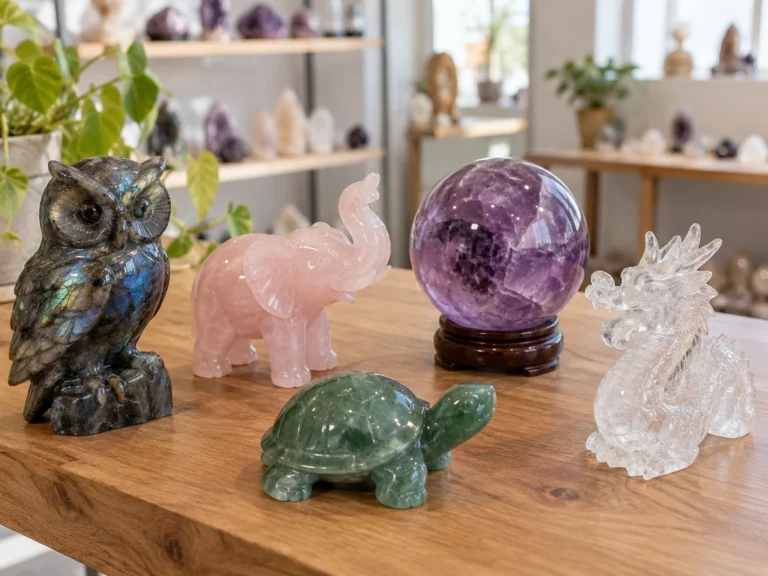
Choosing the best gemstones for carving often frustrates product managers who treat natural stone like injection-molded plastic. When you pair an intricate 3D design with the wrong mineral structure, you face severe factory breakage, muddy surface details, and unviable unit costs. Matching your design blueprint to the physical limits of the raw stone solves this production bottleneck.
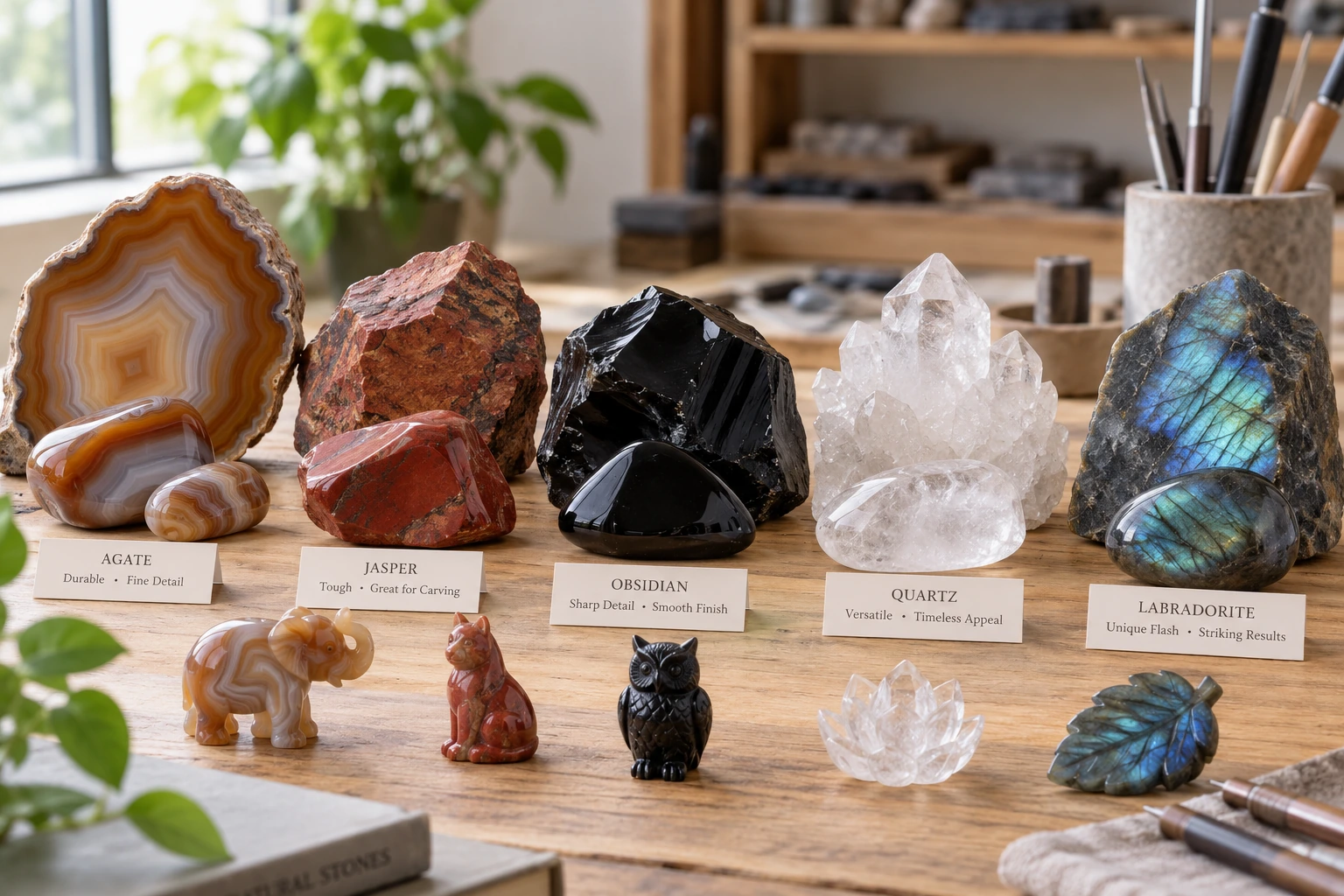
There is no single universal choice among the best gemstones for carving; instead, the ideal stone depends entirely on your design's geometry and detail level. Cryptocrystalline stones like agate and jasper hold microscopic details best1, while optical stones like labradorite require broad, smooth curves to display their natural color flash2.
As a B2B manufacturer of natural crystal carvings in Donghai, our production team reviews client blueprints daily. We frequently help overseas buyers adjust their CAD files or switch stone varieties before cutting begins. Below, I break down how you can match mineral properties to your specific product designs.
What Makes a Gemstone Suitable for Carving?
Buyers often select a trending mineral for a new product line without checking its structural integrity. This oversight leads to cracked prototypes, wasted sample fees, and delayed product launches. Evaluating a stone's workability alongside your design geometry prevents these costly sourcing mistakes.
A gemstone is suitable for carving when its internal crystal structure, fracture resistance, and raw block size align with the target design's thinnest features. The best gems to carve allow diamond rotary tools to cut from multiple angles without splitting along internal cleavage planes or losing surface definition.
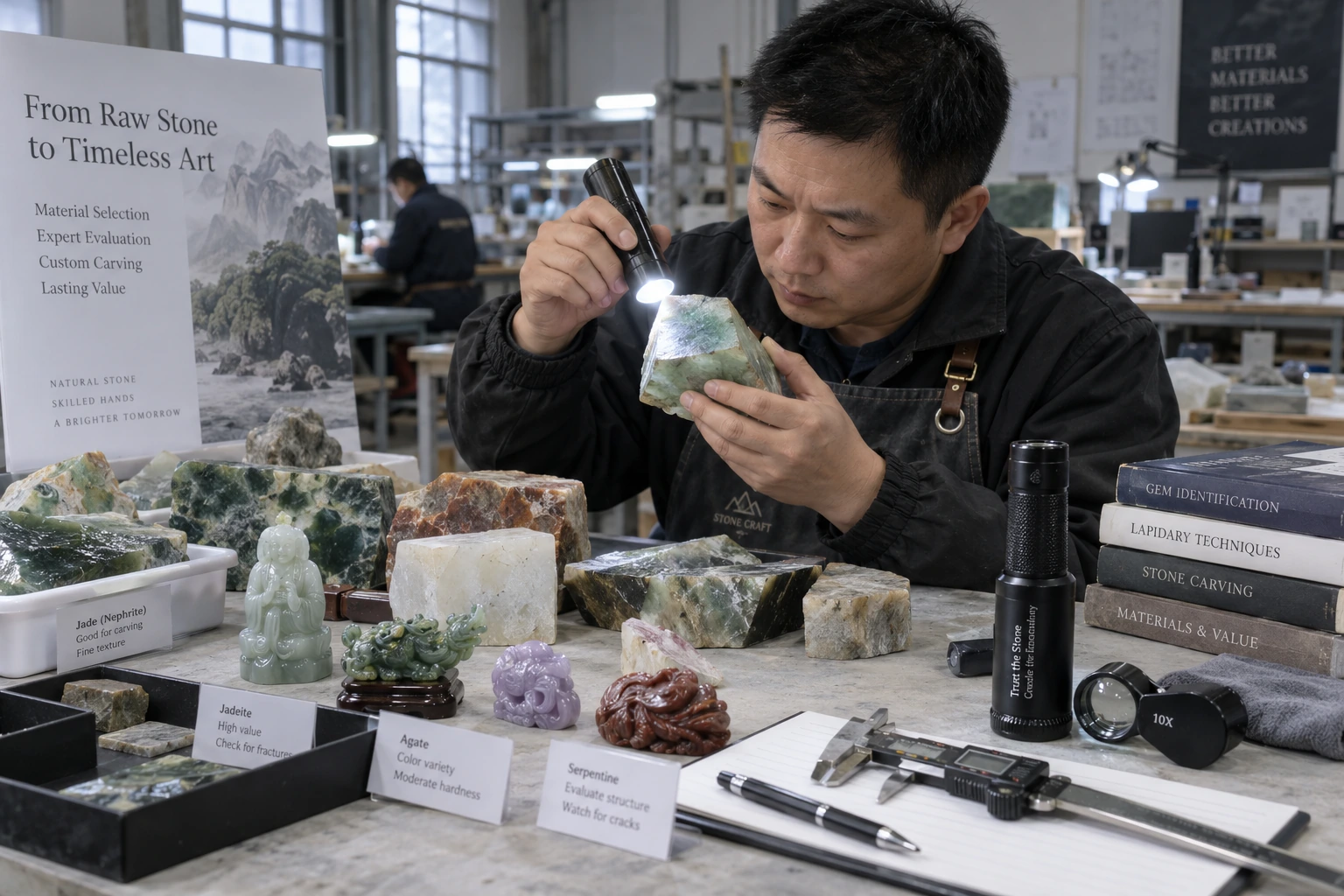
Defining the Thinnest Structural Feature First
In our carving workshop, an ironclad rule governs production: your design blueprint must compromise with the physical genetics of the mineral. Before you ask a supplier for a quote, you must identify the thinnest, most fragile structural point in your 3D model.
Look closely at protruding elements like dragon scales, thin angel wings, sharp geometric edges, or undercut openwork. If a design features a 3mm cantilevered wing, the stone must withstand high-speed diamond burrs and subsequent tumbling or hand-polishing vibration without snapping.
Three Core Production Criteria
When we evaluate custom crystal orders for retail brands and importers, we filter material options through three manufacturing realities:
- Tool Response: Does the stone grind away smoothly into a fine powder, or does it chip in jagged flakes when the CNC spindle changes direction?
- Rough Block Yield: How much usable, fracture-free material exists inside a raw boulder? High-waste stones drastically increase the unit cost of large sculptures.
- Visual Contrast: Does the polished surface actually show the carved relief? A highly transparent or heavily included stone can visually swallow shallow surface engravings.
Hardness, Toughness, Fractures and Other Material Factors?
Many sourcing managers rely solely on the Mohs hardness scale to judge stone durability. However, hard stones can still shatter easily under the stress of ultrasonic drills or international transit3. Separating scratch resistance from structural toughness protects your wholesale inventory from high defect rates.
In gemstone carving, hardness measures scratch resistance, while toughness measures the ability to resist breaking under impact or vibration. Additionally, cleavage planes, internal healed fractures, and crystal grain size determine whether a stone will hold sharp edges or split cleanly in half during machining.
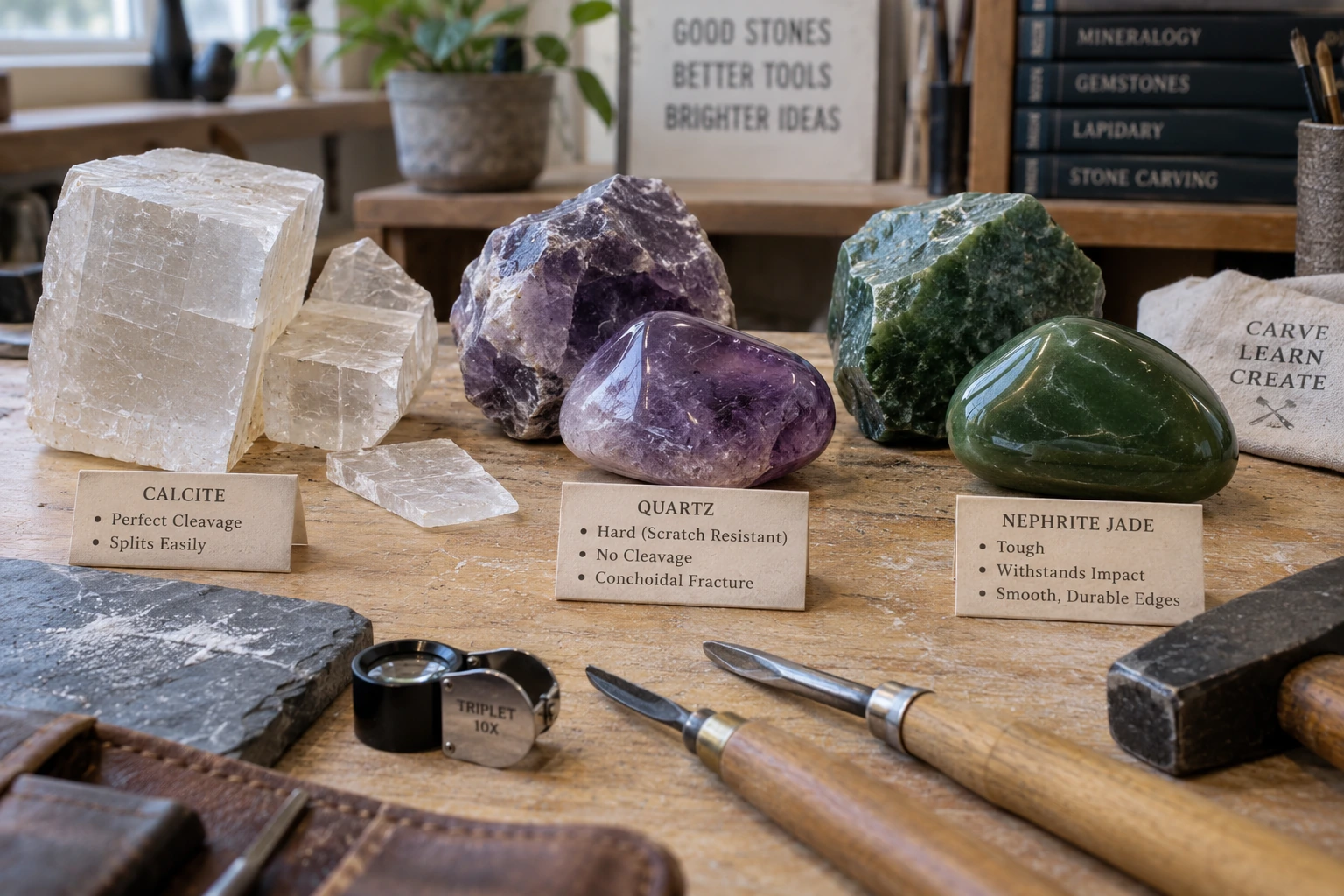
Separating Hardness from Toughness and Cleavage
According to standard gemological principles established by the Gemological Institute of America (GIA), durability consists of three distinct factors: hardness, toughness, and stability.
A mineral can rank relatively high on the Mohs hardness scale (which only tests surface scratch resistance) while possessing poor toughness due to internal cleavage. Cleavage refers to a mineral's tendency to split along flat, predictable atomic planes when struck4.
- Mohs Hardness: Dictates the type of abrasive grit required for cutting and how well the finished retail piece resists consumer scratches.
- Toughness (Tenacity): Dictates how well the stone survives high-speed CNC routing, thin-wall Undercutting, and drop impacts.
- Cleavage: Acts as a structural fault line. If a carving tool hits a cleavage plane at the wrong angle, the stone shears apart cleanly.
- Internal Fractures (Ice Cracks): Natural stress cracks formed during geological growth5. Unlike cleavage, these follow irregular paths and often hide inside raw rough until the saw blade opens the stone.
Why Soft and Cleavage-Prone Stones Are Workshop Red Zones
Minerals like fluorite (Mohs hardness 4), malachite (Mohs 3.5–4), and satin spar selenite (Mohs 2) are perennial bestsellers in metaphysical and gift shops. However, they represent high-risk materials on the factory floor.
Fluorite exhibits perfect octahedral cleavage in four directions6. If a machine vibration is slightly too strong, or if a worker taps a thin edge during polishing, the piece snaps along a flat plane. Selenite is so soft that a fingernail can scratch it, and its fibrous structure peels easily.
For these materials, buyers must avoid thin extensions, delicate tails, or hollow openwork. Designs must remain chunky, compact, and rounded—such as palm stones, thick bowls, or solid geometric shapes—to keep production and transit breakage under control.
Matching Stone to Fine Details and Simpler Shapes?
Forcing a complex micro-carving onto a coarse or optically sensitive stone ruins both the artistic detail and the mineral's natural beauty. You end up paying high labor fees for a sample that looks lifeless on a retail shelf. Pairing your surface geometry with the right mineral family maximizes visual impact.
Fine details and sharp geometric reliefs require cryptocrystalline stones or volcanic glass, which lack cleavage and polish to a high-contrast mirror finish. Simpler, flowing shapes with broad curved surfaces are best matched with optical feldspars or soft minerals to showcase light reflection and prevent edge chipping.
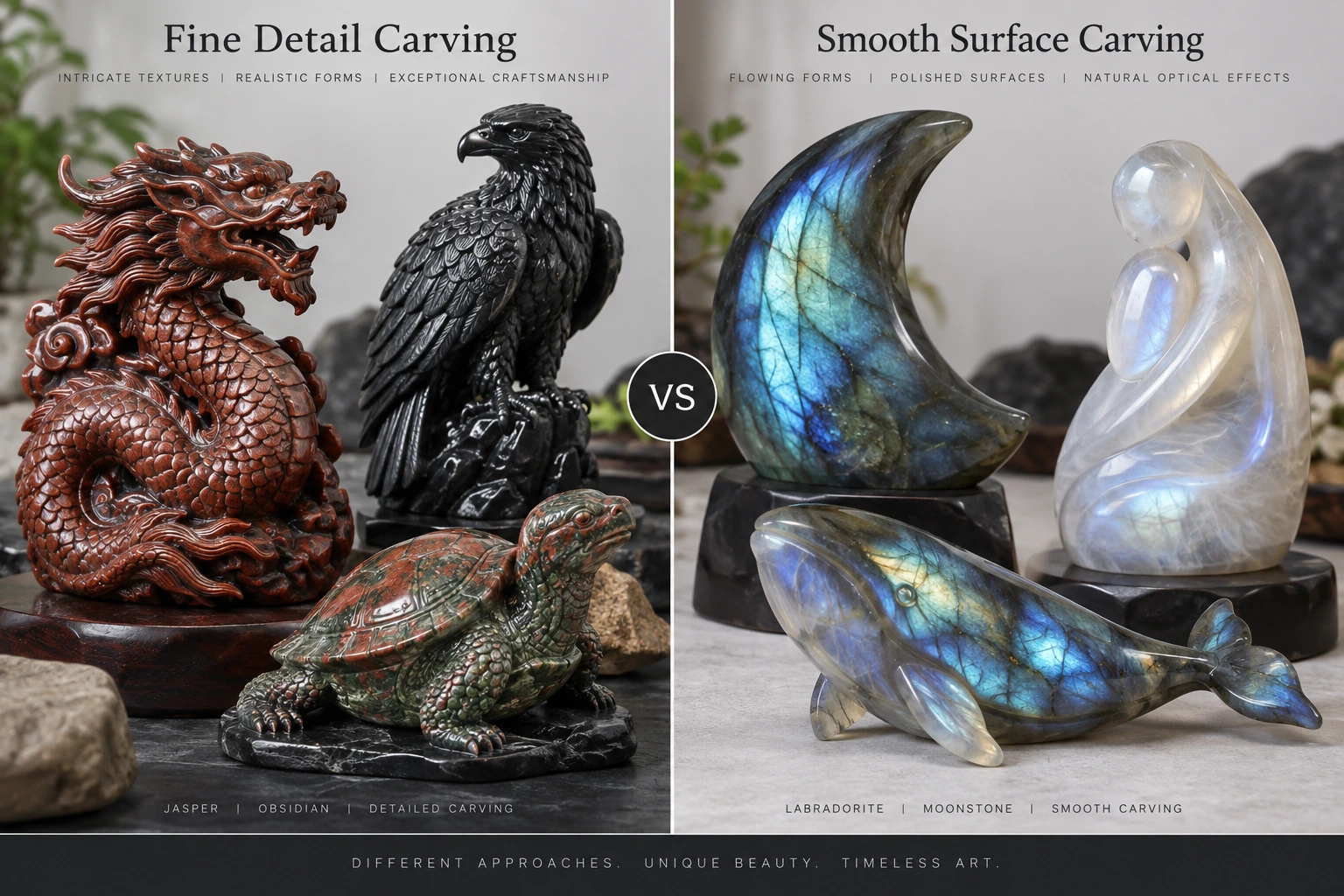
The Kings of Micro-Detail: Agate, Jasper, and Obsidian
When a buyer submits a blueprint featuring intricate textures—such as fine feathers, facial micro-expressions on figurines, dragon scales, or architectural pieces with razor-sharp edges—our master carvers immediately recommend cryptocrystalline quartz (agate, chalcedony, jasper) or natural volcanic glass (obsidian).
The production logic here is straightforward. These materials sit between 5.0 and 7.0 on the Mohs scale and possess no directional cleavage. Because agate and jasper consist of microscopic, interlocking quartz crystals, a diamond burr can cut into the stone from any angle without tearing out chunks along a grain line.
Furthermore, opaque materials like black obsidian and red jasper take a fierce mirror polish7. This strong reflection creates high visual contrast inside shallow bas-relief grooves, making every carved line pop clearly. Because raw rough for these stones often comes in solid, fracture-free blocks, factory yield remains high, which helps control your per-unit wholesale cost on complex designs.
The Canvas Rule for Optical Stones: Labradorite and Moonstone
Many buyers love the blue and violet iridescence (labradorescence) of labradorite. However, a common mistake is applying an intricate, heavily textured design to this stone. The resulting sample often looks like a dead, gray rock with zero color flash.
Labradorite's optical effect comes from light refracting off internal lamellar layers8. In the workshop, our cutters must inspect each raw block with a high-lumen flashlight to locate the "flash layer" orientation before sawing.
If you carve tiny scales or deep cross-hatching across that surface, you break up the continuous optical plane, and the flash disappears. Therefore, labradorite, moonstone, and tiger's eye require designs with wide, smooth curved surfaces—such as sleek animal backs, full mushroom caps, crescent moons, or minimalist facets. Leaving a broad "canvas" allows the natural light play to command a higher retail margin.
Comparing Quartz, Chalcedony, Obsidian and Labradorite?
Sourcing managers often receive wildly different quotes when requesting the exact same 20cm sculpture across different stone types. Without understanding raw crystal growth habits, it is difficult to know if a factory quote is fair. Comparing how major mineral families behave during sourcing and machining clarifies these price gaps.
Macro-crystalline quartz, cryptocrystalline chalcedony, volcanic obsidian, and feldspar labradorite differ significantly in raw block size, cleavage risk, and detail retention. While obsidian and rose quartz allow large, cost-effective sculptures, high-clarity amethyst is restricted to smaller carvings due to natural crystal growth limits.
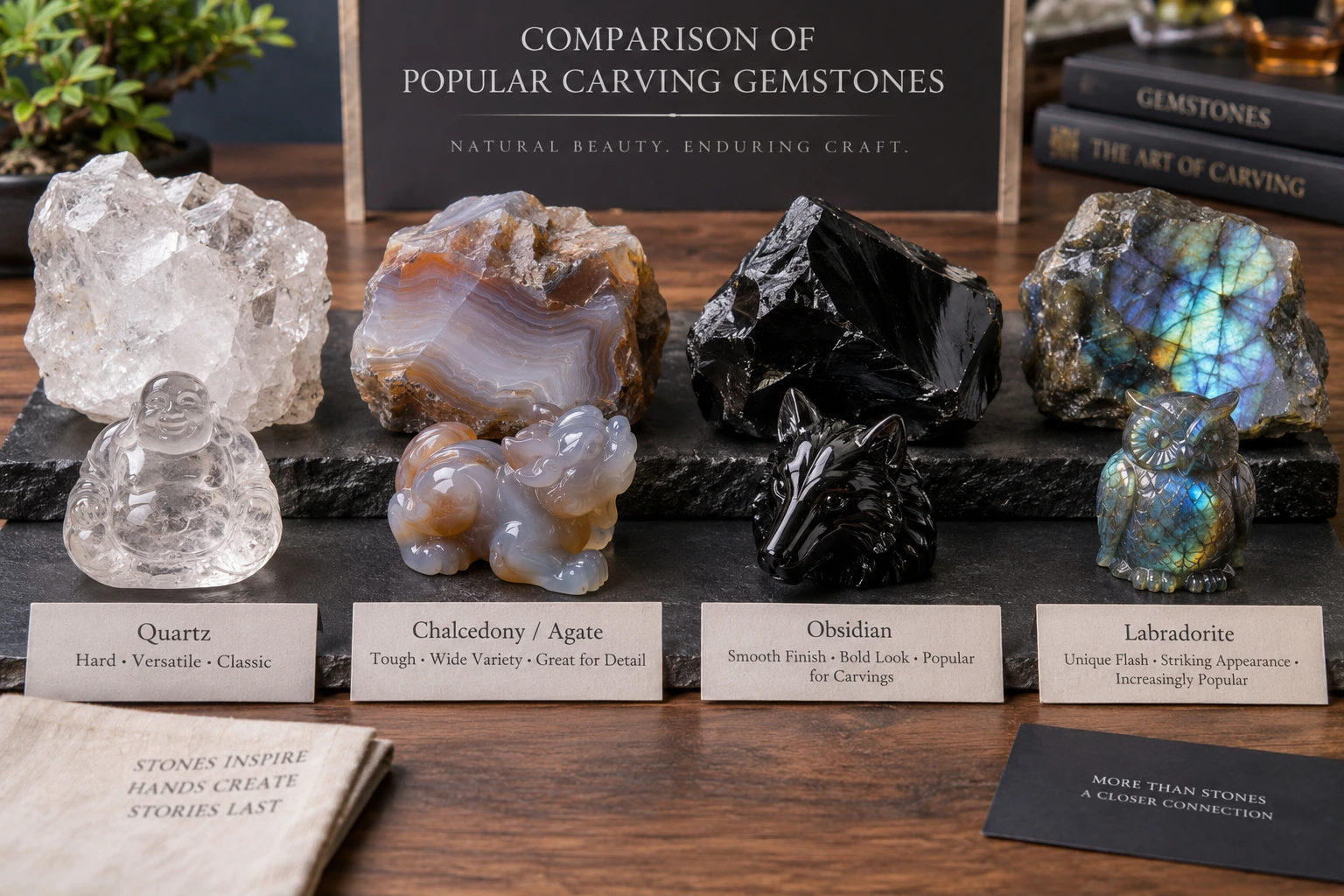
Why Raw Block Size Dictates Design Scale
Buyers frequently ask why a 20cm unicorn carved from black obsidian is relatively affordable, whereas the exact same design in high-clarity amethyst costs several times more. The answer lies in how these minerals form in nature.
Natural amethyst typically grows as relatively short crystals lining the inside of geode cavities9. The base of the crystal usually contains milky white quartz ("cotton") and heavy internal fractures. Finding a raw piece of clean, evenly colored purple amethyst that measures 25cm across without fatal cracks is exceedingly rare.
If you want to develop 5cm to 8cm mini carvings, using amethyst, citrine, or rutilated quartz is highly practical because factories can trim the clean crystal tips. However, for 15cm+ statement sculptures, smart buyers select massive-habit minerals like rose quartz, clear quartz, jasper, or obsidian. Mines extract these materials in multi-ton boulders, sparing you from paying an exponential premium for rare raw material dimensions.
Design and Material Procurement Comparison Table
Use the table below to align your product development goals with manufacturing realities before requesting supplier quotes:
| Design Requirement | Comparable Materials | Primary Production & Transit Risks | What to Confirm with Supplier Before Quoting |
|---|---|---|---|
| Micro-details, sharp edges, deep relief | Agate, Jasper, Chalcedony, Black Obsidian | Thin obsidian edges can chip on hard impact due to brittle conchoidal fracture. | Minimum safe thickness for protruding features; surface polish level inside deep grooves. |
| Optical flash / chatoyancy (light play) | Labradorite, Rainbow Moonstone, Tiger's Eye | Cutting against the optical plane kills the flash; feldspar cleavage can split under stress. | Percentage of surface area guaranteed to show flash; orientation of the flash (front vs. side). |
| Large statement sculptures (15cm+) | Rose Quartz, Clear Quartz, Banded Agate, Obsidian | Heavy weight requires reinforced inner packaging; natural color zoning across large areas. | Whether the piece is carved from a single solid block or glued; acceptable natural cloudiness/veining. |
| Small high-clarity figurines (3cm–8cm) | Amethyst, Citrine, Smoky Quartz | Base milky inclusions or internal rainbows may appear if budget rough is used. | Grade of raw material (tip vs. base); acceptable level of internal "cotton" or natural inclusions. |
| Soft / cleavage-prone mineral designs | Fluorite, Malachite, Selenite, Calcite | High breakage rate during tumbling, polishing, and shipping if features are too thin. | Modification of sharp corners into rounded edges; individual protective foam cavities for transit. |
How Color, Transparency and Natural Variation Affect Samples?
Approving a single Golden Sample does not guarantee your bulk order of 500 pieces will look identical. Because natural gemstones are mined rather than mixed in a vat, color banding and internal inclusions vary from boulder to boulder. Setting realistic visual tolerance bands prevents post-production disputes.
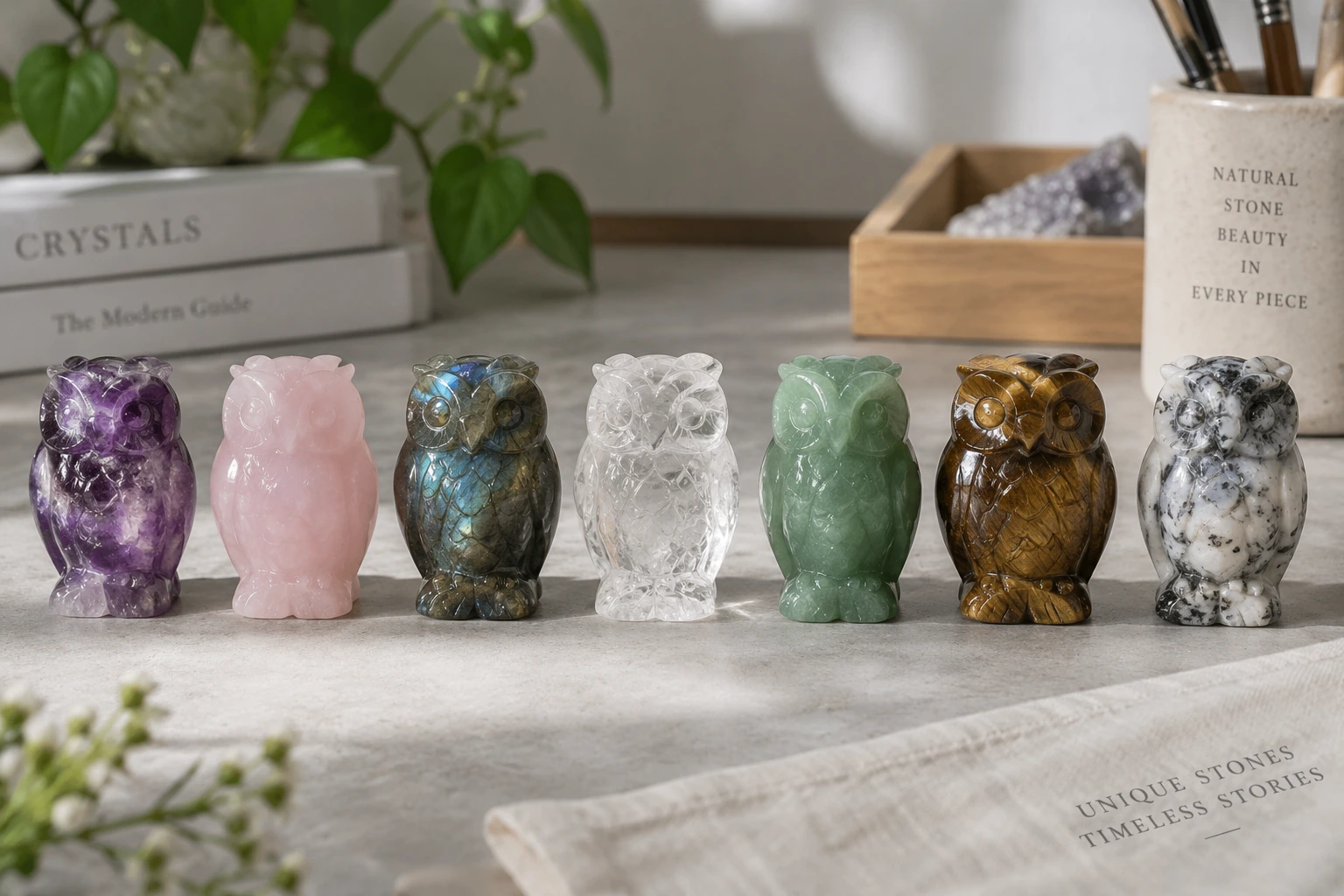
Color zoning, transparency levels, and natural inclusions directly impact how carved details appear10 across a bulk production run. High transparency can obscure shallow surface reliefs, while dramatic color banding in stones like fluorite or agate means no two wholesale units will look exactly alike.
How Transparency Interacts with Surface Relief
When designing with transparent to translucent stones like clear quartz, smoky quartz, or pale rose quartz, light passes right through the material. If your design relies on shallow surface engravings (such as facial features or light geometric linework), the lack of opaque contrast makes the carving look invisible under bright retail lighting.
To make details stand out on transparent stones, we often advise buyers to use dual-finish techniques. By leaving the recessed carved lines matte (frosted/sandblasted) and polishing the raised surfaces to a high gloss, you create mechanical contrast that catches the eye regardless of the stone's clarity.
Managing Bulk Variation in Banded and Included Stones
In B2B wholesale, managing customer expectations around natural variation is critical for e-commerce sellers and retail chains. Consider how these visual traits shift during mass production:
- Color Zoning (e.g., Fluorite, Amethyst): A single block of rainbow fluorite transitions through purple, green, and clear bands. In a batch of 100 carved towers or animals, some pieces will be predominantly green, others mostly purple, and some multi-colored.
- Matrix and Veining (e.g., Turquoise, Lapis Lazuli, Jasper): The distribution of host rock matrix or pyrite flecks changes every millimeter. You must decide if matrix across the "face" of a carved figurine is an acceptable natural trait or a visual defect.
- Healed Fractures ("Rainbows"): In quartz varieties, internal stress fractures reflect light like a prism. While many metaphysical buyers prize natural rainbows, jewelry or luxury home decor buyers may view prominent surface-reaching lines as structural flaws.
Instead of approving a single perfection sample, experienced buyers ask their supplier for a range sample set (showing the lightest, darkest, and most included acceptable states) to establish clear quality control boundaries.
A Material Selection Checklist for Custom Crystal Orders?
Sending a factory a 3D file with a vague note like "quote in high-quality crystal" slows down sourcing and leads to inaccurate pricing. Suppliers have to guess your quality tier, packaging needs, and structural tolerances. Following a structured material selection checklist streamlines your RFQ process.
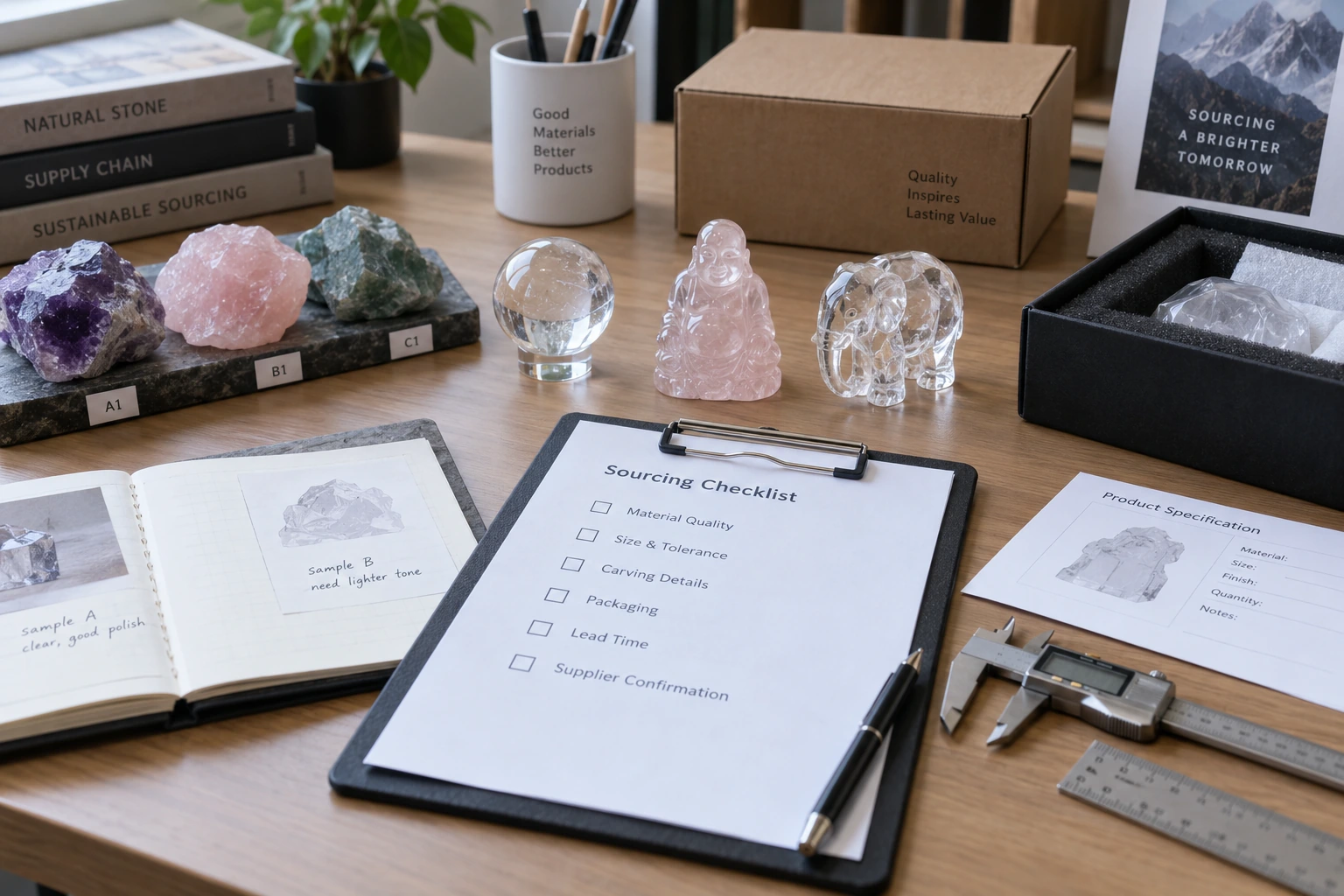
A complete material selection checklist for custom crystal orders defines the target design geometry, minimum wall thickness, raw stone grade, optical orientation, and packaging standards before sampling begins. Defining these parameters upfront ensures accurate supplier pricing and reproducible bulk manufacturing.
Step-by-Step Procurement Evaluation
Before you finalize a stone choice or pay for sample tooling, walk through this five-step checklist with your product development team:
- Audit the Weakest Structural Point: Measure the thinnest cross-section of your design. If any part is under 4mm thick, eliminate high-cleavage stones (like fluorite or calcite) and brittle fibrous stones (like selenite), or thicken the 3D mesh.
- Match Surface Texture to Grain Structure: Confirm whether your design relies on micro-engraving or broad forms. Assign fine-detail designs to opaque/translucent cryptocrystalline stones, and reserve broad, smooth designs for optical or banded minerals.
- Verify Raw Rough Availability for Your Target Size: Check if the mineral naturally occurs in clean blocks large enough for your dimensions. If your design exceeds 12cm–15cm, request alternative quotes in massive-habit stones (like rose quartz or obsidian) to compare cost efficiency.
- Define Visual Acceptance Standards (A/B/C Grading): Specify how much milky base, natural matrix, color banding, or surface pits you allow on the primary display face versus the bottom base of the carving.
- Align Packaging with Mineral Fragility: Standard bubble wrap works for compact jasper palm stones, but intricate carvings or cleavage-prone minerals require custom-cut EPE foam inserts and double-walled export cartons to survive international courier drops.
Questions to Resolve Before Approving a Carving Sample?
Rushing to approve a prototype based on a single studio photo often leads to costly surprises when the bulk shipment lands at your warehouse. Hidden glue repairs, dyed enhancements, or unrepeatable hand-carving details can ruin a product launch. Resolving key technical questions before signing off protects your investment.
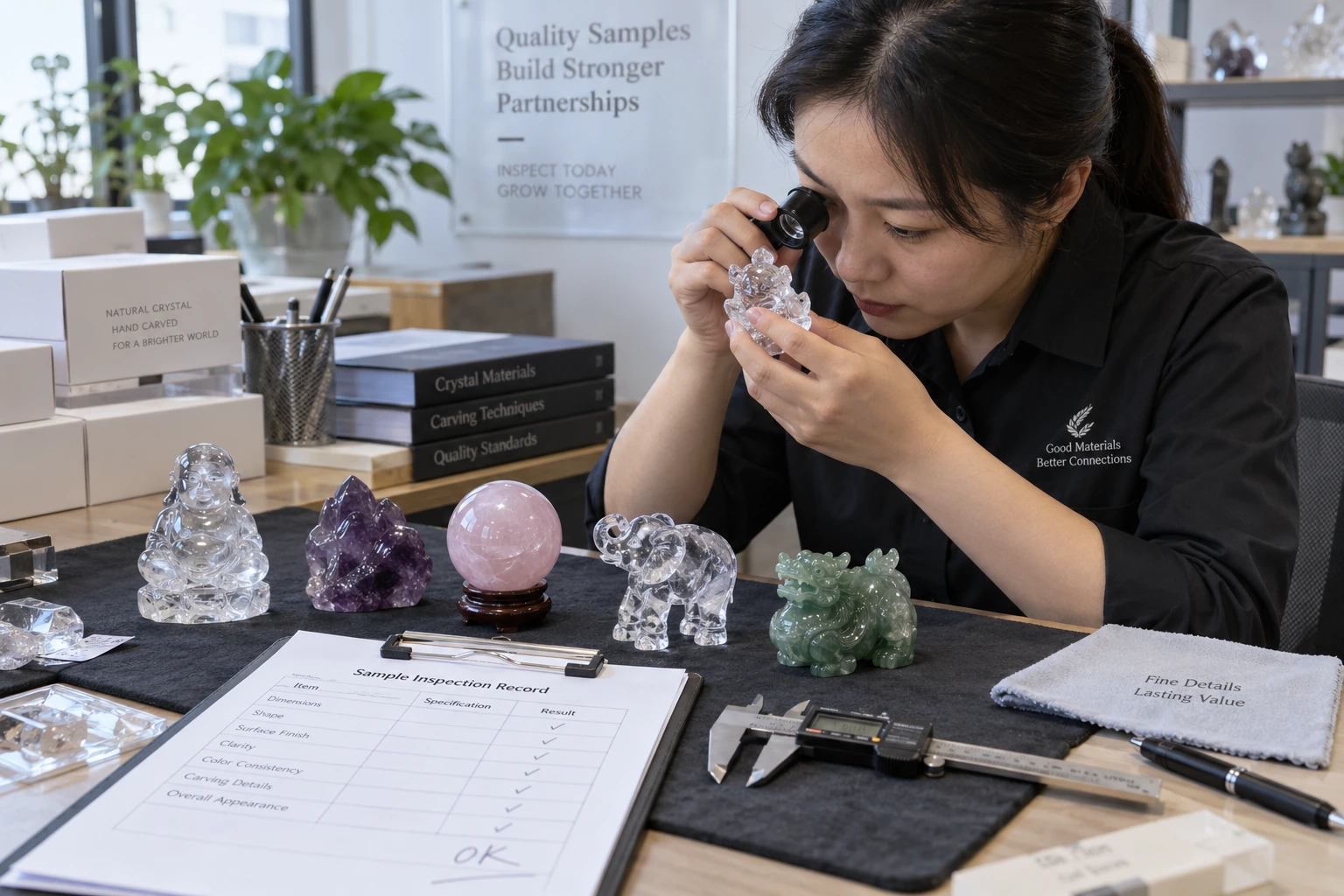
Before approving a carving sample, buyers must confirm whether the sample represents average bulk raw material, how dimensional tolerances are maintained between CNC and hand-finishing, and whether any artificial treatments like dyeing or resin stabilization were applied to the stone.
Technical Questions for Your Factory Account Manager
When our team develops custom OEM/ODM carvings for overseas brands, we encourage buyers to clarify the following production details before locking in bulk production:
1. Is this sample cut from "hand-picked master rough" or standard bulk rough?
Factories naturally want to impress you with the first prototype and may use a rare, museum-grade piece of raw stone. Always ask the supplier to show photos or videos of the actual raw material pile that will feed your 200-piece or 1,000-piece bulk order.
2. Which parts are CNC-machined and which are hand-finished?
Modern crystal carving usually combines ultrasonic/CNC roughing with manual detailing and hand-polishing. CNC ensures consistent outer dimensions, while hand-carving shapes undercuts and polishes tight corners. Ask for the expected dimensional tolerance (typically ±1mm to ±3mm on natural stone carvings) so your custom retail gift boxes fit properly.
3. Are there any treatments, dyes, or resin fillings?
In the commercial stone trade, certain fragile or porous materials are routinely stabilized with clear resin, and pale agates are often dyed. If your brand promises 100% natural, untreated minerals, you must state this requirement in writing on the purchase order. Treat any supplier gemological certificates as documents to verify through independent third-party testing (such as GIA or local accredited labs) if strict material authentication is critical for your market.
4. Can we run a small-batch trial order first?
Even with thorough planning, natural stone behaves unpredictably at scale. Working with a supplier that supports low MOQs and mixed-material trial runs allows you to test both factory consistency and retail sell-through before committing major capital.
Frequently Asked Questions About Choosing Carving Stone
What is the easiest natural stone to carve for intricate details?
Cryptocrystalline quartz varieties—specifically agate, chalcedony, and jasper—are the most reliable natural stones for intricate details. They possess a tough, interlocking microscopic structure with no cleavage planes, allowing diamond tools to cut crisp lines from any direction without flaking or splitting.
Can soft stones like selenite and fluorite be carved into complex shapes?
Soft or cleavage-prone stones like selenite (Mohs 2) and fluorite (Mohs 4) should not be carved into complex shapes with thin, unsupported parts. High-speed machining vibrations and polishing stress cause severe breakage rates. These minerals perform best in chunky, compact, and rounded designs.
Why do custom carvings in natural crystal have size tolerances?
Even when initial shaping is performed on a CNC machine, every natural stone carving requires manual grinding, sanding, and buffing to remove tool marks and achieve a glossy polish. Because workers adjust pressure based on local stone hardness and fractures, finished pieces typically vary by 1mm to 3mm.
How can I tell if a carved crystal is natural or synthetic glass?
Look for natural internal variations such as subtle color zoning, tiny healed feathers, or directional crystal grain, and check the thermal conductivity (natural crystal feels colder to the touch than glass). For high-value commercial shipments, always submit random samples to a qualified gemological laboratory for refractive index and spectroscopic verification.
Conclusion
Selecting the best gemstones for carving is not about finding a single superior mineral; it is about engineering a match between your 3D design and the physical reality of the stone. By evaluating your design's thinnest features first, separating hardness from toughness and cleavage, and respecting raw crystal growth sizes, you can prevent factory breakage and control unit costs.
If you are developing a new line of custom crystal carvings or private-label giftware, our Donghai manufacturing team can help you evaluate your blueprints, suggest cost-effective stone pairings, and run low-MOQ sample trials. Contact us today with your design files or reference photos to get a tailored material assessment and wholesale quote.
<!--[googlesitekit-end-of-content]-->
"Chalcedony", https://en.wikipedia.org/wiki/Chalcedony. Cryptocrystalline quartz varieties, such as agate and jasper, are known for their fine-grained structure, which allows for detailed carving without splitting along cleavage planes. This property is widely recognized in gemological studies and carving practices. Evidence role: general_support; source type: encyclopedia. Supports: Cryptocrystalline stones like agate and jasper are suitable for intricate carvings due to their interlocking microscopic structure.. Scope note: The source may not address specific carving techniques or industrial applications. ↩
"Wikipedia:WikiProject Metalworking/Template list", https://en.wikipedia.org/wiki/Wikipedia:WikiProject_Metalworking/Template_list. Labradorite exhibits labradorescence, an optical phenomenon caused by light interacting with its internal layers. Smooth, broad surfaces maximize this effect by maintaining the integrity of the optical plane. Evidence role: mechanism; source type: education. Supports: Labradorite's optical flash is best displayed on broad, smooth surfaces due to its internal lamellar structure.. Scope note: The source may not provide specific carving guidelines for labradorite. ↩
"More than the Mohs Scale | Understanding Gem Durability", https://4cs.gia.edu/en-us/blog/more-than-mohs-scale-gem-durability/. Gemological studies distinguish between hardness and toughness, noting that high hardness does not guarantee resistance to impact or stress-induced fractures. Evidence role: mechanism; source type: research. Supports: Hardness measures scratch resistance, while toughness determines a stone's ability to withstand impact or stress, explaining why hard stones can still shatter.. Scope note: The source may not address specific industrial scenarios like ultrasonic drilling. ↩
"Cleavage (crystal)", https://en.wikipedia.org/wiki/Cleavage_(crystal). Cleavage is a well-documented property in mineralogy, describing the tendency of minerals to break along specific atomic planes, which can impact carving processes. Evidence role: definition; source type: encyclopedia. Supports: Cleavage is a mineral property where stones split along flat atomic planes, affecting their carving suitability.. Scope note: The source may not provide specific examples relevant to carving applications. ↩
"Fracture (geology)", https://en.wikipedia.org/wiki/Fracture_(geology). Stress cracks, often referred to as healed fractures, are natural features in gemstones resulting from geological stress during formation. Evidence role: mechanism; source type: research. Supports: Stress cracks in gemstones are natural features formed during geological growth.. Scope note: The source may not address specific impacts of stress cracks on carving processes. ↩
"Fluorite", https://en.wikipedia.org/wiki/Fluorite. Fluorite is known for its perfect octahedral cleavage, which can lead to breakage during machining or handling. Evidence role: general_support; source type: encyclopedia. Supports: Fluorite's perfect octahedral cleavage makes it prone to splitting under stress, posing challenges for carving.. Scope note: The source may not address specific carving techniques to mitigate cleavage risks. ↩
"Gemstones in the Bible", https://en.wikipedia.org/wiki/Gemstones_in_the_Bible. Opaque stones like obsidian and jasper are known for their ability to achieve a mirror-like polish, which highlights carved features effectively. Evidence role: general_support; source type: research. Supports: Black obsidian and red jasper polish to a high-contrast mirror finish, enhancing carved details.. Scope note: The source may not address specific polishing techniques used in carving workshops. ↩
"Labradorite", https://en.wikipedia.org/wiki/Labradorite. Labradorescence in labradorite occurs when light refracts off its internal lamellar layers, creating vivid color flashes. Evidence role: mechanism; source type: education. Supports: Labradorite's optical flash is due to light interacting with its internal lamellar layers.. Scope note: The source may not provide specific carving guidelines to preserve labradorescence. ↩
"Amethyst", https://en.wikipedia.org/wiki/Amethyst. Amethyst typically forms as short crystals within geodes, restricting the availability of large, fracture-free blocks for carving. Evidence role: historical_context; source type: education. Supports: Amethyst crystals grow inside geodes, often limiting their size and suitability for large carvings.. Scope note: The source may not address specific carving size thresholds. ↩
"Sapphire", https://en.wikipedia.org/wiki/Sapphire. Gemological studies note that factors like color zoning, transparency, and natural inclusions can obscure or enhance carved details depending on the stone's properties. Evidence role: general_support; source type: research. Supports: Color zoning, transparency, and inclusions influence the visibility of carved details in gemstones.. Scope note: The source may not provide specific examples of carving outcomes for different stones. ↩
Keep Reading