Struggling with inconsistent chalcedony quality? Wasting money on carvings that don't match photos? You need a better way to buy. Learn to specify your needs and avoid costly surprises.
Successful wholesale chalcedony sourcing isn't about finding the "best" stone. It's about matching the material's color, pattern, and stability to your specific product design, price point, and market needs. Clear communication with your supplier is the key to getting exactly what you want.
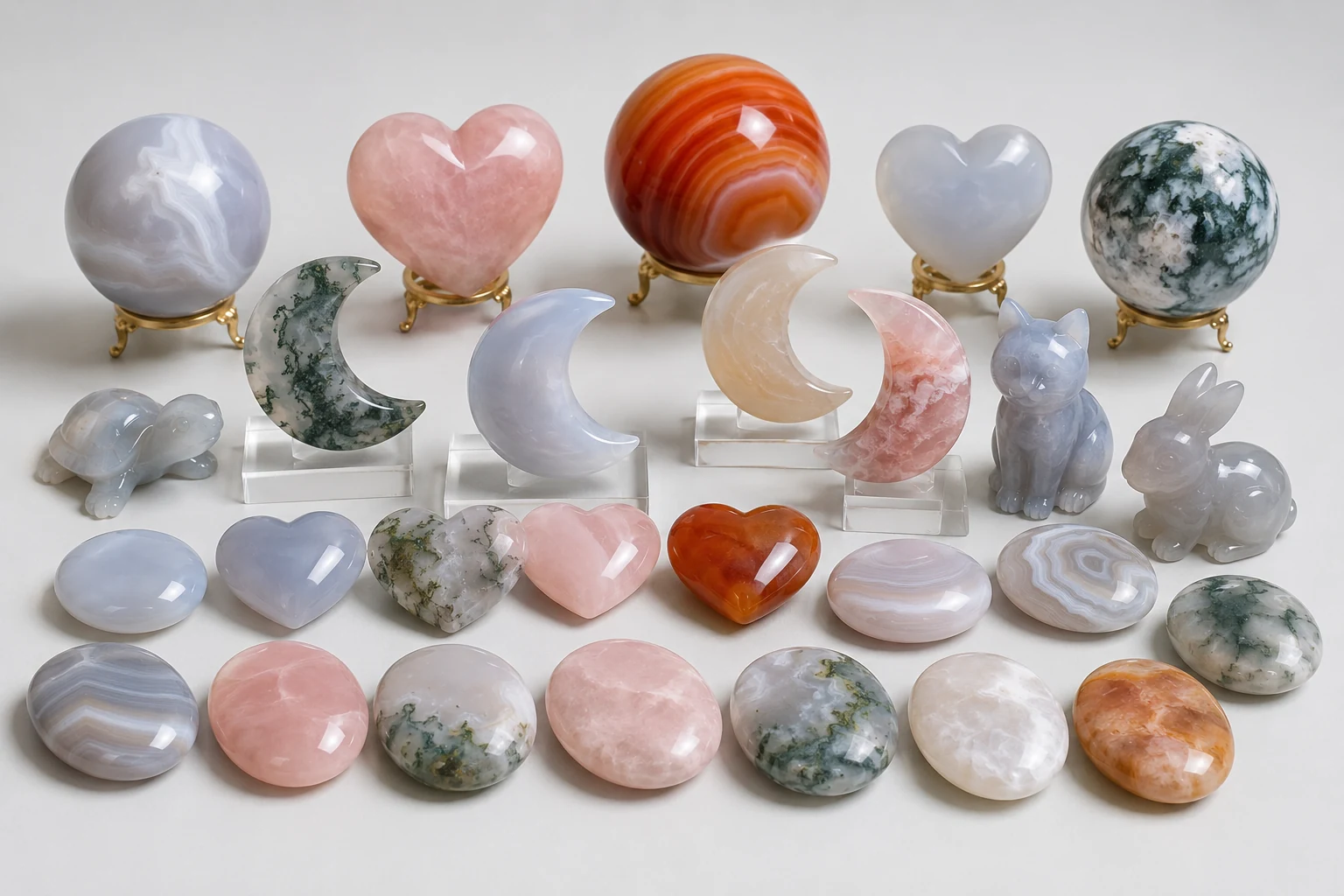
When I first started helping overseas buyers source crystal carvings, many conversations began the same way: "Do you have AAA-grade blue chalcedony?" It's a simple question, but it often leads to disappointment. The world of chalcedony is vast, and what one person considers "AAA-grade" can be completely different from another's expectation. To truly build a profitable collection, you need to move beyond simple trade names and learn to communicate your exact requirements. This guide will walk you through the practical steps I use every day to help clients source chalcedony carvings that sell. Let's get started.
What Are the Different Types of Chalcedony for Carvings?
Confused by all the chalcedony names? You see "Moss Agate," "Blue Chalcedony," and "Carnelian," but it's hard to know which is right for your shop. This confusion can lead to ordering the wrong material.
These are all commercial terms for varieties within the chalcedony family.1 The key is to stop focusing on the name and start focusing on the material's properties: its color, pattern, and translucency. This lets you choose the right stone for your carving designs and customer base.
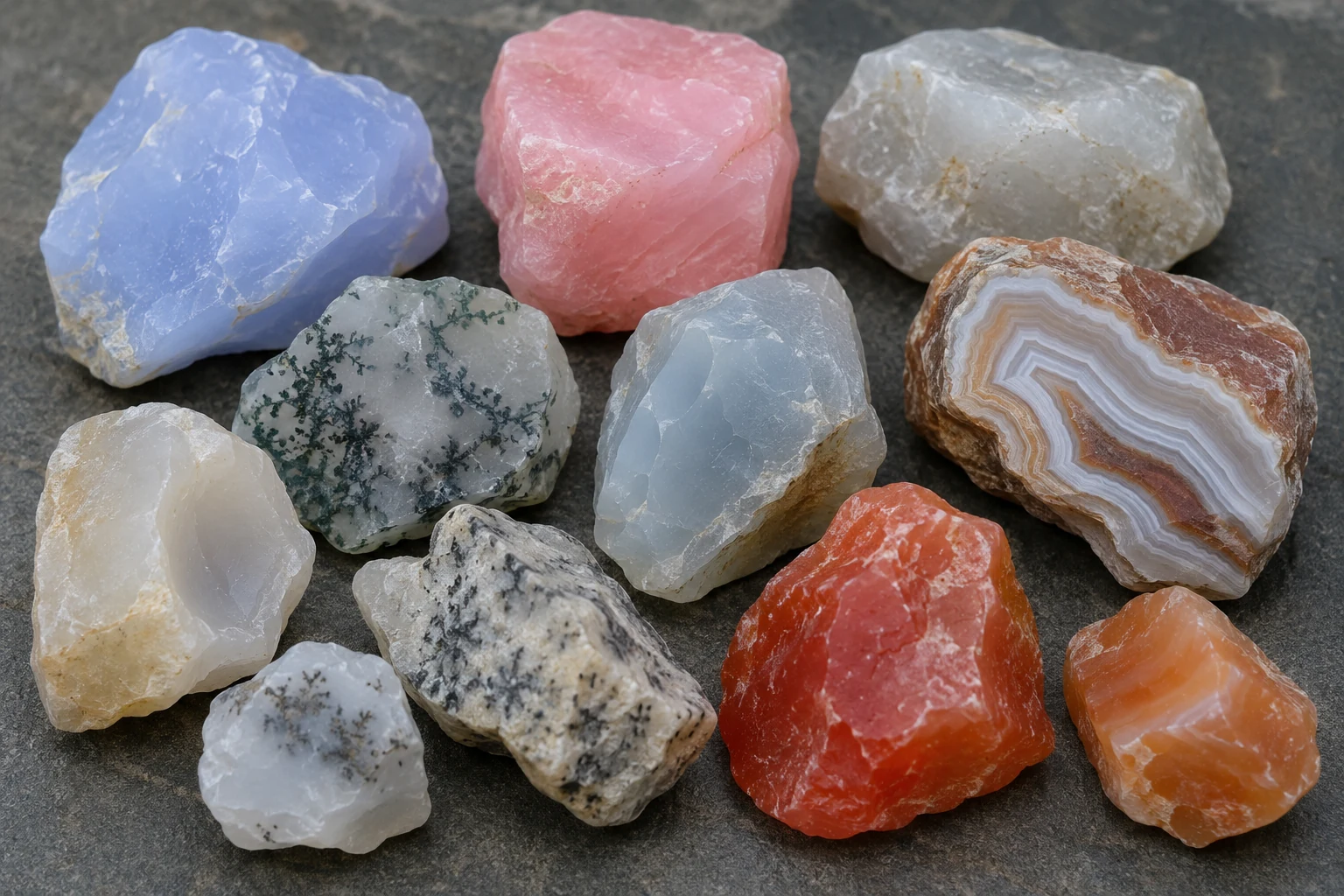
When you source from a supplier, trade names are just the beginning of the conversation. I once had a client who wanted "blue chalcedony" carvings. They showed me professionally edited photos of a vibrant, electric blue stone. The natural material we had was a beautiful, but much softer, grayish-blue. They were disappointed at first. This is a common misunderstanding. We solved it by taking photos and videos of our actual stock under neutral lighting. They realized the softer, natural color was perfect for their wellness-focused brand.
The lesson is to use trade names as a starting point, then define your needs with visual proof.2 Instead of asking for a generic name, specify what you need. For example: "I need translucent pink chalcedony with minimal white banding for 40mm hearts." This tells the supplier exactly what you're looking for.
Common Chalcedony Types and Their Commercial Uses
| Chalcedony Type | Common Appearance | Best for Carvings? | Market Application |
|---|---|---|---|
| Blue Chalcedony | Translucent, soft grayish-blue to light blue. | Good for smooth shapes like spheres, hearts, palm stones. | Popular in spiritual and wellness markets for its calming look. |
| Pink Chalcedony | Opaque to translucent, pale to medium pink. | Excellent for hearts and gentle shapes. Uniform color works well. | Strong seller in gift shops and for jewelry-focused brands. |
| Moss Agate | Clear to milky base with green, moss-like inclusions. | Best for simple shapes (spheres, slabs, freeforms) that showcase the pattern. | A favorite in metaphysical shops and for nature-themed decor. |
| Carnelian | Translucent to opaque, orange to reddish-brown. | A stable agate that carves well into both simple and detailed shapes. | Great for energy-focused collections and autumn-themed promotions. |
| Banded Agate | Layers of different colors (e.g., blue lace, Botswana). | Simple shapes are best to avoid cutting through the bands awkwardly. | Valued for its unique patterns, often sold as one-of-a-kind pieces. |
How Does Material Choice Affect Carving Complexity?
Ever order beautifully detailed animal carvings, only for them to arrive with broken wings or horns? It's a frustrating waste of inventory and profit. This often happens when the wrong material is used for a complex design.
The solution is to match the material to the design. Uniform, structurally sound materials like some agates are perfect for intricate details.3 Materials prized for their unique patterns, like moss agate, are better for simple shapes like hearts or spheres that won't risk breakage at fragile points.
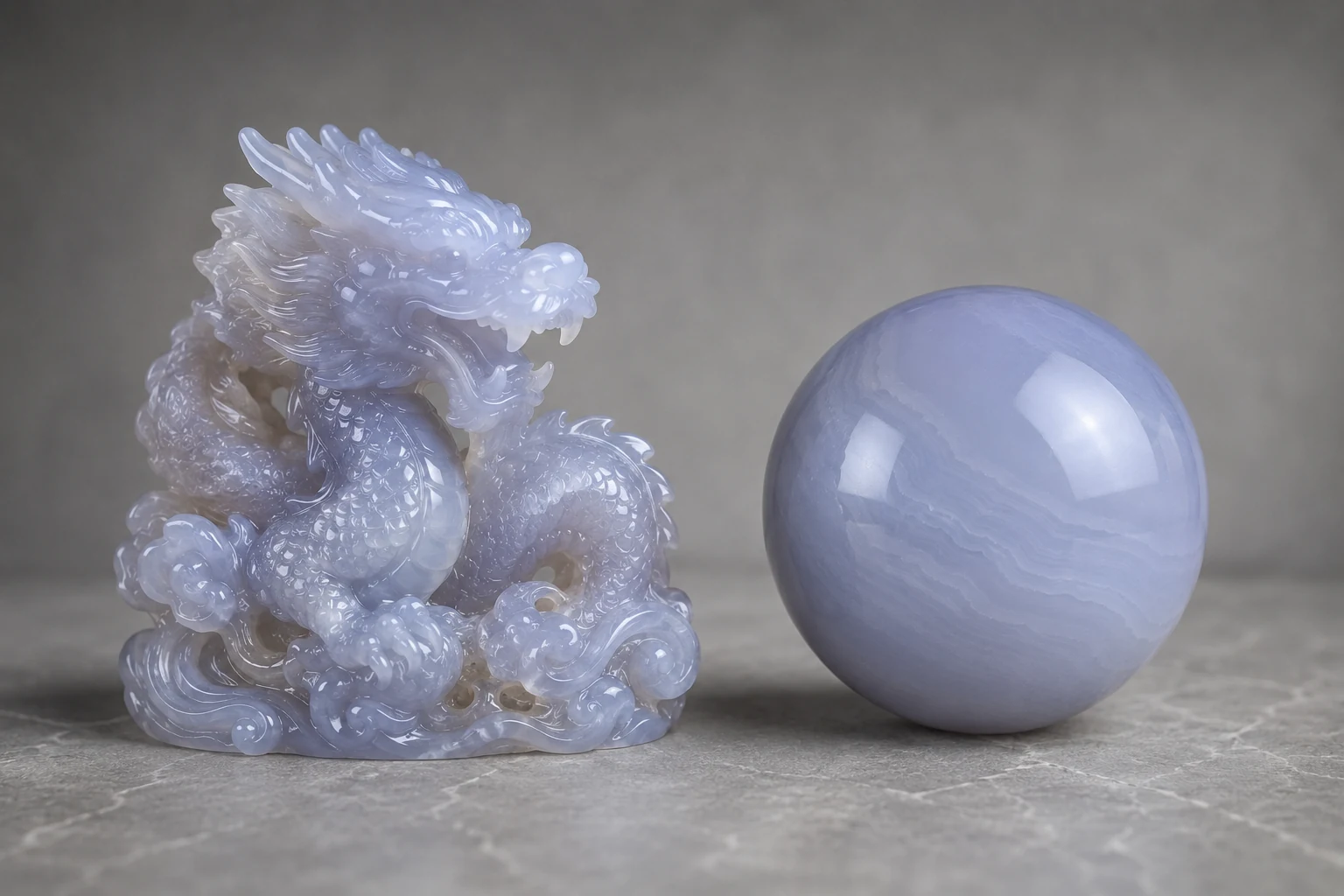
I remember working with a new Etsy seller who fell in love with a piece of moss agate. It had stunning green plumes inside. They ordered a batch of intricate fairy carvings made from similar material. When the order was ready, we noticed a problem during our final inspection. On several fairies, the delicate wings had a natural fracture line running right through them from the stone's internal pattern. They were too fragile to ship. The design was beautiful, but the material was not suited for it. We ended up remaking the order in a more uniform blue aventurine and made some gorgeous moss agate towers for them instead. The towers sold out instantly because the simple shape perfectly showcased the stone's natural art.
This experience highlights a critical rule: the more complex the carving, the more uniform the material needs to be. A stone's internal patterns can be points of weakness.
Matching Material to Your Design
| Shape Complexity | Best Material Type | Why It Works |
|---|---|---|
| Simple Shapes (Hearts, Spheres, Palm Stones, Towers) | Patterned Chalcedony (Moss Agate, Banded Agate, Ocean Jasper) | The simple form acts like a canvas, showcasing the stone's unique internal patterns without risking breakage. These shapes are all about the material itself. |
| Complex Shapes (Figurines, Animals with thin parts, detailed statues) | Uniform Chalcedony (Pink Chalcedony, some Blue Chalcedony, Carnelian) | These materials offer greater structural integrity. There are no large inclusions or bands to create weak points that could fracture during carving or shipping. |
Before you place a bulk order, always discuss the design's suitability with your supplier. A good partner will tell you if your chosen material is a risk for a complex design and suggest a better alternative.
How Can You Ensure Consistent Quality in a Bulk Chalcedony Order?
Have you approved a perfect sample, only to receive a bulk order that looks completely different? This "perfect sample" trap is a common and expensive problem for buyers. It leaves you with inventory you can't sell.
The key is to understand that a sample defines a quality range, not an identical replication. For natural stone, "consistency" means the bulk order stays within an agreed-upon spectrum of color, pattern, and quality. You must confirm this range with your supplier using photos and videos of a random selection from the batch.
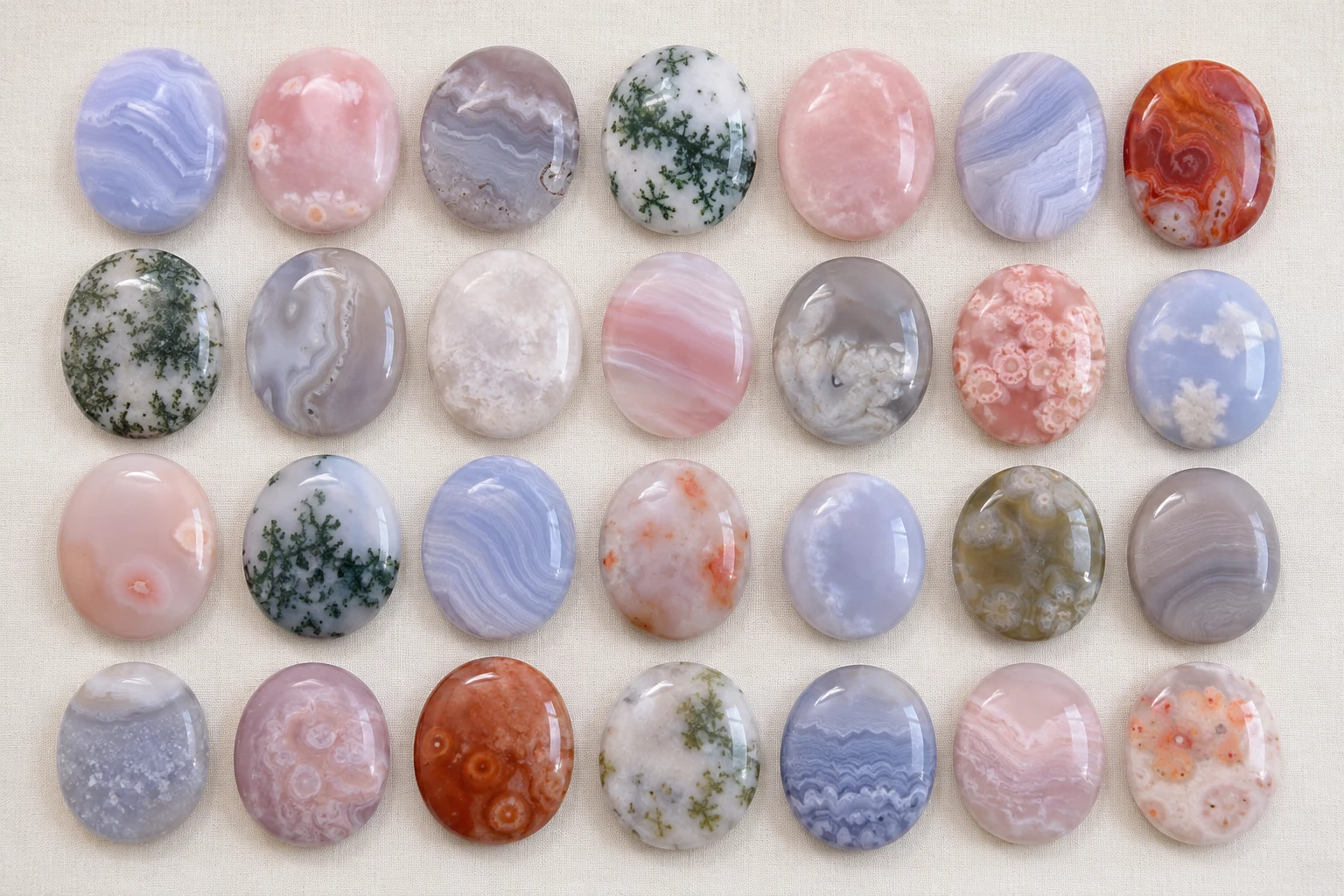
A few years ago, a private-label brand client approved a single, flawless moss agate sphere sample. It was perfect—crystal clear with a dense, vibrant green mossy pattern. They placed an order for 500 pieces. When the batch was produced, we sent them photos of a random dozen spheres pulled from the order. Some were milkier, some had sparser patterns, and a few had small dark mineral spots. The client was initially concerned because they weren't all identical to the "hero" sample.
We explained that this variation is natural for moss agate. We worked together to define the acceptable range: what percentage of milkiness was okay? How sparse could the pattern be? Which mineral spots were natural features versus unacceptable blemishes? By sorting the batch according to these new rules, we provided them with a final order that met their realistic expectations. They learned to define the quality range upfront, not just approve one perfect piece.
Defining Your Quality Range with a Supplier
To avoid this trap, discuss these points with your supplier before confirming a bulk order:
- Color Saturation: Provide a visual range. For example, "The blue chalcedony color should be between these two shades, and we cannot accept pieces that are mostly gray."
- Pattern Density: For stones like moss agate, specify the acceptable amount of pattern. "We need at least 40% of the stone to have visible green inclusions."
- Translucency: Clarify your needs. "The pink chalcedony hearts must be translucent enough to see light through them, not fully opaque."
- Defects vs. Features: Be clear about what is unacceptable. Natural internal lines are okay, but surface-reaching cracks that can be felt with a fingernail are defects.4 Agree on a defect rate (e.g., "no more than 2% of the batch can have surface cracks").
- Request Batch Media: Always ask for photos and a short video of a random selection of 10-20 pieces from your actual bulk order before it ships. This is the best way to confirm the batch falls within your agreed-upon range.
What Should You Ask Suppliers About Treatments and Quality Inspection?
Worried about unknowingly selling dyed or filled crystals? The fear of undisclosed treatments can damage your brand's reputation. It’s a valid concern that makes buyers hesitant.
The most important thing is not avoiding all treatments, but demanding 100% disclosure from your supplier. Many commercial-grade chalcedonies are treated. A trustworthy partner will be transparent about it, allowing you to make an informed decision for your market.5
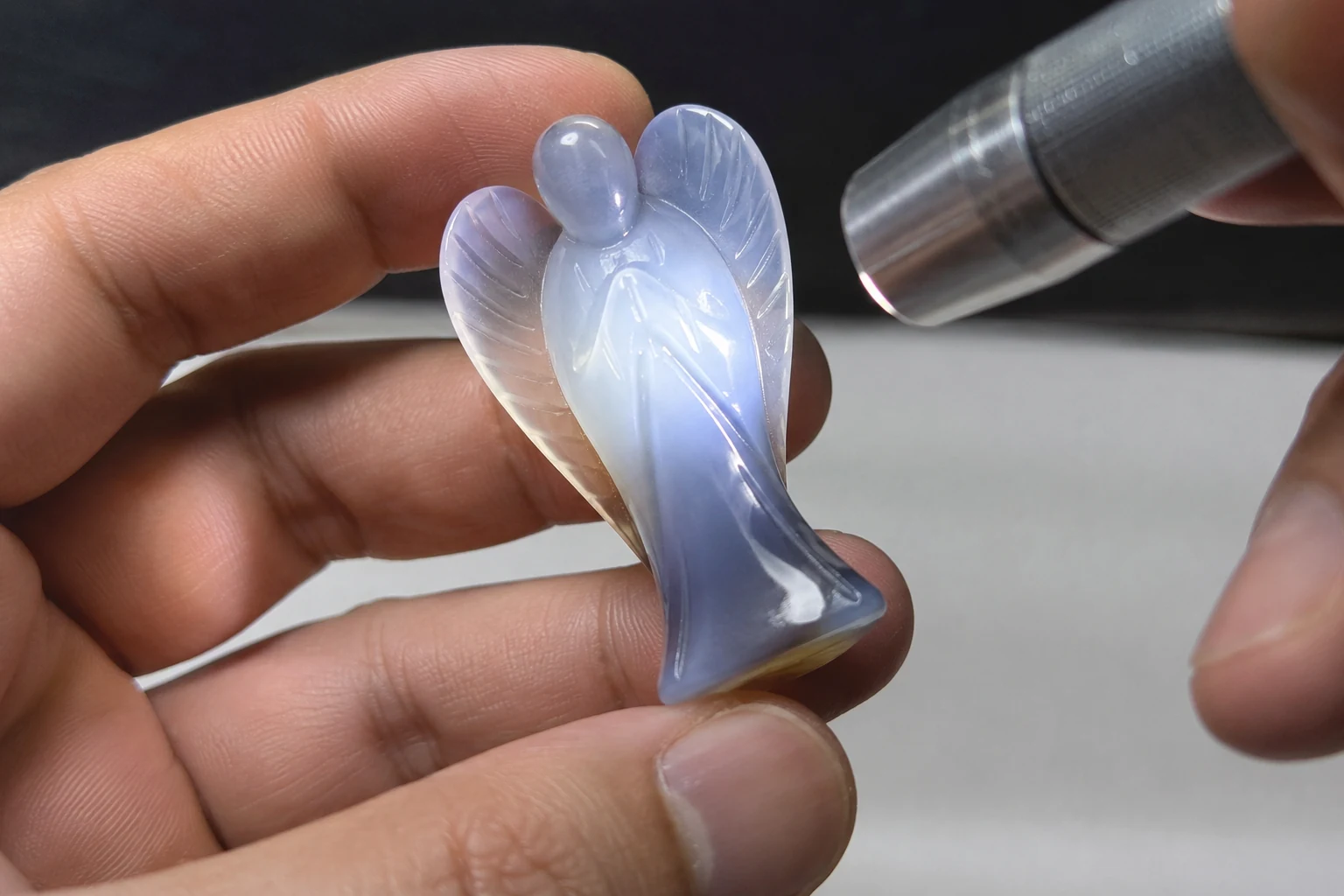
Many vibrant agates you see are dyed.6 This isn't necessarily bad if the dye is stable and disclosed. The problem arises when it's not. I always encourage buyers to ask direct questions. Instead of "Is this natural color?", which can be ambiguous, ask "Has this material been dyed or heated to enhance its color?". A simple "yes" or "no" gives you a clear answer.
Beyond the material itself, the quality of the carving and polish is what creates value. A piece might be made of good material, but if it’s poorly finished, it won't sell. During our inspections, we perform a two-part check. First, we look at the carving itself: Are the proportions right? Is it symmetrical? Can it stand stably on its base? Second, we inspect the polish. We hold the piece under a light and tilt it, looking for dull spots, scratches, or leftover polishing compound in the crevices. A simple heart with a perfect, glossy finish is far more valuable than a complex figurine with a sloppy polish.7
Checklist for Supplier Communication and Inspection
Questions to Ask About Treatments:
- Has this material been dyed to alter or enhance its color?
- Has this material been heated to change its color?
- Are there any stabilizers or resins used on the surface or to fill cracks?
- Is the treatment stable, or will the color fade in sunlight or wash off with water?
Two-Part Quality Inspection Process:
- The Carving:
- Form & Symmetry: Does the carving look like what it's supposed to be? Are both sides symmetrical?
- Details: Are lines clean? Are features like faces or wings well-defined?
- Stability: If it's a standing piece like a tower or figurine, does it sit flat without wobbling?
- The Finish:
- Polish: Is the surface consistently glossy with no dull patches or scratches?
- Grooves: Are the crevices clean, with no white or colored polishing compound left behind?
- Feel: Does the surface feel smooth, with no chips or sharp edges?
Conclusion
Sourcing chalcedony successfully depends on clear communication and matching the stone to your business goals.8 Define your needs, ask direct questions, and you will build a beautiful, profitable crystal collection.
"Chalcedony - Wikipedia", https://en.wikipedia.org/wiki/Chalcedony. Encyclopedic entries on chalcedony confirm that terms like 'Moss Agate' and 'Carnelian' are commercial names for specific varieties of chalcedony. Evidence role: definition; source type: encyclopedia. Supports: The classification of 'Moss Agate,' 'Blue Chalcedony,' and 'Carnelian' as varieties within the chalcedony family.. ↩
"Analysis of Gemstones at GIA Laboratories", https://www.gia.edu/gems-gemology/winter-2024-gemstone-analysis. Studies on gemstone trade practices highlight the role of visual proof in ensuring alignment between buyer expectations and supplier offerings. Evidence role: general_support; source type: research. Supports: The importance of using visual proof to clarify expectations in gemstone sourcing.. ↩
"Agate", https://en.wikipedia.org/wiki/Agate. Research on gemstone carving materials confirms that uniform agates are structurally sound and suitable for intricate designs. Evidence role: mechanism; source type: research. Supports: The suitability of uniform agates for intricate carvings due to their structural properties.. ↩
"An Introduction to Gem Treatments - GIA", https://www.gia.edu/gem-treatment. Educational materials on gemstone quality standards classify surface-reaching cracks as defects, distinguishing them from natural internal lines. Evidence role: definition; source type: education. Supports: The classification of surface-reaching cracks as defects in gemstone quality.. ↩
"An Introduction to Gem Treatments", https://www.gia.edu/gem-treatment. Institutional guidelines on ethical gemstone sourcing emphasize the need for supplier transparency regarding treatments. Evidence role: expert_consensus; source type: institution. Supports: The importance of supplier transparency in gemstone treatments for ethical sourcing.. ↩
"An Introduction to Gem Treatments", https://www.gia.edu/gem-treatment. Research on gemstone treatments indicates that dyeing is a common practice for enhancing the color of agates. Evidence role: statistic; source type: research. Supports: The widespread use of dyeing to enhance the color of agates.. ↩
"Colored Gemstone Value Factors - GIA", https://www.gia.edu/gia-news-research/value-factors-design-cut-quality-colored-gemstone-value-factors. Market research on gemstone carvings shows that polish quality significantly impacts value, often outweighing carving complexity. Evidence role: general_support; source type: research. Supports: The higher market value of well-polished simple carvings compared to poorly finished complex ones.. ↩
"The Color of Responsibility: Ethical Issues and Solutions in ...", https://www.gia.edu/gems-gemology/summer-2016-color-responsibility-ethical-issues-solutions-colored-gemstones. Educational resources on gemstone sourcing emphasize the importance of clear communication and aligning material properties with business objectives. Evidence role: general_support; source type: education. Supports: The role of clear communication and alignment with business goals in successful chalcedony sourcing.. ↩
Keep Reading