Struggling with selenite's true meaning? You hear about its power but worry about fakes and fragility. You need clear, practical answers from a source that handles the stone daily.
Selenite, most often satin spar gypsum in the trade, is strongly linked to the Crown and Third Eye chakras1. It is used for mental clarity, spiritual connection, and cleansing energy. Its main purpose is to purify spaces, other crystals, and one's own energy field.
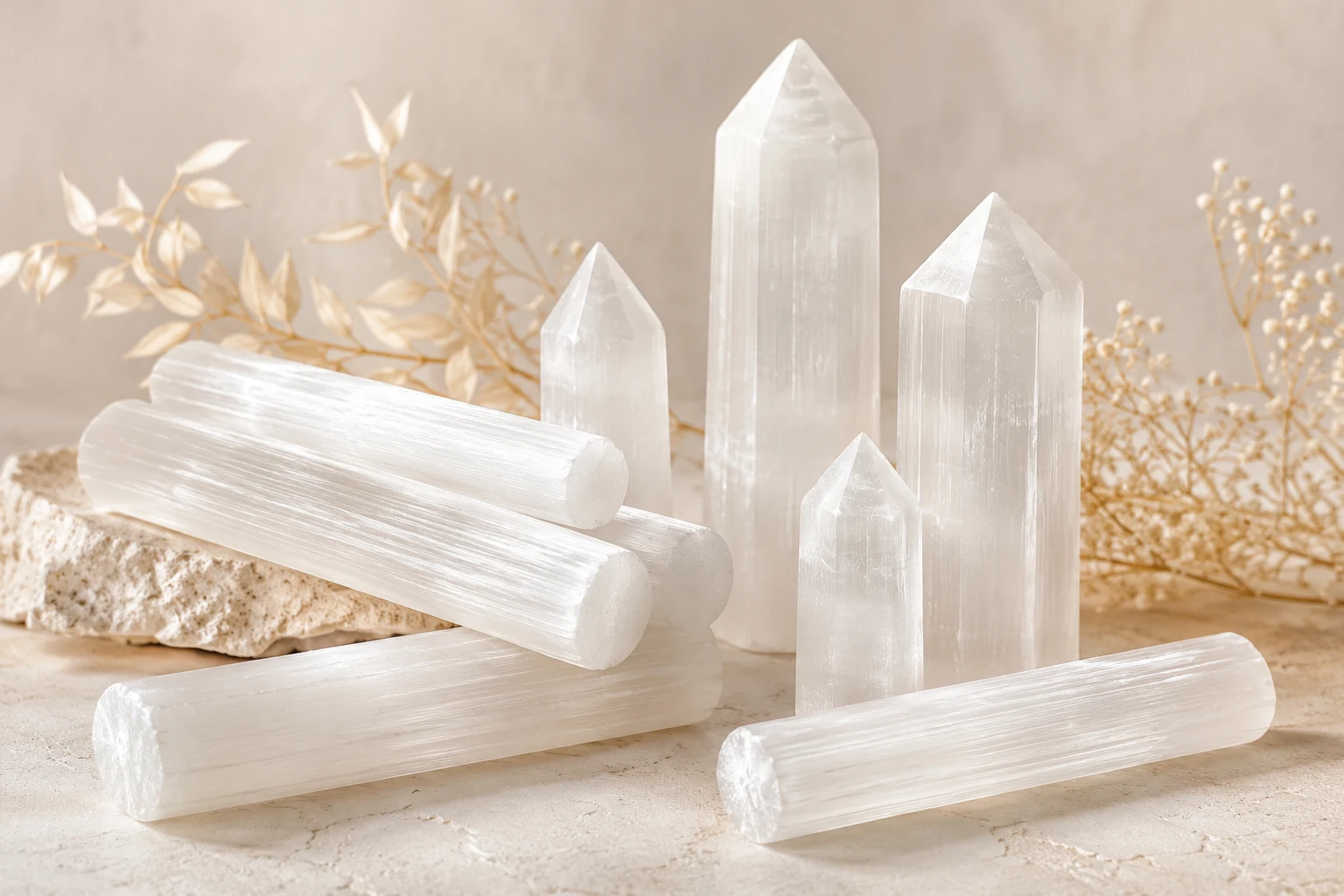
Before we dive into the chakras and meanings, it's critical to understand what the "selenite" you buy actually is. As a wholesale supplier, I've seen firsthand how confusion over the material itself leads to mistakes in care and use. Understanding the physical stone is the first step to unlocking its spiritual potential. Let's start there.
What is "Selenite" in the Crystal Trade?
Confused by different types of selenite? You see transparent crystals and milky white wands both called selenite. It's frustrating when you don't know what you're actually buying.
Most "selenite" products like wands, towers, and plates are actually a fibrous form of gypsum called satin spar.2 True selenite is a transparent, sheet-like variety. The trade uses "selenite" as a family name for both, which is important for buyers to understand.
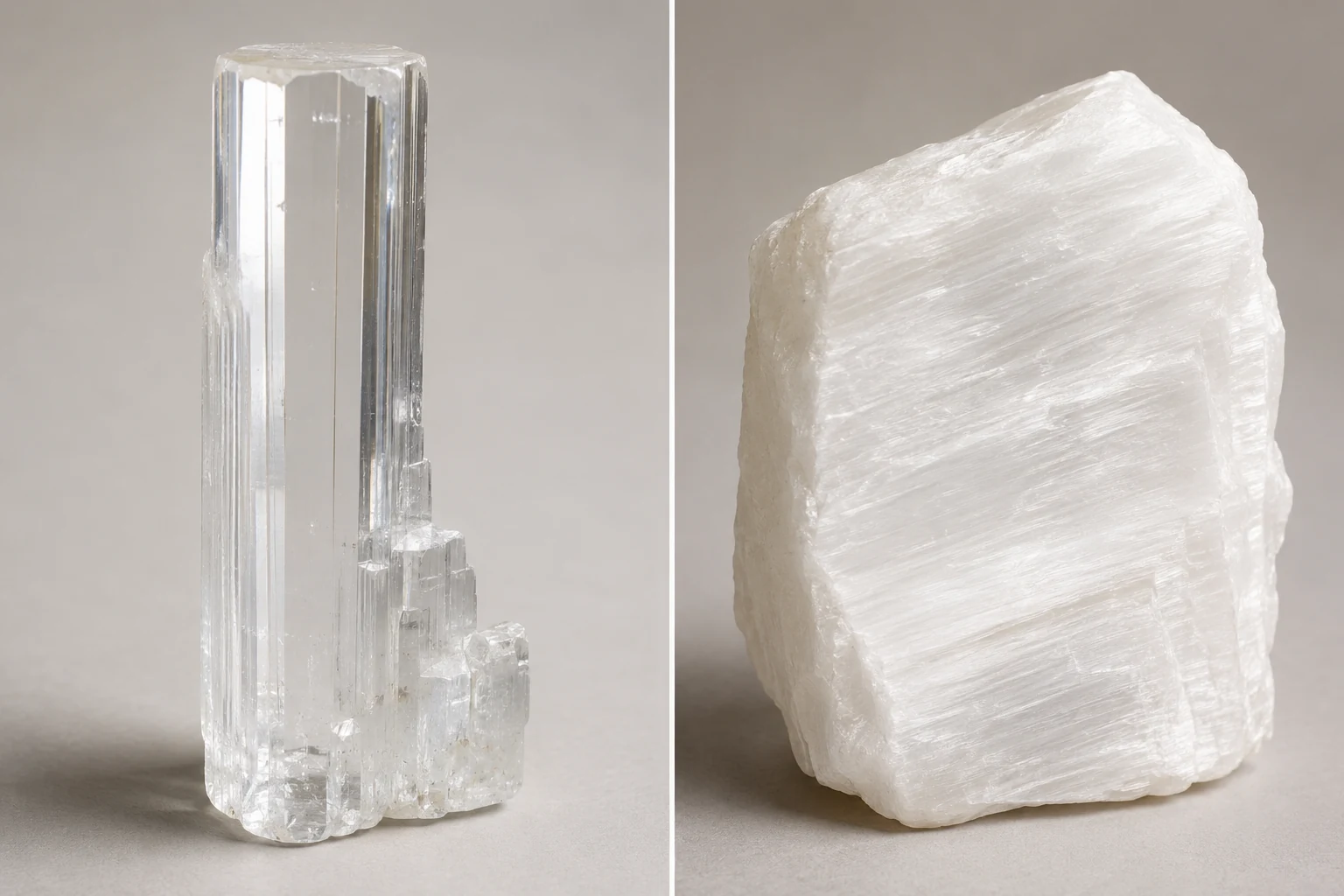
From a supplier's perspective, this is the most common point of confusion for new buyers. A situation we have encountered more than once involves a buyer expecting perfectly clear, glass-like selenite but receiving the beautiful, milky-white satin spar towers they ordered. This isn't a case of mislabeling to deceive; it's a trade convention. The mineral is gypsum, and its common varieties include:
- Satin Spar: Fibrous, milky, with a cat-eye-like sheen. This is what 99% of commercial wands, towers, bowls, and charging plates are made from.3
- Selenite: Transparent and tabular (sheet-like). It's more fragile and harder to carve, so it's less common in shaped forms.
- Desert Rose: Rosette-shaped clusters of gypsum, often with sand inclusions.
When you see a "selenite wand," you are almost certainly buying a satin spar wand. Understanding this helps you appreciate its unique fibrous look and fragility. It also helps you communicate clearly with suppliers by asking for product photos of the exact material you'll receive.
What is the Selenite Chakra Association?
Unsure which chakra selenite connects with? You hear different things and want to know its primary role. This uncertainty can block your ability to use it with clear intention.
In modern crystal practices, selenite is most strongly associated with the Crown Chakra (Sahasrara) and the Third Eye Chakra (Ajna). It is believed to clear blockages and open a channel to higher consciousness, intuition, and spiritual insight.

In spiritual traditions, selenite is seen as a high-vibration tool.4 Its connection to the higher chakras is central to its use.
The Crown Chakra (Sahasrara)
This chakra, located at the top of the head, is your center for spirituality and connection to the universe. Selenite's pure white color and light-conducting properties are believed to cleanse and open the Crown Chakra. Practitioners use it during meditation to foster a sense of unity and spiritual awareness. Holding a selenite wand or placing a palm stone on your head is a common practice to facilitate this connection.
The Third Eye Chakra (Ajna)
Located between the eyebrows, the Third Eye is the seat of intuition and foresight. Selenite is thought to bring clarity and remove energetic fog from this chakra. This allows for clearer thinking and a stronger connection to your inner wisdom. It’s not about predicting the future, but about seeing the present moment and your own path with greater insight. The belief is that selenite doesn't force intuition, but rather clears the way for it to emerge.
How Do You Use a Selenite Charging Plate?
Wondering if selenite charging plates really work? You see them everywhere but doubt their function and proper use. You're afraid of damaging your crystals or the plate itself.
A selenite charging plate is used to cleanse and "recharge" other crystals by placing them on its surface. It's believed that selenite's purifying energy removes negativity from the stones. Never use water, as it will damage the selenite plate.
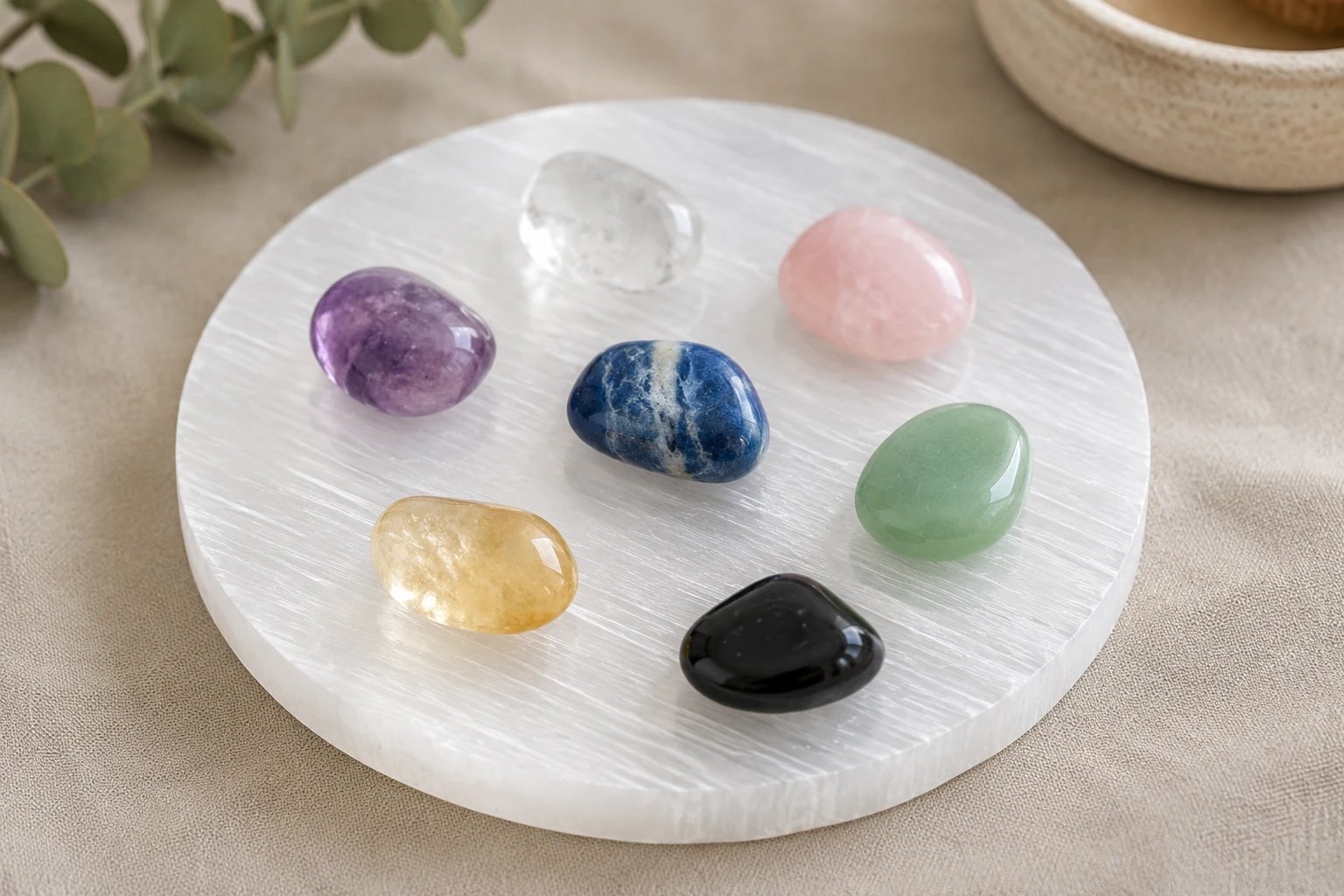
The belief behind using a selenite charging plate is that selenite is one of the few crystals that doesn't hold onto negative energy and therefore never needs to be cleansed itself5. It acts as a constant source of purifying energy. When you place other crystals, like your amethyst or rose quartz jewelry, on the plate, the selenite is thought to absorb and neutralize any stagnant energy they have collected.
This composite example reflects a common wholesale problem: a retailer once contacted us, upset that their new selenite charging plates had become dull and chalky. After a brief discussion, we learned they had been "cleansing" the plates by rinsing them under tap water, just as they would with quartz. This is a critical mistake. The water began to dissolve the gypsum, ruining the smooth polish. The solution is always a dry cleanse. For your retail customers, including a small care card explaining this is a great way to add value and prevent returns.
Can Selenite Get Wet?
Afraid of ruining your beautiful selenite? You want to cleanse it but have heard warnings about water. One wrong move could permanently damage your piece.
No, selenite absolutely cannot get wet. It is a very soft form of gypsum with a Mohs hardness of only 26. Water will cause it to degrade, become cloudy, and eventually start to dissolve over time. Always keep your selenite products dry.
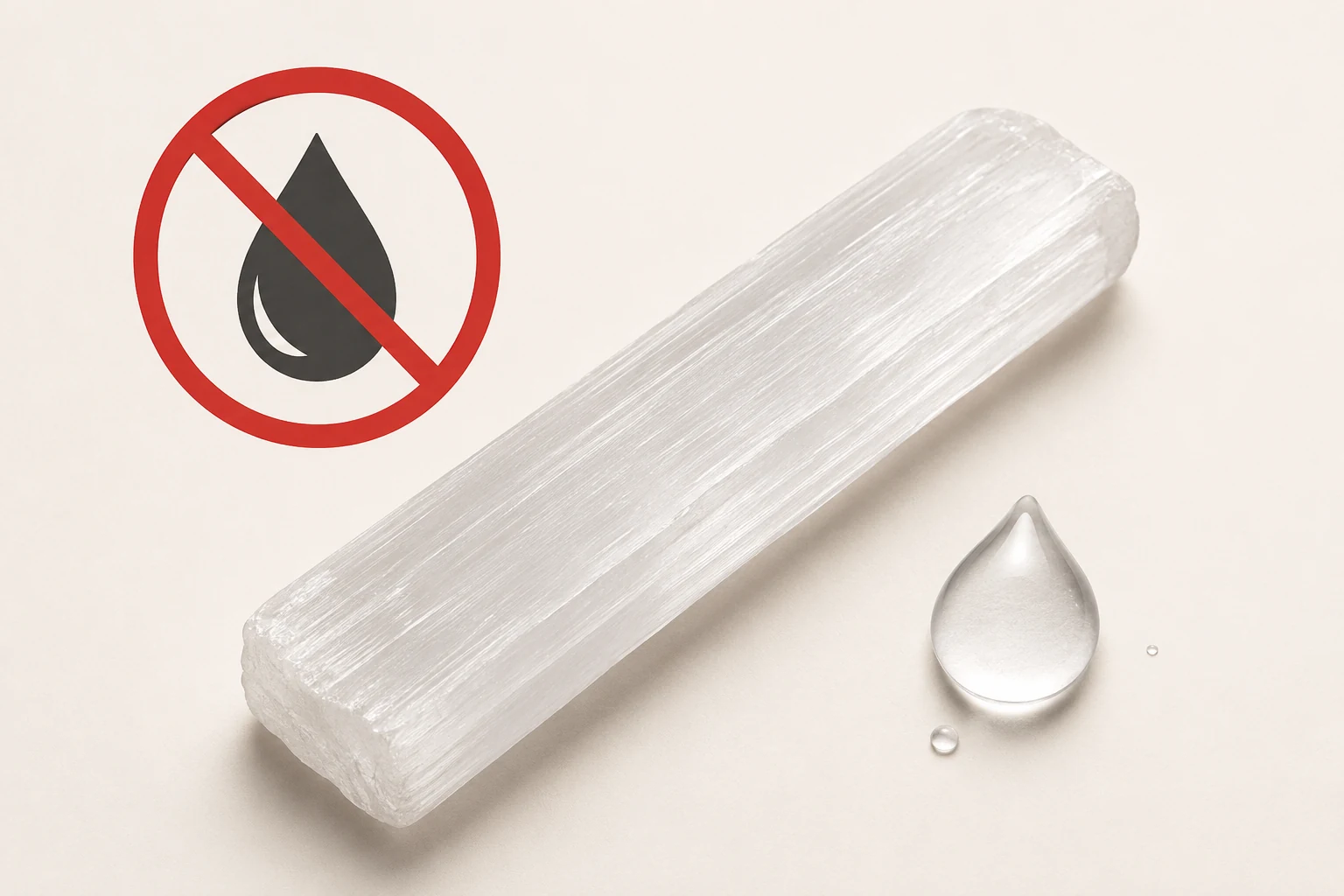
This is not a myth; it's a mineralogical fact. Gypsum is a hydrous calcium sulfate7, meaning water is part of its chemical structure. When you add more water, especially for prolonged periods, you start a process of dissolution.8 It won't vanish instantly, but the effects are immediate and irreversible. The polished surface will become dull and chalky. The fine fibrous structure can start to flake or peel. If left in water, a piece of selenite will shrink and lose its shape entirely.
Even high humidity can be a problem.9 From a supplier's standpoint, we ensure selenite is stored in a dry environment. For retailers, this means not placing it near humidifiers, in bathrooms, or in damp display areas. For end-users, it means keeping it away from the kitchen sink or a steamy shower. This one rule of care—keep it dry—is the most important for preserving its beauty and structural integrity.
How Should You Cleanse Selenite Without Water?
Your selenite is dusty but you know water is forbidden. How can you clean it safely? You need a method that restores its beauty without causing any damage.
To clean selenite, use a very soft, dry cloth or a soft-bristled brush to gently remove dust. For stubborn spots, you can use a wooden pick carefully. The key is to avoid moisture and abrasive materials that could scratch its soft surface.
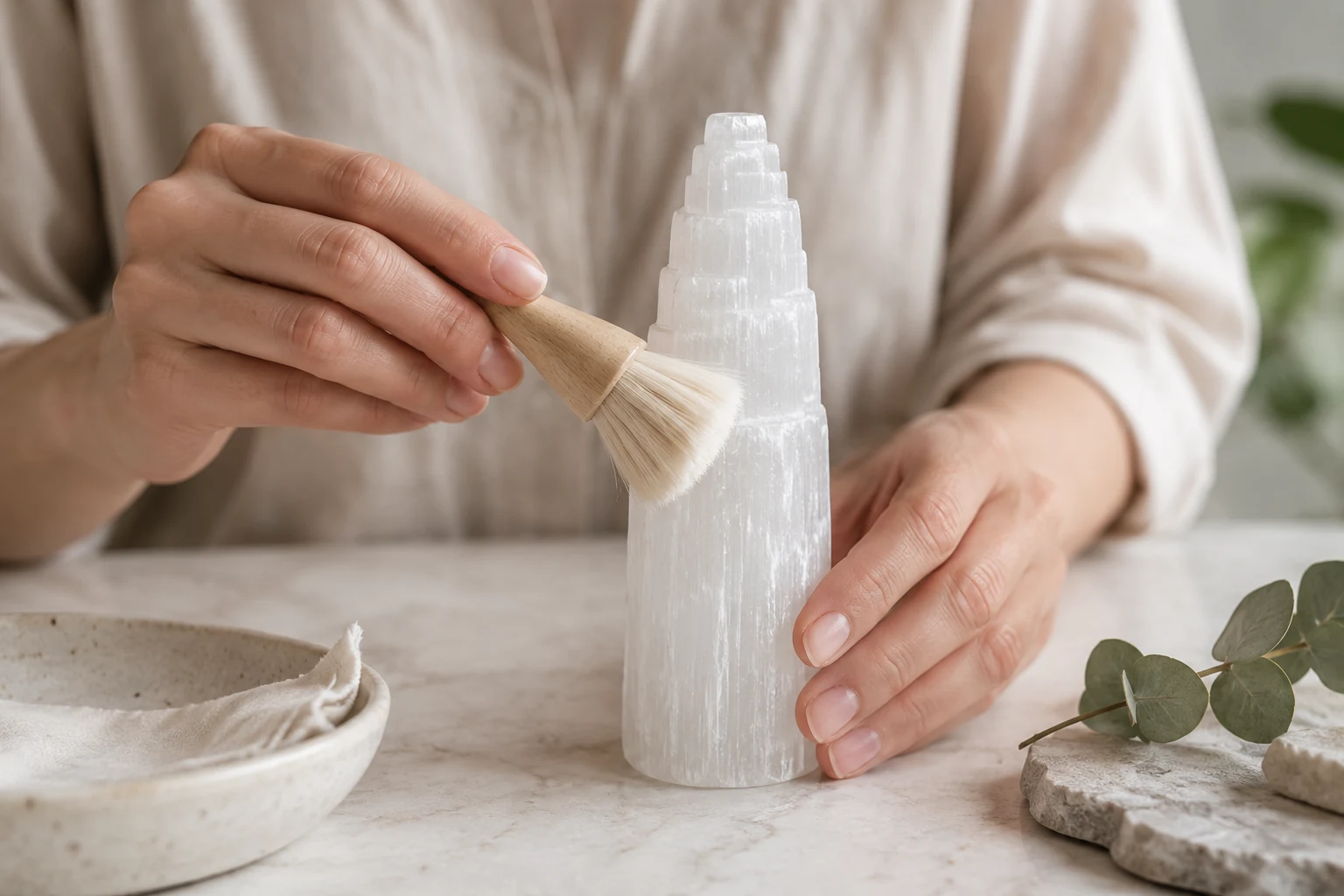
Properly cleaning selenite involves two different concepts: physical cleaning and energetic cleansing. Both must be done without water.
Physical Cleaning
Dust and fingerprints are the main culprits.
- Dusting: Use a microfiber cloth or a very soft, clean makeup brush. Gently sweep the dust off the surface, paying attention to the crevices in raw pieces.
- Stubborn Dirt: If there is a small amount of grime stuck to the piece, do not rub it. Instead, take a wooden toothpick or bamboo skewer and very gently try to flake the dirt off. The wood is softer than many other tools and less likely to cause a deep scratch.
Energetic Cleansing (Metaphysical Practices)
While selenite is believed to be self-cleansing, some practitioners like to refresh it.
- Moonlight: Place your selenite on a windowsill overnight during a full moon. The gentle energy of the moon is considered a safe and effective cleanser.10
- Sound: Use a singing bowl or chimes near your selenite. The vibrations are thought to break up and dissipate any stagnant energy.
- Smoke: Smudging with sage, palo santo, or incense is another popular dry-cleansing method. Simply pass the selenite through the smoke with intention.
How Do You Identify High-Quality Wholesale Selenite?
Struggling to judge selenite quality for your store? You see varying prices but can't tell the difference. Buying blind is a huge risk for your business's reputation.
From a supplier's view, quality selenite (satin spar) has good translucency, a consistent fibrous pattern, and a smooth, well-polished finish without chips. For wholesale, consistency across a batch is just as important as the quality of a single piece.
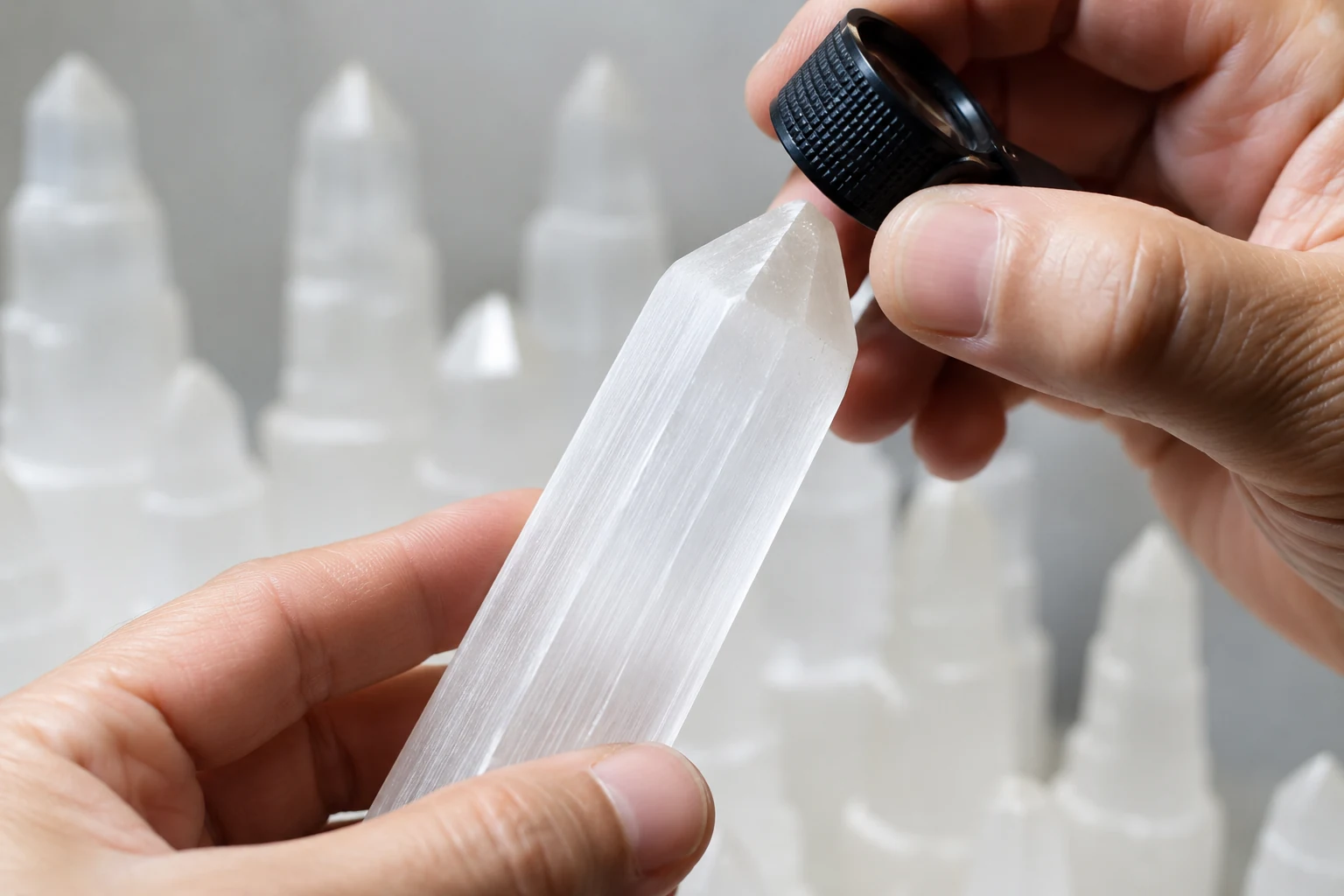
When we inspect a bulk order of selenite towers or plates, we don't rely on vague terms like "A Grade." We look for specific, observable characteristics. As a buyer, you should too. Here is a practical checklist:
| Quality Factor | What to Look For |
|---|---|
| Translucency | Hold the piece up to a light. High-quality satin spar has a beautiful glow as light passes through its fibers.11 |
| Polish & Feel | The surface should feel smooth and silky, not chalky or powdery. A poor polish will shed fine white dust when handled. |
| Integrity | Check the most vulnerable parts: the tips of towers, the points of wands, and the edges of plates. They should be crisp and free of chips. |
| Color & Clarity | The color should be a clean, uniform white. Look out for excessive brown or yellow mud or mineral stains, which lower the value. |
| Workmanship | For carved items like bowls or hearts, check that the shape is symmetrical and the lines are clean. |
| Consistency | For a wholesale order, ensure the pieces are consistent in size, weight, and overall quality, matching the approved sample. |
Always ask your supplier for photos or a short video of the actual batch you are purchasing, not just a stock photo. This simple step helps manage expectations and ensures you get the quality you are paying for.
Why is Packaging So Important for Selenite?
Have you received broken selenite towers or wands? It's incredibly frustrating and costly when fragile items arrive damaged. The problem often starts with poor packaging.
Selenite is extremely fragile.12 Good packaging is non-negotiable. Each piece must be individually wrapped with extra protection for tips and edges. They must be packed tightly and separated from harder stones to prevent damage during transit.
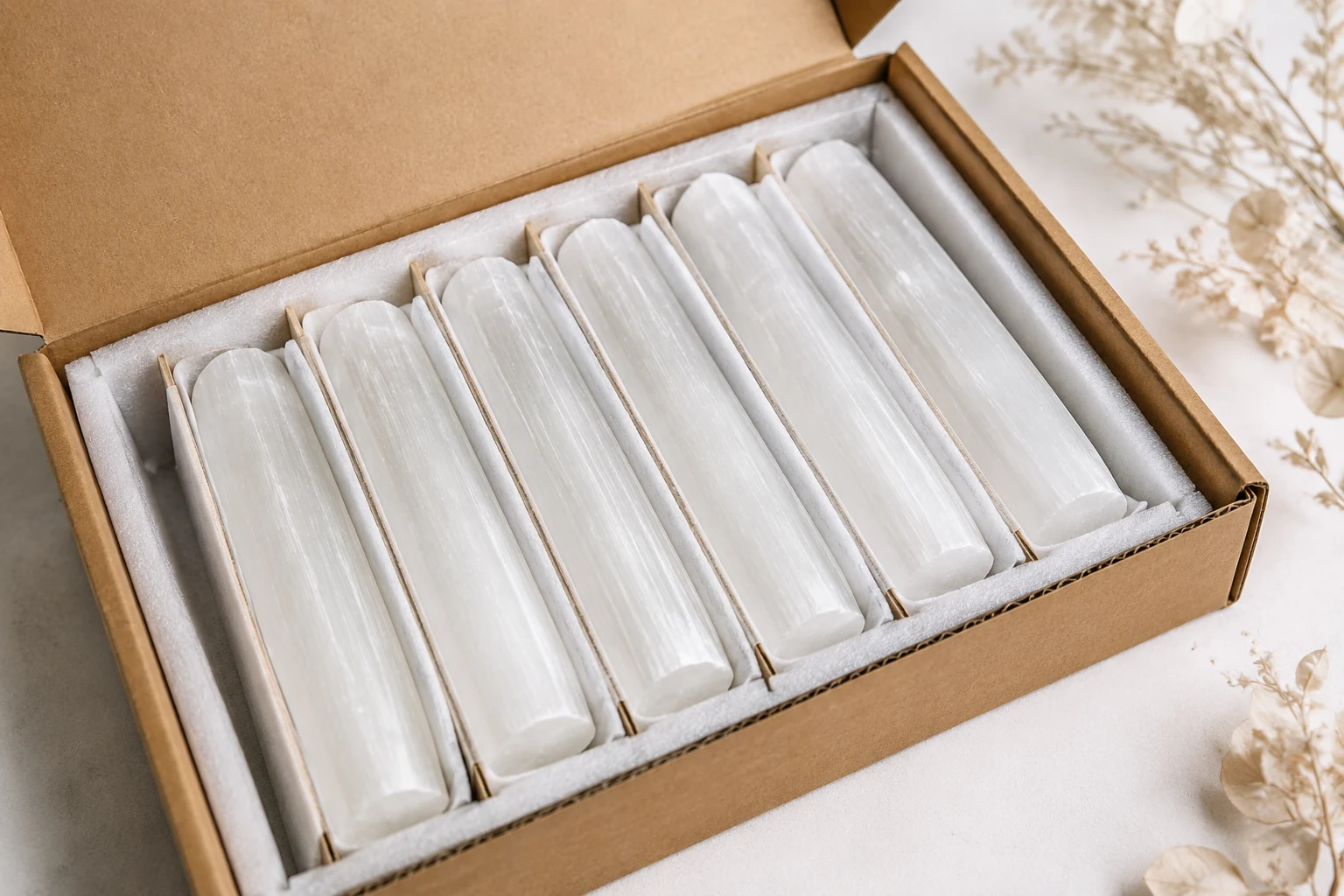
This is where a supplier's experience becomes critical. A situation we have had to correct reflects a common wholesale problem: a shipment of selenite towers arrived at their destination with a number of chipped tips. The cause was not rough handling by the courier, but insufficient internal packaging. The towers were wrapped too thinly and packed loosely, allowing them to rub against each other during transit. The impact between the selenite pieces was enough to cause chipping.
The solution is multi-layered. First, each piece must be wrapped in a soft sleeve or paper to protect the polish. Second, vulnerable areas like the point of a tower need extra foam or bubble wrap. Third, pieces must be separated by cardboard or foam dividers within the carton so they cannot touch. Finally, the box must be packed tightly so nothing can shift. When sourcing selenite, asking your supplier about their specific packaging methods for fragile items is just as important as asking about the quality of the stone itself.
Conclusion
Understanding selenite begins with its physical nature. Its softness and water solubility are not flaws, but key facts that inform its proper care, handling, and ultimately its successful use.
<!--[googlesitekit-end-of-content]-->
"Selenite Guide: Properties and Meaning", https://www.sagegoddess.com/library/gemstones/selenite/?srsltid=AfmBOoospNzfqjVwyq0B4a1_ht1U-GqQECneMd3bQCFtqO6UrfN19t52. In many modern crystal healing and New Age belief systems, selenite is commonly associated with the higher chakras, specifically the Third Eye (Ajna) and the Crown (Sahasrara), and is believed to facilitate mental clarity and spiritual connection. Evidence role: general_support; source type: other. Supports: The source should document the common association of selenite with the Crown and Third Eye chakras within metaphysical and crystal healing traditions.. ↩
"Gypsum | Common Minerals", https://commonminerals.esci.umn.edu/minerals-g-m/gypsum. Mineralogical sources confirm that selenite and satin spar are two of several crystalline varieties of gypsum. The trade name 'selenite' is frequently applied to the fibrous, opaque satin spar variety, which is more easily carved into shapes like wands and spheres than the transparent, tabular selenite crystals. Evidence role: definition; source type: encyclopedia. Supports: The source should clarify that selenite, satin spar, and desert rose are all varieties of the mineral gypsum, and that the fibrous satin spar is commonly marketed and sold as selenite.. ↩
"Selenite vs Satin Spar: What You're Actually Buying", https://beyondbohemian.com/pages/selenite-vs-satin-spar?srsltid=AfmBOopf5z6R_X18p_5kFHf-Kf6HMB1Y9YxV2UZQ0yMG8vp3QRcuHM_L. Due to its fibrous structure, which is more durable and easier to shape and polish than the fragile, sheet-like crystals of true selenite, the satin spar variety of gypsum constitutes the vast majority of carved items like wands, towers, and plates sold under the selenite trade name. Evidence role: general_support; source type: research. Supports: The source should support the claim that satin spar is the predominant form of gypsum used for carved commercial products sold as 'selenite'.. Scope note: The 99% figure is likely an illustrative estimate, as precise market share data for specific mineral varieties is not typically available. ↩
"High Vibrational & Powerful : r/Crystals - Reddit", https://www.reddit.com/r/Crystals/comments/1cb21im/high_vibrational_powerful/. Within crystal healing lore, certain stones are categorized as having a 'high vibration' or 'high frequency,' a quality believed to align with spiritual purity and higher states of consciousness. Selenite is consistently described as one such crystal. Evidence role: definition; source type: other. Supports: The source should define the concept of 'high-vibration' crystals within New Age or spiritual belief systems and note selenite's inclusion in this category.. ↩
"Does anybody know what crystals actually self cleanse and can ...", https://www.reddit.com/r/SpiritualCrystals/comments/1c69h8m/does_anybody_know_what_crystals_actually_self/. A widely held belief in modern metaphysical practices is that selenite is one of a few minerals that does not absorb or retain negative energy, making it 'self-cleansing' and thus a useful tool for energetically purifying other crystals. Evidence role: general_support; source type: other. Supports: The source should describe the common belief in crystal healing that selenite is 'self-cleansing' and can cleanse other stones.. ↩
"Gypsum - Wikipedia", https://en.wikipedia.org/wiki/Gypsum. Geological and mineralogical sources confirm that gypsum has a hardness of 2 on the Mohs scale, making it a very soft mineral that can be scratched with a fingernail (which has a hardness of approximately 2.5). Evidence role: statistic; source type: education. Supports: The source should state the Mohs hardness of the mineral gypsum.. ↩
"Gypsum - Wikipedia", https://en.wikipedia.org/wiki/Gypsum. Gypsum is defined as a soft sulfate mineral composed of calcium sulfate dihydrate, with the chemical formula CaSO₄·2H₂O. The 'dihydrate' indicates that each molecule of calcium sulfate is associated with two water molecules. Evidence role: definition; source type: encyclopedia. Supports: The source should provide the chemical definition and formula for gypsum.. ↩
"Gypsum - Wikipedia", https://en.wikipedia.org/wiki/Gypsum. Gypsum is slightly soluble in water. While it will not dissolve instantly, prolonged or repeated exposure to water will cause the mineral's surface to degrade, lose its polish, and eventually break down as it dissolves. Evidence role: mechanism; source type: paper. Supports: The source should explain that gypsum is water-soluble.. ↩
"Gypsum-Based Humidity-Control Material: Preparation ... - PMC", https://pmc.ncbi.nlm.nih.gov/articles/PMC10419816/. Museums and institutions that curate mineral collections recommend storing gypsum specimens in a controlled, low-humidity environment. Due to its solubility, high ambient humidity can cause the surface of the mineral to become chalky or degrade over time. Evidence role: general_support; source type: institution. Supports: The source should confirm that high humidity is a risk for gypsum specimens.. ↩
"Does moonlight *cleanse* Crystals? Or only charge them? - Reddit", https://www.reddit.com/r/Crystals/comments/xal4j2/does_moonlight_cleanse_crystals_or_only_charge/. The practice of 'moon bathing,' or placing crystals in a location where they can absorb moonlight (especially from a full moon), is a widely documented method for energetic cleansing within various New Age, Wiccan, and crystal healing traditions. Evidence role: case_reference; source type: other. Supports: The source should describe the practice of using moonlight to 'cleanse' or 'charge' crystals.. ↩
"Chatoyancy", https://en.wikipedia.org/wiki/Chatoyancy. The silky, glowing appearance of the satin spar variety of gypsum is caused by the optical phenomenon known as chatoyancy. This 'cat's-eye' effect is produced by the reflection of light off its numerous parallel fibrous crystals. Evidence role: mechanism; source type: education. Supports: The source should explain the optical effect of satin spar gypsum.. ↩
"Mohs scale - Wikipedia", https://en.wikipedia.org/wiki/Mohs_scale. With a Mohs hardness of only 2, gypsum is among the softer minerals and is highly susceptible to scratches, chipping, and fractures. Careful handling and packaging are essential to preserve the integrity of specimens. Evidence role: general_support; source type: institution. Supports: The source should confirm the fragility of gypsum and the need for careful handling.. ↩
Keep Reading